
Heliene and Caelux have started commercial-scale production of perovskite-silicon tandem modules at a facility in Minnesota
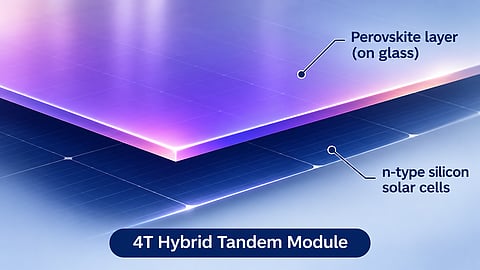
The 4T design uses separately manufactured perovskite and silicon layers, each operating with its own electrical contacts
The companies are targeting module efficiencies above 29% by 2028, with commercial deliveries expected in 2027
Heliene, a US-based PV module manufacturer, and perovskite solar manufacturer Caelux have started commercial-scale production of perovskite-silicon tandem solar modules in the US. The tandem approach uses a four-terminal (4T) configuration with a brand name ‘Hybrid Tandem’.
These tandem modules are manufactured at Heliene’s facility in Mountain Iron, Minnesota, under a multi-year GW-agreement. The companies plan to commercialize the modules in the US market, targeting module efficiency above 29% by 2028.
The 4T tandem module combines two layers: a perovskite-based layer incorporated into Caelux’s ‘Energy Producing Glass’, which acts as the front glass with perovskite cells developed on it. The second layer is the conventional n-type silicon solar cells. The perovskite layer is manufactured separately on glass, while the silicon cells are assembled into a conventional module. These two operate as separate electrical devices, each with its own electrical contacts. This differs from 2T tandem, in which the perovskite layer is deposited directly onto the silicon solar cell.
The 4T configuration allows the tandem manufacturing without largely disrupting the existing module production lines. Martin Pochtaruk, CEO and Founder of Heliene, says, “One of the advantages of Caelux’s technology is that we can integrate its Energy Producing Glass into our existing manufacturing lines without having to build an entirely new production setup.”
Heliene plans to display the module at RE+ 2026 in Las Vegas next week. Commercial deliveries are expected in 2027.
