

Edge passivation is emerging as a key enabler for multi-cut TOPCon architectures by mitigating recombination losses introduced during cell cutting
Leadmicro's ALD-based platform combines high passivation quality with throughputs of up to 20,000 pieces per hour and compatibility across multiple cell technologies and formats
As cell segmentation increases from half-cut to quarter-cut designs, advanced passivation approaches and next-generation ALD processes are becoming increasingly important to control edge-related losses
As TOPCon manufacturers increasingly adopt multi-cut cell architectures to improve module performance, managing edge-related losses is becoming a critical part of the technology roadmap. Effective edge passivation has emerged as a key solution to address these losses. The mechanisms behind edge-related recombination losses and the corresponding passivation approaches in TOPCon cells were covered in our previous article
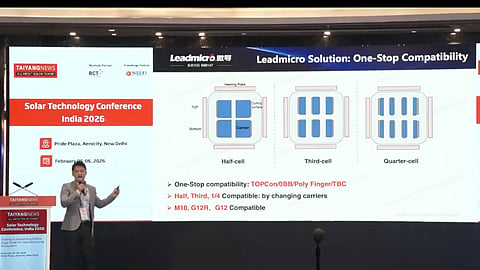
At the TaiyangNews Solar Technology Conference India 2026, Baochen Liao, CTO of Leadmicro, discussed developments in industrial edge passivation systems. He highlighted high-throughput ALD-based solutions designed for multiple cell architectures and wafer formats, as well as their role in enabling advanced multi-cut TOPCon designs (see Edge Passivation Targets Recombination Losses In Cut TOPCon Cells).
Liao emphasized that Leadmicro’s solutions are designed with a strong focus on ‘one-stop’ applicability. That means the tool platform is compatible across multiple cell architectures, including TOPCon, BC, and advanced designs such as 0BB and poly-finger structures. In addition, the equipment supports various cell formats and cell slicing configurations, including half-cut to third- and quarter-cut cells, as well as different wafer sizes such as M10, G12, and rectangular formats. This modularity makes the tool CapEx-effective in the long run.
On the process front, the company’s tool platform facilitates all passivation mechanisms. The edge passivation system from Leadmicro is based on a tube-type ALD configuration, which, according to Liao, results in high-density films that provide better chemical passivation. The high fixed negative charge of aluminum oxide generally provides field-effect passivation. The hydroxyl treatment, as part of the ALD half-reaction, facilitates interface treatment during hydrogen passivation. Thermal treatment and light-soaking are also integral parts of the process. It also results in conformal coating on uneven surfaces.
Another important feature of these edge passivation tools is their remarkably high throughput, making a business case for themselves even under current overcapacity conditions. Leadmicro’s tool, for example, supports a throughput of 20,000 pieces per hour, irrespective of size and configuration. It is integrated with advanced features, such as real-time visual monitoring, to ensure consistent handling of ultra-thin wafers and stable operation under high-throughput conditions, underscoring the platform’s maturity. The resulting passivation quality is reflected in achieved lifetimes exceeding 760 μs and thickness uniformity within ~3%.
Looking ahead, current edge passivation solutions are largely based on TMA + H₂O ALD processes, which inherently lead to some wraparound deposition. It becomes increasingly challenging as the industry moves more towards finger segmentation, such as quarter-cut cell strips, because the relative edge area increases with the number of cuts. This is one reason alternative approaches, such as amorphous silicon-based passivation, are being explored, as they avoid wraparound effects. To address this gap, Leadmicro is also working on next-generation ozone-based solutions, rather than water, in the ALD to control wraparound.
The process is particularly relevant to TOPCon, as HJT has long adapted to processing half-cells all along the production line. As a batch process carried out in several key steps, TOPCon is not exactly compatible with half-wafer processing. However, this has changed; at least Leadmicro has developed tools that support half-cut wafers.
On the other hand, such a solution has no relevance in the current market, where the multi-cut module layout is a hot topic. In fact, edge passivation is also a key enabler for multi-cut technology, and several companies have tried commercializing modules based on multi-cut cell strips in the past. However, given that edge losses are directly proportional to the number of cuts, the half-cut format has remained the state of the art for quite some time. With the introduction of effective edge passivation solutions, this limitation is expected to ease, potentially enabling wider adoption of multi-cut architectures.
The text is an edited excerpt from TaiyangNews’ latest report on Cell & Module Technologies Trends 2026, which can be downloaded for free here.
