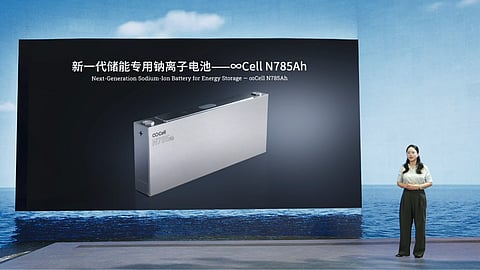


HiTHIUM has unveiled a 4 MWh sodium-ion ESS for utility-scale applications
Its new ∞Cell N785Ah supports storage durations of 2 to 8 hours and has a claimed cycle life of 20,000 cycles
The company plans to begin full-scale production and start supplying the sodium-ion solution in 2027
Chinese energy storage company HiTHIUM has unveiled the ∞Power N4.0MWh, an integrated sodium-ion energy storage system (ESS) designed for utility-scale applications. The 4 MWh system features the company’s new ∞Cell N785Ah sodium-ion battery cell. The company plans to begin full-scale production and commercial shipments of the sodium-ion solution in 2027.
The 785 Ah cell has a claimed cycle life of 20,000 cycles and supports storage durations ranging from 2 to 8 hours. The company says it is designed to be compatible with its existing 1,000 Ah lithium-ion manufacturing platform, including its cell and system-integration production lines.
The ESS uses stacked cells and a battery management system (BMS), with a specified state-of-charge (SoC) estimation accuracy of within 2.5%. The system is compatible with power conversion systems (PCS) operating between 800 V and 1,500 V.
According to the company, the system architecture increases PCS rated-power utilization by more than 20% compared with its previous-generation sodium-ion system. It also claims the design reduces the required storage-station footprint by 30% and provides a 24-hour comprehensive efficiency of more than 88%.
The system combines air and liquid cooling with AI-based thermal management and weather monitoring. It uses weather data to select the appropriate cooling mode. The company claims this approach reduces auxiliary power consumption during operation by 30% and standby auxiliary power consumption by 50%.
∞Power N4.0MWh has a claimed design life of 30 years. The company plans to extend its sodium-ion technology beyond utility-scale storage into commercial & industrial, residential, and broader energy-access applications.
HiTHIUM has also introduced the ∞Edge Pioneer Program to test its batteries and systems under extreme environmental conditions. It plans to disclose progress over the next 3 years and gradually release technology packages for extreme environments. Its longer-term target is to reduce the levelized cost of storage (LCOS) to RMB 0.1/kWh.
