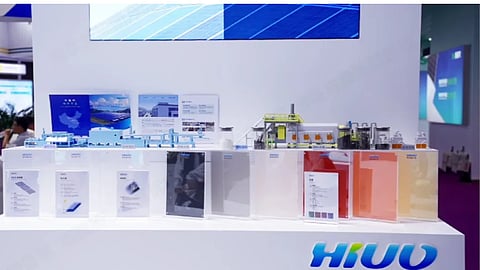


HIUV presented specialized encapsulation materials for terrestrial and space PV applications at SNEC 2026
Its light-conversion film showed no fluorescent-material migration after testing at 105°C for 96 hours
The product range also included a flame-retardant film, a colored BIPV film, and an interconnection film for 0BB cells
Shanghai-based encapsulation material manufacturer HIUV New Materials presented a range of specialized PV films at SNEC PV 2026. Building on its existing encapsulation portfolio, the company showcased products for space PV, fire-resistant modules, UV light conversion, building-integrated photovoltaics (BIPV), and zero-busbar (0BB) cell interconnection.
One of the products was an encapsulation film developed for PV modules used on low-Earth-orbit satellites. According to HIUV, the film combines low weight with resistance to radiation and extreme temperature variations. It is designed to withstand space conditions including high vacuum, high-energy particle radiation, and large temperature variances. HIUV says the product replaces a liquid encapsulation system with a space-grade silicone film. By changing the material from liquid to film, the product helps address challenges in producing space PV components.
For terrestrial PV modules, HIUV presented a flame-retardant encapsulation film designed to improve fire safety, with a V-2 flame-retardancy rating.
Another focus at the event was a zero-migration light-conversion film. Such films are particularly relevant to UV-sensitive cell technologies, including heterojunction (HJT), as they convert short-wavelength UV radiation into visible light. This can help limit UV-induced degradation (UVID) while allowing the converted light to contribute to additional power generation.
HIUV showcased a product that uses its proprietary anti-migration design. According to the company, this film showed no migration or material precipitation in a test conducted at a temperature of 105°C for 96 hours, while comparable light-conversion films showed fluorescent-material migration of 6-7 mm. HIUV says this indicates improved stability of the light-converting material under high-temperature conditions. After high-intensity UV aging at 240 W/m², the film retained a light-conversion quantum efficiency of nearly 57%. HIUV also reported stable light-transmission performance after damp-heat and UV aging.
For BIPV applications, HIUV showcased a colored encapsulation-film series designed to balance architectural appearance with power-generation performance. Its high-transmittance colored film reaches a maximum transmittance of 85%. According to the company, this is 10-25% higher than conventional colored BIPV glass products and can increase module power output by 8-20%. The film can be used in applications including building façades, daylighting roofs, and PV sunshades.
HIUV also presented an interconnection film that is compatible with major variants of zero busbar (0BB) cell technologies. According to the company, this film offers high adhesion, low flow, and resistance to thermal deformation. It reported no wire detachment or cell delamination after thermal-cycling tests and no abnormalities during electroluminescence testing.
In addition to materials used in module manufacturing, HIUV highlighted its module recycling business. According to the company, its recycling process recovers more than 94% of the materials in end-of-life PV modules. HIUV says its recycling service covers more than 20 provinces in China and has an annual processing capacity of 20,000 tonnes.
