
Key takeaways:
Risen Energy’s Po-Chuan Yang described HJT evolution as a phased transition focused on reducing material usage and improving production scalability
Metallization changes, including silver reduction and finer fingers, remain central to improving both cost and performance
Module-level designs, such as multi-cut cells and zero spacing, contribute to achieving higher power without major changes to the BOM
Heterojunction technology (HJT) solar cell and module manufacturers continue to compete with the mainstream TOPCon in terms of efficiency, production costs, and performance. Risen Energy, a leading Chinese HJT player, presented recent cell and module level advancements and the future roadmap beyond 2026.
At the TaiyangNews High-Efficiency Solar Technologies 2025 Conference, Po-Chuan Yang, CTO of Risen Energy, provided a practical view on the company’s HJT evolution in mass production.
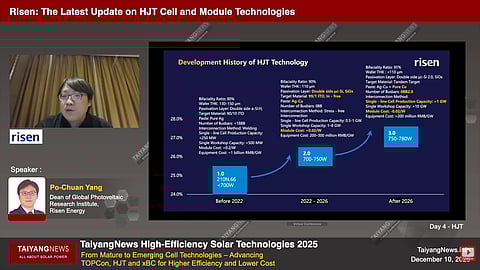
Yang outlined Risen’s transition towards HJT over the past years, highlighting the company’s early move to large-format (G12) and thin-wafer adoption of 110 µm in production in 2023. There were concerns at that time around yield and breakage, but once it was demonstrated at scale, it became more widely accepted across the industry. Alongside this, zero-busbar (0BB) designs and stress-free interconnection approaches were also introduced.
He framed the broader evolution of Risen’s HJT in 3 phases. Early-stage HJT was limited by high silver consumption, thicker wafers, and relatively lower throughput. The current phase (2022-2026) is driven by a few key changes: moving to microcrystalline silicon layers for better performance, introducing silver-copper pastes to reduce silver usage, and standardizing thinner wafers. These changes have enabled module power to move into the 700-750 W range, while narrowing the cost gap with mainstream technologies. Looking ahead, the next phase is expected to push further on material changes, such as pure copper metallization and indium reduction, along with thinner wafers and higher single-line production capacities of about 1 GW.
Yang focused on metallization, which remains a critical driver of cost and performance in HJT. Risen’s approach has been to gradually replace pure silver paste with silver-copper compositions, significantly reducing silver content while maintaining electrical performance. In parallel, there has been a steady reduction in finger widths from around 40 µm a few years ago to about 18 µm currently, which helps significantly reduce shading losses. At the same time, increasing the number of busbars (24BB) improves current collection and supports reliability, especially for thinner wafers.
His presentation also included technological developments on the rear side of a cell, particularly on the transparent conductive oxide (TCO) layer, where the goal is to maintain good conductivity while improving optical transmission and reducing reliance on indium. These material-level changes, combined with improvements in carrier mobility and contact design, contributed to efficiency gains.
Module-side improvements included integrating multi-cut cells (1/3- and 1/4-cut) with zero cell spacing and optimized interconnection layouts. This directly translates into higher module power without fundamentally changing the bill of materials (BOM). Yang mentions that this will be a key upgrade in Risen’s next-generation HJT technology.
He also addressed the topic of reliability, particularly UV stability and moisture protection. Enhancements, such as improved anti-UV treatments, UV down-conversion films, and edge-sealing approaches, are aimed at reducing degradation and limiting moisture ingress over time.
Towards the end of his presentation, titled Latest Update on HJT Cell and Module Technologies, Yang also shared field simulation observations. According to the results, the differences between different technologies are moderate. However, in high-temperature environments, such as 50°C, HJT shows an advantage of 6.86% in energy yield, which is mainly related to the temperature behavior and bifaciality performance.

