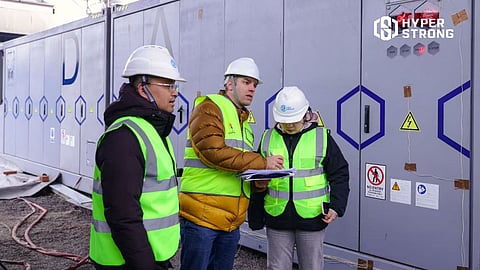

HyperStrong conducted its test in accordance with CSA/ANSI C800:2025 and UL9540A:2025 standards, validating fire-resistance design and thermal insulation of its HyperBlock III series
The test setup comprises 5 BESSs, placed in a side-by-side and back-to-back layout, while unit ‘A’ goes through the deliberate internal combustion process for up to 16 hours
During testing, the other 4 units maintain operational peak cell temperature below 56°C without thermal runaway or fire spreading
Chinese battery energy storage solutions (BESS) provider Beijing HyperStrong Technology Co., Ltd. has tested its HyperBlock III series BESS for large-scale fire safety at the utility-scale system level, validating its fire-resistance design and thermal insulation performance.
This containerized BESS, measuring 6,058 × 2,438 × 2,896 mm (W × D × H), is equipped with 314 Ah LFP battery cells (placed in 12P416S configuration) and is rated for up to 5.016 MWh of stored energy.
According to the company, this test was conducted in accordance with CSA/ANSI C800:2025 and UL9540A:2025 (latest draft), particularly for the North American market. The former is a new standard for reliability and quality assurance for BESS developed by the CSA Group, while the latter is a fire-safety testing framework developed by UL Solutions. The test setup with 5 identical BESSs (A, B, C, D, E, and F), placed side-by-side (A-D-E) and back-to-back (A-C-B), mimics a field installation, replicating real-time heat transfer and temperature distribution. During testing, all units were kept at full state of charge (SoC), and the respective fire suppression systems were kept deliberately dysfunctional, simulating a worst-case scenario. Next, the unit ‘A’ battery banks undergo an ‘intense’ combustion, sparked by one of the faulty battery cells (intentionally), for up to 16 hours. The company states that the BESS’s enclosure maintains its structural integrity (deflagration) under high-temperature combustion and thermal expansion without opening its doors, even in the absence of a fire suppression function throughout the testing cycle. It is attributed to the BESS’s door locking mechanism (self-developed) with a reinforced connection. On the internal side, liquid-cooling units and electrical control cabinets on the side of the burned battery banks don’t show any sign of burning, although the internal temperature goes up to 1,400°C after 3 hours of ignition. In terms of peak cell temperature (during the test cycle) of the neighboring BESSs, the company notes that the nearest back-to-back unit (‘C’) reaches 56°C, while the rest remain below 35°C without thermal runaway or fire spreading during the test.
HyperStrong says its AI platform, blended into the BESS, ensures uninterrupted data communication between cells and the battery management system (BMS) (built-in) of the 4 neighboring containers at ms intervals, throughout the combustion. It identifies temperature trends and issues an early warning automatically, helping to stabilize operations. In addition, this AI platform logs and preserves operational data for post-event analysis, Hyperstrong adds.
The company states that this test was witnessed by CSA Group and a North America-registered Fire Protection Engineer (FPE), with more than 40 clients attending virtually.

