
Key takeaways:
Helmholtz-Zentrum Berlin presented progress in perovskite-silicon tandem efficiency, stability, and commercialization
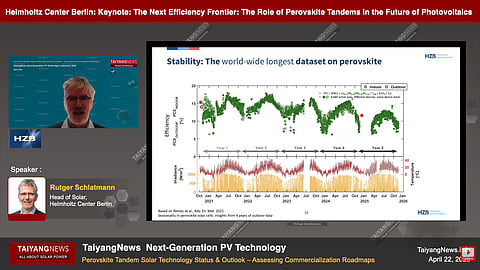
Outdoor-tested perovskite cells fabricated in 2019 continued operating after 5 years under real-world conditions
Scaling tandem technology to industrial production remains focused on process optimization, stability, and manufacturability
Any single-junction cell has a practical maximum efficiency well below the Shockley-Queisser (SQ) limit of 33.7%. Combining technologies in tandem with each other increases efficiency. On the system side, this translates into using less area and lower balance-of-system (BOS) costs, resulting in a lower levelized cost of electricity (LCOE). This gives opportunities for technologies to access new markets.
Perovskite is better suited for tandem integration with a silicon bottom cell because of its tunable large band gap, low processing temperature compatible with the silicon cell, among other reasons. This combination can effectively use the solar spectrum to generate electricity, thereby improving the efficiency of the overall multi-junction cell. III-V materials are another option, but they do not offer the same cost advantage as perovskites.
Rutger Schlatmann, Head of the Solar Energy Division at Helmholtz-Zentrum Berlin, shared his insights in his presentation titled Status, Outlook and Commercialization Roadmap of Perovskite Tandem Solar Technology at the TaiyangNews Next-Generation PV Technology Conference.
Schlatmann discussed how both HJT and TOPCon cells can serve as suitable bottom cells, citing a recent record by HZB and Qcells that surpassed 30% efficiency in a perovskite-TOPCon tandem cell. There are several layers in the perovskite cell, as well as the front surface of the silicon cell, that can be optimized to improve efficiency. Realizing these optimizations at commercial scale is an important part of taking tandem technology to the next level.
Schlatmann presented the outdoor performance of 1 cm² active-area perovskite cells fabricated in early 2019, with measurements beginning in 2020. Even though degradation was observed after 5 years, a positive view of the performance is that these small cells survived outdoor operation without major losses during the summer season, the most relevant operating period. He also highlighted undesirable metastable effects that were observed. However, on the positive side, the cells were made 6 years ago using encapsulation, screen printing, and other methods available at the time, and they are still surviving. Moreover, these issues are minor or absent in industrial-scale production. Several other effects, one of which is phase segregation, remain intrinsic challenges that need mitigation even in industrial cells.

Performance data for pre-commercial modules collected over 6 months showed that perovskite-silicon tandem modules consistently outperform the silicon module. He briefly touched upon narrow-band-gap perovskite cells replacing silicon bottom cells, or perovskite-perovskite-silicon tandem concepts, which have higher efficiency potential and a lower CO₂ footprint.
