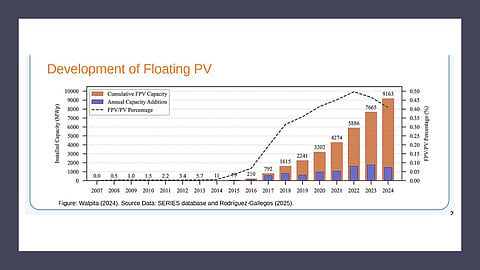


Global floating PV capacity rose to 9.16 GW by the end of 2024, with 1.5 GW added during the year, says the IEA PVPS
Annual additions declined from 2023, when more than 1.77 GW was installed, led mainly by China
The IEA PVPS calls for better modeling, automated O&M solutions, and deeper research into environmental impacts
The cumulative installed capacity of floating PV (FPV) systems globally reached 9.16 GW at the end of 2024, with the addition of 1.5 GW during the reporting year, according to the International Energy Agency Photovoltaic Power Systems Programme (IEA PVPS).
This annual addition is a drop from over 1.77 GW the world brought online in 2023, when China accounted for 50% of the global cumulative of 7.7 GW. The IEA PVPS says Asia held almost 90% of the installed floating PV projects in 2023, while the largest markets outside Asia were the Netherlands and France (see IEA PVPS: Global Floating PV Capacity Hit 7.7 GW In 2023).
Summarizing the findings of its earlier Task 13 report, Floating Photovoltaic Power Plants: A Review of Energy Yield, Reliability, and Maintenance, in a factsheet, IEA PVPS analysts highlight the role FPV can play in saving land while enabling the European Union to meet its energy needs.
Yet, FPV faces several challenges in realizing its full potential in the bloc, ranging from regulatory barriers, uncertainties about environmental impacts, and cost competitiveness relative to ground-based PV (GPV).
Critical parameters that could impact the energy yield of FPV systems include thermal losses, wave-induced losses, and soiling losses, since its components are exposed to stress factors different from GPV. Although the economic viability of PV power plants is fundamentally linked to their lifetime energy yield, stress profiles in such installations are not yet fully characterized or quantified.
“As a result, optimisation strategies for FPV systems must account for local environmental conditions and specific FPV technologies to ensure reliable long-term performance,” recommend the analysts.
The report outlines the key O&M considerations for optimum upkeep of FPV systems, starting with preventive measures such as regular inspections and periodic recommissioning checks. Corrective measures to be considered include unscheduled maintenance and faster response time. Additionally, predictive O&M should cover real-time monitoring to predict possible failure modes and an early warning system for individual failure events.
Moreover, the IEA PVPS recommends research priorities for the further development of FPV. Measures suggested include studying the special conditions floating solar faces, such as waves, wind, heat, and biological fouling, and developing reliable models to predict how these factors affect the performance and lifetime of FPV systems.
They also believe the industry must create automated tools and methods to monitor and maintain such facilities. Another recommendation is to assess the environmental impacts of FPV, including effects on water quality, aquatic life, and nearby ecosystems.
FPV carries immense potential, as a January 2025 SERIS research found. It pegs FPV potential at 22 TW, utilizing just 10% of the world’s inland reservoirs (see 22 TW FPV Can Be Hosted On Just 10% Of World’s Inland Reservoirs: Research).
