

IEA PVPS has published its largest update of public PV life cycle inventory data in over 10 years, covering today's leading PV technologies
The report introduces updated datasets for TOPCon, PERC, CdTe, PV systems, balance-of-system components, and country-specific electricity mixes
It also adds simulation-based life cycle inventories for advanced silicon PV manufacturing alongside industry-measured datasets
The International Energy Agency's PV Power Systems Programme (IEA PVPS) has updated the life cycle inventory (LCI) datasets for modern PV technologies in its Task 12 Life Cycle Inventories of Photovoltaic Systems 2026 report.
It describes the publication as its most comprehensive update of publicly available LCI data for solar PV systems in more than a decade.
Aimed at helping researchers, policymakers, manufacturers, and life cycle assessment (LCA) practitioners, it evaluates the environmental performance of current PV technologies using transparent and verified datasets.
LCI measures the environmental impacts and resource use of a product throughout its lifecycle, from raw material extraction to recycling or disposal.
The updated report expands on the previous 2020 edition with new LCI datasets covering TOPCon and PERC monocrystalline silicon PV supply chains, cadmium telluride (CdTe) modules, balance-of-system (BoS) components, and residential, commercial, and utility-scale PV systems. It also includes country-specific PV electricity mixes and updated recycling data.
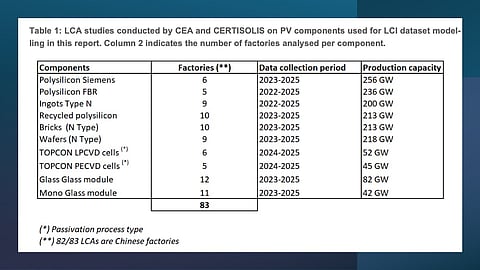
According to the report, the monocrystalline silicon datasets are based on 83 quality-screened factory-level LCAs collected through the French PV tender process between 2022 and 2025. The French tender process was selected since carbon performance is an explicit criterion here, but it may not fully represent the global market.
These datasets represent around 29% of global polysilicon production capacity, 16% of wafer capacity, 7% of cell capacity, and 9% of module capacity.
The CdTe datasets are based on data from the technology's largest global producer, First Solar, which accounts for more than 90% of global CdTe module production.
The datasets also cover different time periods, including monocrystalline silicon data primarily from 2022 and 2025, and CdTe data up to 2023.
For the first time, the report also includes simulation-based, bottom-up LCIs for advanced monocrystalline silicon manufacturing, developed by Fraunhofer ISE.
Developed to complement measured industry data, these datasets support future manufacturing analysis, process optimization, and technology development. The report notes that all datasets have undergone a multi-stage quality assurance process to improve transparency and reliability.
Uncertainties, however, remain due to differences in manufacturing processes, regional electricity mixes, reference years, and coverage of some components. Therefore, the writers recommend using the datasets as general reference data, while manufacturer-specific environmental assessments should rely on product-specific information.
The complete report is available for free download on the IEA PVPS website.
