

Integrating PV onto curved vehicle surfaces requires careful design, balancing cell bending, weight, and energy yield, says IEA PVPS
Aesthetics, coloring methods, and surface finish are crucial for consumer acceptance and performance in this space
It calls for standardization, special testing, and attention to durability, recyclability, and safety as essential for long-term VIPV reliability
Vehicle-integrated photovoltaics (VIPV) are emerging as a way to generate clean electricity directly on board electric vehicles (EVs). In a new Task 17 report, IEA PVPS highlights that while the technology could reduce reliance on charging infrastructure and cut emissions, integrating PV modules into vehicles poses technical, design, and safety challenges.
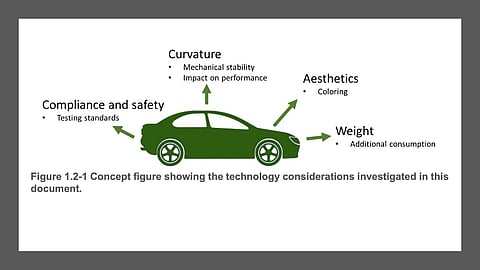
Usually, flexible solar panels made from lightweight materials are attached to the body of the car. However, challenges primarily relate to curvature, aesthetics, and weight as unique design concerns.
The IEA PVPS report examines PERC, IBC, SHJ, CdTe, and CIGS PV technologies for vehicle integration, with specific power 148–249 W/m² and efficiency 14.8–24.9%. PV cells include a 150 g/m² encapsulant, and control electronics are modeled at 1, 2.5, or 5 kg.
Using the 2016 Nissan Leaf and Tesla Model S EVs, simulations show that PV weight affects energy consumption. Yield factors range from 77.2%–89.7% in worst-case and 94.5%–98.2% in best-case scenarios (driving phase only). Analysts underline that the results highlight the importance of considering both driving and parking-phase generation when selecting onboard PV technologies.
According to the report, although VAPV (Vehicle Applied Photovoltaics) and VIPV use different manufacturing methods, PV cells must withstand bending without cracking or losing efficiency. Curvature affects the performance and energy yield of the modules.
Color and surface finish are important for VIPV integration. Different PV technologies use various coloring methods, but achieving consistent color reproducibility can be challenging, analysts point out. The report also discusses the challenges of color reproducibility and the demand for specific RAL colors in VIPV applications.
Another major stumbling block is the lack of dedicated standards in the markets. Safety qualification currently relies on existing PV and automotive standards – combining elements from IEC 61730-2:2016 and ISO 16750 – with extra tests tailored for VIPV applications. Recent updates to these standards could affect how VIPV systems are tested and certified.
“In particular, road authorities have their own quality tests for safety requirements. VIPV performance and energy yield evaluation require much more input data, including the commute pattern, without having any standard that allows a comparison between different VIPV systems,” it highlights.
IEA PVPS calls for special testing methods for curved PV modules to accurately assess performance and ensure long-term reliability. It also stresses the need for more research to optimize curved PV designs, improve coloring, boost energy yield, standardize testing, and ensure VIPV durability and safety.
The report, titled PV System Technology Considerations for PV-Powered Passenger Vehicles, is available for free download on the IEA PVPS website.
