
Key takeaways:
IFC’s Performance Standards and Equator Principles have become reference frameworks for managing environmental and social risks in utility-scale solar projects worldwide
Sustainability considerations directly influence project design decisions, including site selection, water use, biodiversity protection, labor practices, and community engagement
Supply-chain traceability and ESG due diligence across modules, cells, wafers, and polysilicon are becoming central requirements for project financing
Sustainability is no longer a parallel discussion in solar but a core condition for project financing. At the TaiyangNews Solar & Sustainability Conference, Guido Agostinelli from the International Finance Corporation (IFC), the private investment arm of the World Bank Group, explained how utility projects are evaluated, financed, and constructed under IFC’s environmental and social standards.
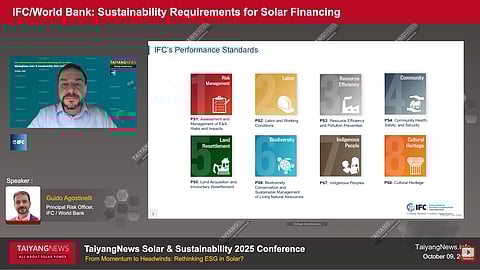
IFC finances solar projects worldwide, and its Performance Standards have effectively become the reference framework for sustainable infrastructure investment. These standards cover 8 core areas, including labor rights, resource efficiency, biodiversity protection, community health and safety, land acquisition, indigenous rights, and cultural heritage. Any project seeking IFC-backed financing must demonstrate that these risks are identified, managed, and monitored throughout the full investment lifecycle. The same framework underpins the Equator Principles, which are followed by more than 100 financial institutions and apply to nearly 85% of global project finance.
A highlight of Agostinelli’s presentation was the way the project’s design is directly influenced by sustainability. For large solar plants spanning hundreds or even thousands of hectares, site selection becomes the first critical sustainability decision. In this case, developers are expected to avoid ecologically sensitive and community lands, minimize involuntary resettlement, and prevent disruption to grazing routes, agriculture, and local livelihoods. In regions such as India, the Middle East, and North Africa, where mega-projects are becoming common, IFC increasingly prefers desert or low-use land to reduce environmental and social conflict.
Construction introduces another layer of risk. Site preparation can disturb large areas of land, cause soil erosion, generate waste, and disrupt vegetation. IFC therefore requires measures such as managed grasslands, soil preservation, erosion control, and dust management. It treats biodiversity protection as a design parameter, rather than an afterthought. While solar plants rarely sit inside protected areas, fencing can disrupt animal movement and bird migration routes, panel heat can affect reptiles, and reflective surfaces may confuse migrating birds. IFC now routinely asks developers to include wildlife corridors, fencing gaps, and mitigation features such as visible panel edges in sensitive zones, to reduce these impacts.
Water is another growing concern, especially for projects in arid regions. While dry-cleaning technologies have significantly reduced water consumption, IFC still treats water use as a key sustainability KPI. Developers are expected to assess long-term water availability, avoid competing with community water supplies, and prioritize dry cleaning wherever possible. In water-stressed regions, peak construction demand must also be factored into environmental planning.
Labor and occupational safety form another major pillar of IFC’s requirements. Construction phases typically employ hundreds or even thousands of workers for 6-18 months, creating risks around contractor management, safety training, transport, accommodation, and worker welfare. IFC expects developers to enforce consistent standards across all subcontractors, covering PPE, rest areas, sanitation, heat management, transport safety, and appropriate training. During operations, workforce numbers drop sharply, but new risks emerge, including exposure to dangerous animals in remote locations. The standards expect these aspects to be considered as well.
On the social side, land use remains one of the most sensitive issues. Large solar plants can disrupt grazing routes, agricultural access, and traditional livelihoods, especially in emerging markets. IFC requires early stakeholder engagement, transparent land acquisition processes, grievance mechanisms, and clear codes of conduct for workers that cover behavioral aspects with the communities to avoid unfortunate cases of child and gender-based violence. In projects involving indigenous communities, developers must follow structured consultation and consent processes.
IFC states its sustainability review does not stop at the project fence. It also assesses transmission lines, substations, access roads, and other associated facilities. These elements can sometimes create greater environmental and social impact than the power plant itself, particularly when transmission corridors cut through forests or key biodiversity areas.
Supply chains have now become a central part of solar financing. Agostinelli emphasizes that IFC expects developers to implement full supply-chain due diligence covering modules, cells, wafers, ingots, and polysilicon. This includes traceability systems, supplier codes of conduct, ESG risk screening, legal commitments against forced and child labor, and continuous monitoring. Developers must be able to demonstrate not only where their equipment comes from, but also how ESG risks are managed across every tier of the supply chain.
Agostinelli concluded by reiterating that Equator Principles and IFC’s Performance Standards have effectively become global benchmarks for managing environmental and social risks in solar projects. Applying the full risk-mitigation hierarchy and conducting rigorous due diligence are essential, particularly when it comes to land use, biodiversity, water demand, worker health and safety, labor conditions, and social impacts. A full video presentation on this topic, titled Sustainability Requirements For Solar Financing, can be accessed here.

