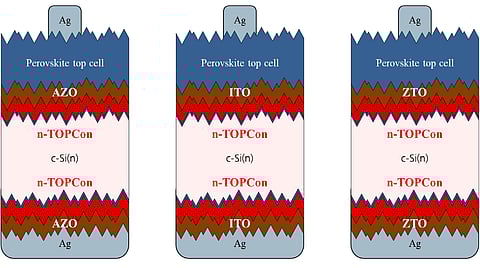


Fraunhofer ISE and partners evaluated indium-free TCOs as recombination layers for TOPCon-based tandem cells
The study compared AZO and ZTO with ITO using industrially compatible sputtering processes
ZTO demonstrated performance comparable to ITO, confirming an indium-free pathway without a measurable efficiency penalty
Perovskite-silicon tandem solar cells are moving toward industrial relevance, with efficiencies rising beyond the limits of single-junction silicon. But scaling these devices brings new constraints. Material availability is one of them. Indium, used in transparent conductive oxides, such as ITO, is in limited supply, and reducing its use is becoming increasingly important.
A study led by Fraunhofer ISE with academic partners, titled Indium-Free Recombination Junctions on Tunnel Oxide Passivating Contacts for Fully Textured Perovskite/Silicon Tandem Solar Cells, examines this challenge in the context of TOPCon-based tandem cells. While most high-efficiency tandem work still relies on silicon heterojunction (HJT) bottom cells, TOPCon dominates commercial manufacturing. The study focuses on replacing indium-based recombination layers with indium-free alternatives that can also be processed using industrial methods such as DC sputtering.
The work compares 3 materials: indium tin oxide (ITO), aluminum-doped zinc oxide (AZO), and zinc-doped tin oxide (ZTO), deposited on textured n-TOPCon substrates. One of the first observations is that sputtering damages the TOPCon surface, leading to a drop in implied open-circuit voltage. A short annealing step at 300°C restores most of the passivation quality. This step is therefore essential when integrating TCO layers on TOPCon.
ITO shows the highest conductivity due to strong carrier mobility. ZTO has lower mobility than ITO, and annealing increases its carrier concentration, resulting in reduced sheet resistance. AZO behaves differently. Its mobility drops significantly after annealing, leading to high resistance. Structurally, ZTO remains amorphous, while ITO crystallizes during annealing. AZO is already polycrystalline after deposition.
Despite these differences, surface indicators such as work function and wettability appear similar across all materials after deposition of the hole transport layer. However, device results do not fully follow these trends. Perovskite solar cells built on AZO show low current density and fill factor. This results in poor efficiency. The exact cause is not fully established, but transport limitations or instability during processing are likely contributors.
In contrast, solar cells on ITO and ZTO perform at a similar level. Both show comparable voltage and efficiency, with only minor differences in fill factor. This becomes more important in tandem devices. When integrated into fully textured perovskite-TOPCon tandem cells, ZTO delivers performance nearly identical to that of ITO. Current density, voltage, and fill factor remain closely matched.
Optical analysis supports this observation. External quantum efficiency and reflectance show similar behavior across most of the spectrum. Minor differences at longer wavelengths do not affect overall performance. This confirms that replacing ITO does not introduce optical or electrical penalties at the device level.
The significance of this result lies in scalability. ZTO can be deposited using DC sputtering from rotary targets. This process is compatible with industrial production tools. Many alternative approaches rely on lab-scale techniques. In contrast, ZTO offers a direct pathway toward large-scale manufacturing.
Overall, the study shows that indium-free recombination layers are not only feasible but also competitive. Demonstrating this on TOPCon-based tandem cells aligns well with current manufacturing trends and addresses a key material constraint.
