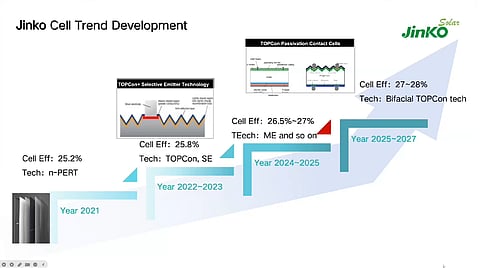


A NIMTE-led team, in collaboration with Zhejiang Jinko Solar and university partners, achieved a record 26.6% efficiency for industrial-scale TOPCon solar cells
The efficiency was demonstrated on a commercial-size M10 wafer (313.3 cm²), showing practical production relevance
The team implemented a dual-sided electrical refinement, optimizing both the boron emitter and rear tunnel oxide/polysilicon structure to reduce electrical losses
The adoption of tunnel oxide passivating contact (TOPCon) solar cell technology is expanding thanks to its manufacturing compatibility and lower costs. On the other hand, TOPCon cell efficiencies have fallen short of their theoretical efficiency ceiling of 29%, primarily due to electrical losses and metallization limitations.
Given this backdrop, researchers in China have reported a new power conversion efficiency (PCE) record of 26.6% for industrial scale TOPCon solar cells. This achievement narrows the long-standing gap between average mass-production efficiencies and the theoretical ceiling.
Led by Prof. Jichun Ye at the Ningbo Institute of Materials Technology and Engineering (NIMTE), the study outlines a manufacturing-compatible pathway for advancing high-efficiency industrial TOPCon cells. By improving electrical performance on both front and rear sides, the approach reduces the efficiency gap between commercial devices and theoretical limits. The study was carried out in collaboration with Zhejiang Jinko Solar Co., Ltd., Soochow University, and China Jiliang University.
The research team implemented a dual-sided electrical refinement strategy for large-area industrial TOPCon cells. The refinements were implemented on an M10 wafer with an effective area of 313.3 cm², industrially relevant dimensions rather than laboratory-scale devices.
On the front side, the researchers introduced high-sheet-resistance boron emitters of approximately 430 Ω sq⁻¹ combined with an optimized grid design. This approach enhanced surface passivation while reducing carrier transport losses.
On the rear side, the team developed a double-layer tunnel oxide/polysilicon structure to mitigate metallization-induced degradation. The structure consists of a highly crystalline inner polysilicon layer and an outer barrier layer designed to prevent silver diffusion from the electrodes into the silicon substrate. This approach improves interfacial passivation and long-term electrical stability.
Additional thinning of the rear polysilicon layer increased the cell’s bifaciality to 88.3%, contributing to higher energy yield potential under bifacial operation.
Through these combined refinements, the industrial TOPCon device achieved:
Open-circuit voltage (Voc) of 744.6 mV
Fill factor (FF) of 85.57%
Power conversion efficiency of 26.6%
"The device has reached 83.8% of the theoretical efficiency limit, outperforming conventional TOPCon solar cells," says Prof. Ye.
The full findings are published in Nature Energy titled "Dual-side electrical refinement enables efficient industrial tunnel oxide passivating contact silicon solar cells".
