
Key takeaways:
UNEF’s approach shows how PV projects can integrate ecological measures, such as renaturalisation, habitat support, and soil monitoring into project design
The framework places strong emphasis on community engagement, local employment, training, and independent auditing
Examples from Spanish PV projects show that well-designed plants can deliver both measurable biodiversity gains and positive economic impacts in surrounding municipalities
Sustainability plays an equally important role on the system side as it does on the manufacturing side of the PV sector. At the TaiyangNews Solar & Sustainability conference, Martín Behar from UNEF shared a concrete view of what sustainable solar development can look like when environmental and social considerations are treated as design inputs for a PV plant.
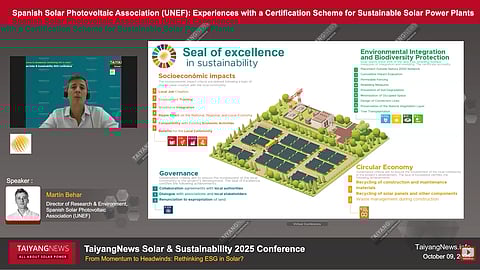
UNEF, an umbrella organization that represents nearly the entire PV value chain in Spain, sees opportunities to demonstrate that large-scale PV can coexist with biodiversity and local communities. That context drove UNEF to create its Environmental Seal of Excellence, a certification scheme developed over a year with 30 technical experts and environmental NGOs, including BirdLife, Greenpeace, Ecologistas en Acción, and WWF.
The certification rests on 4 key aspects:
Environmental integration & biodiversity,
Socio-economic impacts,
Circularity, and
Governance
On the environmental side, developers are expected to avoid protected areas entirely, reduce habitat fragmentation using wildlife-friendly fencing, and plant pollinator-friendly vegetation around project boundaries as a natural visual and ecological buffer. Inside the plant, UNEF requires renaturalisation measures based on a prior ecological assessment. This includes building ponds to address summer dryness (a measure Martín said has been particularly successful), insect hotels, reptile shelters, and nest boxes to strengthen local food chains. These efforts also extend to monitoring soil health, panel spacing, and topsoil preservation.
Behar stated that the social dimension is treated with equal importance. Developers are encouraged to start conversations and maintain relationships with the local communities well before permitting and throughout construction and operation. UNEF pushes for concrete commitments from developers, such as hiring local workers, offering training programs, building community-benefit agreements, and avoiding expropriation wherever possible. Independent auditors like SGS and Applus verify both paperwork and on-site execution, which gives the scheme credibility beyond industry self-reporting. As of now, roughly 5.6 GW of Spanish PV capacity is certified or undergoing certification under this program, as highlighted by Behar.
Behar presented results from an investigation on the impact of PV plants on the birdlife. When renaturalisation measures are implemented, the richness of species inside PV plants matches or even exceeds the adjacent control areas, according to him. Birds of prey are increasingly present due to the improved food chain, and several steppe species, including the little bustard and the stone-curlew, have started using the sites more than originally anticipated. Field observations even show animals fleeing into PV plants when startled, since they perceive the plants as safer spaces with no hunting and minimal human disturbance.
UNEF also presented a couple of project examples. In the municipality of Talayuela in Cáceres, a PV plant developed by Statkraft, includes ponds, observation towers for bird population censuses, insect hotels, nest boxes, and reptile shelters. This supports the ecological system within the PV plant and, according to him, has been working very well. On the social side, another example by Enel Green Power was highlighted: the Totana plant in Murcia employed 100 local workers out of 350 and funded self-consumption projects for public facilities, including a center for people with intellectual disabilities. Another major project in Extremadura hired roughly 1,000 workers from the surrounding province during construction. UNEF views these cases as models for how developers can leave behind tangible socio-economic value.
UNEF also quantified these impacts. A study isolating the influence of PV plants on rural municipalities found increases of 3–7% in population, around 2% growth in local businesses, a 1% rise in per capita income, and a 11% average increase in municipal public finances, with some towns reaching 30%. Behar stated that these shifts, if paired with effective local governance, have the potential to improve the quality of life for the local inhabitants. UNEF is now expanding the Seal to cover storage projects, adding criteria for fire safety, noise reduction, and visual impact reduction.
The full presentation can be accessed here on: Experiences with Certification Scheme for Sustainable Solar Power Plants.

