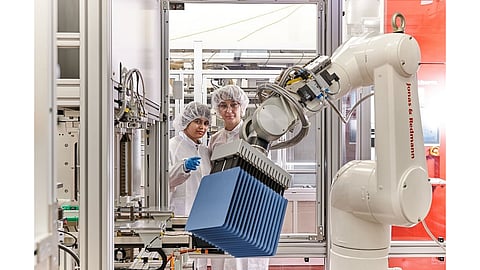


ISC Konstanz has produced its first TOPCon solar cell using equipment installed in its new research laboratory
The new laboratory covers all major solar cell manufacturing steps, including automated material handling
New research projects will focus on TOPCon cell efficiency, BC cell manufacturing, and module reliability
Germany’s International Solar Energy Research Center (ISC) Konstanz has produced its first tunnel oxide passivated contact (TOPCon) solar cell entirely using equipment installed in its new research laboratory. The new infrastructure will support the development and optimization of solar cell manufacturing processes for industrial applications.
According to ISC Konstanz, much of its research equipment was nearly 20 years old and needed an upgrade. To continue its research activities during the modernization, the institute acquired a neighboring building and converted it into a new laboratory. The State of Baden-Württemberg approved €10.15 million in funding for the modernization. ISC Konstanz says it has reduced the initial estimated project cost of €19 million by adopting cost-effective construction methods and carrying out much of the work in-house. The expansion is still underway (see ISC Konstanz Moves One Step Closer To New Research Lab).
The new laboratory houses equipment for wet-chemical processing, high-temperature treatments, deposition, laser processing, and metallization. Equipment suppliers involved in the project include centrotherm, RENA, ASYS, InnoLas, halm, and BÜRKLE. The laboratory also uses industrial robots to load wafers into high-temperature furnaces, helping improve process reproducibility (see ISC Konstanz’s New Laboratory Gets Bürkle’s Laminator).
“Our goal is not only to achieve high efficiencies in the laboratory,” says Dr. Radovan Kopeček, Member of the Board of ISC Konstanz. Bringing these technologies into mass production is equally important, he adds. The institute also wants to strengthen the position of German equipment manufacturers in the global solar market.
The new infrastructure will support a number of publicly funded research projects. One of them is LAPIS, launched in June 2026, under which ISC is developing laser-structured passivated contacts to further improve TOPCon cell efficiency.
Another project, BC-Pilot, brings together ISC Konstanz and the Institute for Solar Energy Research Hamelin (ISFH). The two institutes are combining their back contact (BC) solar cell technologies to develop a turnkey production solution for industrial manufacturing (see Back Contact In Europe Edges Toward Commercial Scale).
At the module level, the international DREAM-PV project explores new module concepts using high-efficiency TOPCon and BC solar cells to improve long-term reliability and reduce costs. The SPRINT project focuses on developing new solar technologies and transferring them to industrial production.