

Key takeaways:
Sun simulators are evolving from production tools to precision measurement systems used across manufacturing, R&D, and certification
Both xenon and LED light sources are widely used, with each suited to different applications such as reference measurements or flexible spectral control
New applications, including perovskite modules, mobile testing, and space PV, are driving diversification in IV characterization systems
IV characterization is the final stage of module manufacturing involving a complex task: simulating sunlight indoors. This shift from mechanical processing to precision measurement means that sun simulators function more like scientific instruments than production machinery, and their suppliers often come from backgrounds different from those of the equipment makers active in earlier stages of the module production line. A total of 3 companies have responded with data for 26 products in this part of the survey.
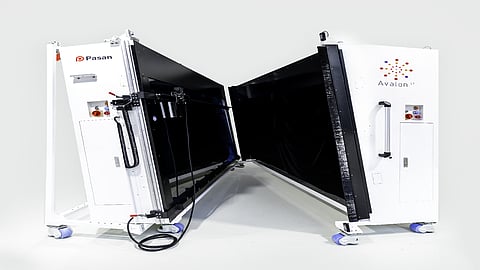
Following Avalon’s acquisition of Pasan in mid2025, the 2 companies together have provided data for a total of 19 sun-simulator platforms, the highest number submitted in TaiyangNews market survey on Solar Module Production Equipment. The portfolio covers the characterization of solar modules across different setups, ranging from inline production testing, high-precision laboratory and certification measurements, R&D, complex cell structures, mobile labs, and space applications. Given its size, it would be difficult to provide the complete details of the entire portfolio. Thus, the product description below groups products by application and highlights key changes. For further details, please refer to the product specification tables in p.61. One of the primary differences among the listed products is that they are either integrated with Pasan’s xenon lamp-based light source or with Avalon/Pasan-branded LED-based light engines. There is also a commonality: except for 2 products – a mobile lab and a tool for mini-modules – all tools featuring Avalon/Pasan light source have the same maximum illumination area of 1,800 × 3,000 mm.
Starting with the production-supporting tools, for which we received data for 3 flasher models, the latest in the group is Pasan Xenon Production. As the name indicates, this sun simulator features Pasan’s xenon light engine with an illumination area of 1,600 × 2,800 mm. It meets the A++A+A++ light source class. The remaining 2 – Nexun Neo (For Production Only) and Nexun Evo (For Production Only) – are based on a 17-channel light source and a short pulse duration of 200 ms. All the listed specifications for this product pair are identical. The only difference identified in the listed specifications is that the Evo model supports bifacial measurement with either 1 or 2 light sources, whereas Neo does not. The 2 models from the Nexun series support a throughput of 500 modules per hour with a cycle time range of 2 to 10 seconds.
The company promotes the Nexun Pro series for lab and production scenarios, meeting both ends: high precision for lab settings and faster inspection times. Facilitating high accuracy characterization, 3 products from this series feature A++A+A++ class LED-based light source. The longer pulse duration of up to 500 ms also allows characterization of high-capacitance cell technologies such as HJT. At the same time, the series also features a shorter cycle time of 2 to 15 seconds. Of the 3 listed models, Nexun Pro – the namesake of the series – is an entry-level model with 17 LED channels, whereas Nexun Pro Max and Nexun Pro Max Duo feature 20 LED channels. However, there is no noticeable difference between these 2 models, at least according to the listed specifications, except for the physical properties. The Duo model is larger at 3,300 × 1,400 × 2,220 mm compared to 3,300 × 900 × 2,220 mm for Max, and is also heavier at 1,000 kg compared to 600 kg.
Addressing today’s PV technology buzzword, the joint representation of Pasan-Avalon features a sun simulator for the characterization of perovskite modules, aptly named Nexun Perovskite. The tool obviously features an LED light source that supports both pulsed and steady-state illumination. In pulsed illumination, the light source meets the A+A+A+ class with a duration of 500 ms. It features a steady-state preconditioning light spectrum that can be customized to match the perovskite spectral response.
The product listing also includes sun simulators with ultra-high-precision measurement, with levels equivalent to those of certification labs. This group has 3 products, of which 2 – Pasan Xenon Reference A++ and Pasan Reference A++ Dual System – are based on Pasan’s light source, i.e., a xenon-based one. They both meet an A++A++A++ simulator class with low uncertainties. The key difference is that the ‘Dual’ model, launched very recently in 2026, features dual light sources: xenon and LED. It also features wavelength control integrated into the software, while the other model has a fixed wavelength. The Dual model supports a pulse duration of 500 ms with LED and 12 ms with xenon, while the other one features only the latter. The third model in this set, Nexun Ultra A++, features only LED-based illumination, but is equipped with 37 channels, facilitating the highest precision measurement among the group and qualifying for A+++A++A+++ simulator class. This product can also characterize with the Air Mass 0 (AM0) spectrum. All these products are rated with a measurement cycle time of up to 15 ms.
Again, 3 products are promoted for lab and R&D setups, one with Xenon and 2 with LED light sources. Pasan Xenon Long Pulse Lab, as the name indicates, is xenon-based and supports a longer pulse of 100 ms. It is rated A++A+A++. Of the remaining 2 LED-based tools, Nexun Steady-State supports a steady-state measurement. And while Nexun Minilab supports both pulsed and steady-state modes, it is primarily designed for characterizing mini-modules used in the development of new cell architectures. It can accommodate a maximum substrate size of up to 500 × 500 mm.
While Nexun Mobile Lab appears intended for the lab application, given its name, its modus operandi is completely different. It is a compact mobile lab designed for power plant assessment, third-party factory verification, or plant decommissioning. It has a maximum illumination area of 1,500 × 2,700 mm, making it second among the products featuring LED light sources with a different maximum substrate size than the above-discussed tester for mini-modules. The joint listing of Avalon and Pasan includes 5 models designed for characterizing modules for space applications, capable of performing measurements under AM0 conditions. However, the latest in this group, the 2025-introduced Nexun Pro Max AM0, can accommodate the space spectrum (AM0) as well as AM 1.5, relevant for terrestrial PV. The remaining 4 are exclusively designed for AM0 measurement environments with spectra ranging from 300 to 1,900 nm; for reference, AM 1.5 refers to 300 to 1,200 nm. The exclusive AM0 simulator group is designed to characterize multijunction PV devices, which are so far mainly used in space applications.
Following the order of latest first, Nexun Cosmo AM0 is a 2023 model, equipped with a combined light source comprising an LED and a tungsten lamp. The simulator for the A+AA class is typically configured to measure 3-junction devices but can also characterize PV modules with up to 6 junctions, with compromised accuracy due to increased uncertainty in the latter case. The 2022 model, Highlight SAT 5J/6J, while capable of characterizing PV modules with 3-junction technologies and 6-junction with increasing uncertainty, is built on a xenon light source platform. It also has a high maximum illumination area of 4,000 × 4,000 mm. The remaining 2 models in this group are also based on a xenon light source and characterize 3-junction devices, but are limited to 4-junction devices, even with increased uncertainty. The major difference between these 2 is that HighLIGHT SMT AM0 is a 2017 model with a maximum illumination area of 2,800 × 2,800 mm. The older 2017 model, Highlight SAT 3J/4J, features a larger illumination area of 4,000 × 3,000 mm.
A few important specifications of these sun simulators are that most xenon testers for space applications are rated at 30,000 flashes, with 20,000 guaranteed, while specs for tools for terrestrial applications are given as 100,000 typical and 60,000 guaranteed. LED-based products are rated for 36 million flashes, except for the space-specific model, which has a lamp life of 1 million flashes. Most of the LED-based tools are capable of supporting a few other characterization methods such as EL, HiPot, and bypass diode check, while the list for xenon lamp-based models, except for the production system, is as follows: EL, spectral response, low irradiance masks, and thermal conditioning. The majority of the tools also support other advanced measurements, including DragonBack, a proprietary name for Pasan’s hysteresis measurement of high capacitance PV technology cells (HJT and TOPCon), dynamic IV measurement, direct and reverse sweeps, modulated IV, and dark IV.
The text is an edited excerpt from TaiyangNews’ Market Survey on Solar Module Production Equipment 2026, which can be downloaded for free here.
