

JA showcased a 28.2% efficiency BC cell and a 26.73% efficiency TOPCon cell featuring thermal transfer printing technology
The company displayed several scenario-based modules designed for urban, desert, marine, and high-reliability applications
JA expanded its storage portfolio with residential, commercial, and utility-scale energy storage solutions
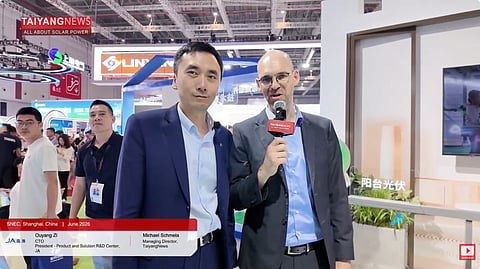
Leading solar manufacturer JA (previously JA Solar) presented a broad portfolio of solar modules and energy storage technologies at SNEC 2026. During the booth interview with TaiyangNews Managing Director Michael Schmela, Ouyang Zi, CTO and President of the Product & Solution R&D Center at JA, outlined the company's latest developments, including advanced cell technologies, future tandem concepts, solar modules for various applications, and battery storage systems.
Zi highlighted the company's back-contact (BC) cell that achieved a conversion efficiency of 28.2%. Building on this technology, JA also showcased its JA-STRING module, rated at 700 W with a module efficiency of 26.0%. The product incorporates the company's proprietary JA-STRING interconnection technology and features full lifecycle traceability.
Alongside the BC technology, JA displayed a TOPCon cell with a certified efficiency of 26.73%. The cell incorporates thermal transfer printing technology, enabling extremely fine metallization lines that are nearly invisible on the cell surface. According to Zi, the design improves conversion efficiency by reducing front-side shading losses.
Future technology concepts formed another part of JA’s display. Among them was a 4-terminal (4T) perovskite-silicon tandem mini-module featuring separate electrical outputs for the perovskite and silicon sub-cells. The company also presented a flexible perovskite-silicon tandem cell based on a 16 µm silicon substrate for potential space applications. Zi described these technologies as future product platforms rather than commercial products.
Moving to modules, JA also showcased its DeepBlue 5.0 platform, including the JAM48D50/LR module, rated at 495 W and 24.8% efficiency. Zi explained that the module employs a 3-cut cell architecture rather than the conventional half-cut design. The configuration divides the module into 3 electrically independent sections. As a result, when one section is shaded, a larger portion of the module remains operational, improving energy yield under partial shading conditions.
The company also showcased an anti-glare module based on its DeepBlue 5.0 platform. Designed for deployment near airports, highways, railway corridors, and residential areas, the module features a specially treated surface that scatters reflected sunlight. Zi explained that the design reduces direct glare from multiple viewing angles. The JAM66D50/GB module designed for this application is rated at 670 W with an efficiency of 24.8%.
For marine and coastal environments, the company presented its DeepBlue Ocean Blue 4.0 module. Zi highlighted the use of a polymer-based frame and anti-corrosion measures designed to improve resistance to saltwater exposure. The module also incorporates IP68-rated electrical components to support operation in humid and marine environments. The JAM66D46/LB module is rated at 745 W with a module efficiency of 24.0% and is suitable for both coastal and floating PV installations
JA also presented its Desert Blue module designed for arid environments. It incorporates anti-dust features intended to reduce soiling losses. Demonstrating the concept at the booth, Zi showed how dust removal with this module differs from conventional module surfaces. He stated that long-term field deployments have shown approximately 4% higher energy generation than conventional modules with the same rated power. It also comes with additional features, including a steel frame and a down-conversion encapsulant intended to reduce UV-induced degradation.
Another technology on display was a self-cleaning coating concept. Zi explained that the hydrophilic coating incorporates titanium oxide and utilizes photocatalytic effects activated by ultraviolet light. Organic contaminants deposited on the module surface are degraded and subsequently removed by water. This technology could be integrated into future module products, says Zi.
Also part of JA’s display was a high-reliability module developed for demanding operating environments. Zi stated that the product achieves Class A fire resistance, can withstand hail impacts up to 65 mm, and supports mechanical loads of up to 5,400 Pa. The design also focuses on thermal cycling durability and self-cleaning performance. The company is positioning the module for applications where long-term reliability is critical, including AI data center projects.
JA also highlighted its growing energy storage portfolio. Zi said the company has expanded its storage offerings in response to customer demand for solar-plus-storage solutions.
For residential applications, JA showcased a balcony PV system comprising modules, microinverters, battery storage, and mounting structures. The plug-and-play solution includes a 2 kWh battery unit and is designed for installation through distributor networks in Europe.
Zi also presented a commercial solar-plus-storage solution combining its DeepBlue 5.0 modules with a 125 kW/261 kWh all-in-one C&I BESS. He highlighted the storage system's integrated design, which combines batteries, inverters, and control systems within a single enclosure. This solution is designed for commercial applications and primarily targets the European market.
For utility-scale projects, JA showcased its JA Galaxy energy storage platform. The containerized system offers approximately 6.26 MWh of storage capacity and is intended for large ground-mounted solar projects.
