
Key takeaways:
Integrated solar and storage solutions are being used to address risks across project assessment, design, and operation stages
Adding storage can increase upfront costs but may improve payback period and overall project returns
Flexible systems combining PV, storage, and other energy sources are supported by software for energy management and trading
In the current phase of PV installations, there are various risks associated with investment assessment, system design, portfolio optimization, and delivery & services stages. During the initial assessment, clarity of the business model, policy, and revenue predictability are key factors. At the design level, configurations of various electrical components and grid interconnection are important. The choice of PV technology and system power-energy balance, followed by operation and maintenance services, combine to play a key role in the later stages of installation.
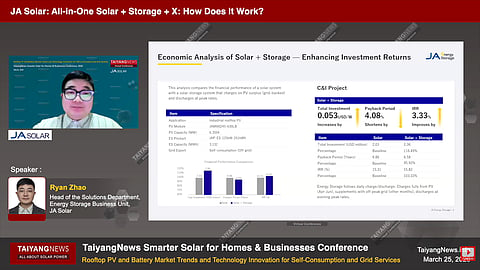
At the TaiyangNews Smarter Solar for Homes & Businesses Conference, Ryan Zhao from the Energy Storage Business Unit of JA Solar elaborated on the company’s all-in-one ‘Solar + Storage + X’ solution. The company claims this solution can address the risks associated with these stages of the installation process and minimize them.
Zhao cited examples to demonstrate how investment returns can be enhanced with this solution. For a C&I project, it was demonstrated that although the total investment increased by about $0.053/W, the payback period was reduced by 4.08%, resulting in a 3.33% improvement in IRR. These analyses were run using a PV-only installation as the baseline, with an initial investment of $2.03 million and a payback period of 6.86 years. Adding storage to a PV installation may increase the initial capital costs, but it is economically viable and profitable during operation, says Zhao.
Referring to the ‘X’, Zhao said it indicates the flexibility of integrating storage with different energy sources, including small- and large-scale generation from PV, wind, and hydrogen. For utility-scale applications, he said JA Solar is currently providing 5 MWh units and will soon launch 6.25 MWh systems. He also showcased the company’s portfolio of C&I and residential products, along with its supporting digital software solutions. Like other software platforms offered by companies providing integrated solutions, JA Solar’s software manages energy generation and supply using AI-based tools and also offers energy trading capabilities.
Zhao concluded his talk, titled All-in-One Solar + Storage + X: How Does It Work?, by presenting some use cases of utility-scale BESS solutions in Inner Mongolia, Zhejiang, Italy, and Kenya.

