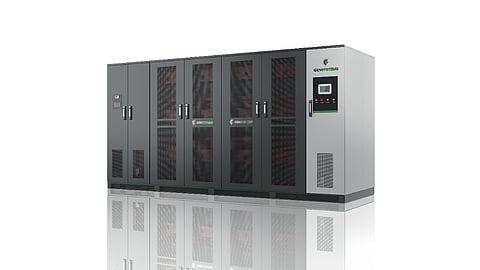

GenSystems Power Solutions LLC, a subsidiary of China’s Jereh Group, displayed its PowerVEGA SST at the RE+ 2026 exhibition
It claims the SST can convert 13.8 kV AC to 800 V DC voltage to feed AIDC server racks without intermediary conversion steps
This system has a power density of 434 kW/m² and uses SiC devices that reduce component count by up to 51% compared to mainstream alternatives
GenSystems Power Solutions LLC (GPS), a US-based power generation and energy solutions company, showcased its latest AIDC solid-state transformer (SST), PowerVEGA SST, at RE+2026.
Measuring 4,599.4 × 1,499.6 × 2,350 mm (L × W × H), it converts 13.8 kV at 60 Hz from either the utility grid or on-site behind-the-meter (BTM) generation to 800 V DC output voltage. This voltage and power conversion is done in a single step rather than using a traditional transformer (AC voltage conversion) and uninterruptible power supply systems (UPSs) (AC to DC power conversion).
It uses multiple interconnected 2.3 kV SiC-based power electronics converters or power modules, for a total power conversion capacity of 3 MW. The company claims that using SiC devices reduces component count by up to 51% and yields a system power density of 434 kW/m² (more than 36%) compared to mainstream alternatives.
These two attributes, shares GPS, address the limitations of power distribution and scalability in AC architecture to meet the growing demands of higher rack power (toward 300 or 500 kW or above). The product datasheet specifies an operating temperature range of -5 to +60°C and a maximum power conversion efficiency of 98.5%.
This system supports direct coupling of its power electronics devices with on-site gas-fired generation by a patented gas-turbine-to-SST coupling architecture. It can also serve as a microgrid energy hub and coordinate gas generation, battery storage, and PV through built-in functions.
According to GPS, which is a wholly-owned subsidiary of China-based Jereh Group, the PowerVEGA SST’s prefabricated design helps with installation and commissioning within 8 hours. It uses redundant power modules, enabling swapping of a faulty module with a healthy one within 300 seconds without operational disturbances, helping to achieve high system availability.
