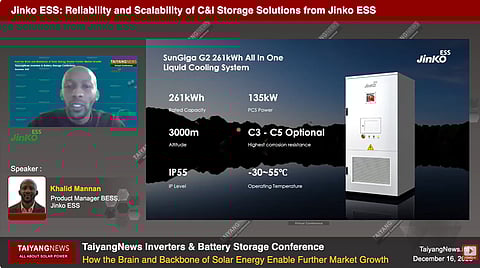


Jinko ESS’s SunGiga G2 is a 261 kWh liquid-cooled all-in-one system with integrated PCS and battery design
System scalability allows up to 12 units, enabling configurations of around 3 MWh for C&I applications
Multi-level safety architecture and thermal management support improved lifecycle, reliability, and deployment in harsh environments
The role of energy storage in commercial and industrial applications is expanding. It is moving beyond standalone battery systems toward integrated platforms that enable hybrid energy systems and decentralized power infrastructure.
Speaking at the TaiyangNews Inverters & Battery Storage Conference, Khalid Mannan, Product Manager at Jinko ESS, outlined the company’s approach to C&I storage, emphasizing reliability, scalability, and system-level integration. In his presentation titled Reliability and Scalability of C&I Storage Solutions from Jinko ESS, he noted that storage is no longer defined by battery capacity alone, but by its ability to function as a configurable and intelligent asset.
A second-generation all-in-one liquid-cooled storage system, the unit offers 261 kWh capacity with a 135 kW PCS output. Its architecture, which integrates battery, PCS, BMS, and fire suppression systems into a single cabinet, reduces system complexity and results in a more compact layout.
The system combines the high-voltage box and PCS into a unified structure, which reduces system volume by around 10% while increasing energy density, claims Mannan. He added that the platform is designed for modular deployment, allowing installations to start with a small number of units and scale up to 12 systems, reaching approximately 3 MWh capacity for larger applications.
The platform uses LFP cells in a 3.2 V, 314 Ah configuration, operating at a 0.5 P rate. The system is rated for a cycle life of around 8,000 cycles at 100% depth of discharge, representing a 33% improvement compared to the previous generation. Round-trip efficiency is reported at about 89%, with system voltage operating between 702 V and 936 V.
The liquid cooling system incorporates non-uniform flow channels and zonal temperature control for thermal management. It maintains temperature variation within 2°C across cells. This reduces thermal imbalance between inner and outer cells and supports consistent performance. The system also integrates an air-cooled chiller, called Envicool EMW30HFNC1A, which uses variable-frequency compression and intelligent load-based control to optimize cooling efficiency under different operating conditions. According to the company, the system is designed for deployment across a wide range of environmental conditions. It supports operation at altitudes up to 3,000 m, offers IP55 protection, and operates within a temperature range of -30°C to 55°C. Corrosion resistance up to C5 level enables use in coastal and high-humidity regions.
Safety is addressed through a multi-layer architecture spanning cell, module, rack, and system levels, Mannan explains. The platform integrates temperature and smoke detection, combustible gas detection, and aerosol-based fire suppression. At the electrical level, protection mechanisms include fuse systems, circuit breakers, and leakage detection. The BMS monitors cell-level parameters, while EMS enables system-level control and diagnostics.
According to Jinko ESS, the SunGiga G2 platform was evaluated under overcharge conditions up to 5.35 V without explosion. It also withstood thermal exposure above 500°C without fire propagation, added Mannan. Short-circuit conditions were managed through controlled fuse activation. These results indicate system-level safety performance under extreme conditions.
He also highlighted the company’s full-stack development approach, covering cells, BMS, PCS, EMS, and cloud-based operational platforms. Its OPS platform uses data-driven algorithms for monitoring, predictive maintenance, and operational optimization, while 24/7 system monitoring supports fault detection and remote management.
The system supports a range of deployment configurations, including grid-connected, self-consumption, and off-grid modes, with applications across commercial buildings, petrol stations, industrial sites, and microgrids. Installations in Europe and Asia demonstrate use cases such as peak shaving and PV-plus-storage operation.
Jinko ESS also addressed cybersecurity considerations for the European market. The company plans to establish local servers in Europe to support compliance and improve data security, offering an alternative to full localization of manufacturing while maintaining operational trust.
The full presentation is available on the TaiyangNews YouTube channel here.
