

Jinko ESS’ Alessandro La Ganga compared AC- and DC-coupled battery storage designs for utility-scale solar plants
DC coupling can reduce conversion stages, while AC coupling enables independent operation of the PV and battery systems
Case studies from Germany and Greece show how storage architecture and battery size depend on the project’s purpose
Limited grid-connection capacity, solar curtailment, and negative electricity prices are increasing the need for battery storage at utility-scale PV plants. Storage can capture surplus electricity during periods of high solar generation and supply it later when demand or electricity prices increase.
Speaking at the TaiyangNews Solar Power Plants & Storage Conference 2026, Jinko ESS BESS Application Engineer Alessandro La Ganga compared AC- and DC-coupled storage designs. He said the right configuration depends on the plant’s grid connection, operating requirements, and intended battery use.
The main difference between the two designs is where the PV plant and battery are connected. In the DC-coupled design currently available, the PV array and battery share the DC side of the power conversion system (PCS). A DC/DC converter on the battery side controls the flow of electricity between the battery and the PV inverter.
This arrangement reduces the number of conversion stages and suits energy shifting. Surplus solar electricity can charge the battery directly and be supplied later. However, La Ganga said using a PV inverter limits grid-support functions, including grid-forming operation.
To address this limitation, PCS manufacturers are developing another DC-coupled architecture that La Ganga expects to become available by the end of 2027. It places the DC/DC converter on the PV side and connects the battery directly to a storage PCS. According to him, this configuration can provide grid-forming operation, inertia support, and fast frequency response.
AC coupling offers a different approach. The PV plant and battery use separate power conversion equipment and connect at the medium-voltage point. This allows the two systems to be controlled and dispatched independently. The storage PCS can also provide grid-forming and black-start functions. However, the additional conversion and transformation stage reduces overall efficiency compared with a DC-coupled system.
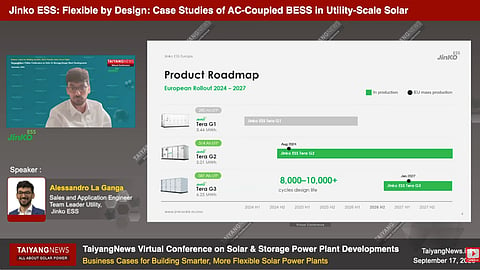
Alongside these system designs, La Ganga presented Jinko ESS’ Tera utility-scale storage roadmap. The Tera G1 uses 280 Ah lithium iron phosphate (LFP) cells and offers 3.44 MWh of capacity. The Tera G2 increases this to 5.01 MWh using 314 Ah cells.
The Tera G3 will use 587 Ah LFP cells and provide 6.25 MWh, with its European rollout planned from January 2027. Jinko ESS states a design life of 8,000 to more than 10,000 cycles for the product range. During the Q&A, La Ganga clarified that the company manufactures the systems in China and supplies them to Europe, where it has a team supporting regional projects.
La Ganga then used two projects to show how the choice between AC and DC coupling changes according to the application. The first was a DC-coupled storage project across three agrivoltaic sites in Germany. Jinko ESS presented the combined battery capacity as 20.06 MW/66.33 MWh, based on its Tera G2 system. The batteries store surplus midday solar generation during periods of low or negative electricity prices, helping reduce curtailment. The modular design allowed the storage capacity to adapt to each site's PV and grid limits. Jinko ESS also conducted joint integration testing with the third-party PCS and DC/DC converter supplier before commissioning.
The second project applied AC coupling at Athens International Airport. The 21.95 MW/123.8 MWh system combines 36 Tera G1 battery containers with an existing 16 MWp PV plant and a newer 35.5 MWp installation. Solar electricity first supplies the airport’s immediate demand, while surplus generation charges the battery. The stored electricity is supplied when PV output falls. According to Jinko ESS, the 5.5-hour system captures around 25 GWh of solar electricity annually and supports the airport’s use of 100% on-site clean energy.
The project has two independent grid-connection points, allowing the PV and battery systems to operate separately. Its design also accounts for the site’s seismic requirements, hot weather and coastal conditions.
Comparing the two projects, La Ganga said the German system has a PV-to-BESS power ratio close to 100%, while the Athens airport project has a ratio of 43%. The difference shows that storage power and duration must be selected according to the application rather than following a common system design. He also stressed the need for early coordination between the battery integrator and PCS supplier. This helps select the system architecture, complete integration testing, and reduce commissioning risks. Summarizing the presentation, La Ganga said, “Integration is the product.”
Jinko ESS provides battery systems from the cell to the container level and can integrate them with power conversion and medium-voltage equipment from different suppliers.
