
JinkoSolar has launched its LightRoof series module for Japan’s low-load-bearing roof applications at the PV Expo 2026
A gloss level of below 1.5 GU makes this module suitable for densely populated rooftops or street-facing facades
Its glass-based encapsulation eliminates potential reliability risks with a polymer-based frontsheet, such as yellowness and cracking
Chinese PV module maker JinkoSolar has unveiled its LightRoof series solar module, tailored for Japan’s densely populated low-load-bearing roofs, at the PV Expo 2026.
The company says this product addresses 3 key concerns of Japan’s distributed PV market: low-load-bearing capacity, visual disturbances from glare, and the country’s aging workforce.
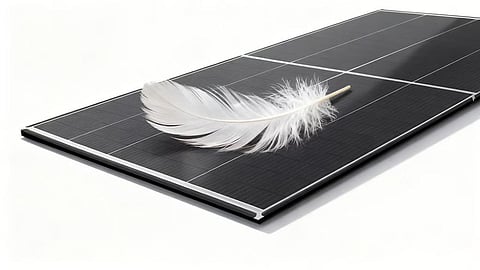
Unlike polymer frontsheet-based semi-flexible or flexible PV modules, it adopts ultrathin front and rear-glass-based configurations. While not disclosing the glass thicknesses, the company claims this 2 m² module weighs 6.5 kg/m², 45% lighter than the 12 kg/ m² of conventional alternatives. This lighter weight makes module easier to handle and install on densely populated rooftops, often with limited space. The company states that it is lighter than some of its glass-based lightweight peers (7 kg/m²) on the market. This, in turn, widens the types of light-load roofs that are technically feasible for PV installations with this module.
On the optical side, the front glass surface is textured via an embossing process and coated with a thin film. This helps sunlight falling on the glass surface scatter in multiple directions rather than concentrating it at a single point, reducing specular reflection or a bright glare. This module, when tested in-house at 60° incident angle, in accordance with Japan’s JSZ8741 standard, showed a gloss level below 1.5 GU. This result, which exceeds Japan’s anti-glare subsidy threshold of 7 GU, ensures minimal light reflection, whether in sloped roofs or street-facing façade installations, Jinko states. Thus, it avoids a sudden bright spot or glare that would visually disturb nearby residents or traffic.
Apart from installation and operational performance, this lightweight module addresses reliability challenges common in lightweight polymer-based peers. The breathable nature of the polymeric frontsheet lets moisture ingress into the lamination stack and react chemically with the embedded encapsulation, resulting in discoloration. Due to reduced transmittance, the module’s power generation is affected. On top of that, the prolonged exposure to UV rays, which react with polymeric compounds, generates cracks on the frontsheet’s outer layer. Eventually, it reduces the module’s insulation resistance (IR), posing safety risks, such as fire. On the other hand, Jinko’s glass-based module, with nearly zero water vapor transmission rate (WVTR), eliminates the risks of yellowing and polymer cracking. It also mitigates fire risks due to its non-combustible composition.
Furthermore, it maintains its mechanical integrity throughout its lifespan, whereas polymer-based alternatives often deform when exposed to high temperatures and humidity over time. The company attributes this feature to the module’s glass-based configuration and framing design. It uses frames with a patented corner-bracket design, without any drainage or dust cutouts, contributing to the module’s mechanical performance. Jinko states that this design creates a contoured surface that guides accumulated dust and rainwater to slide off the module, reducing potential power-generation losses. It also lowers cleaning frequency. For the safety of installers, the corners of these frames are designed as rounded chamfers instead of sharp right angles.
This module will use the company’s Tiger Neo 3.0 series TOPCon module platform. The company’s press release, however, didn’t provide any details on its commercialization.

