
JinkoSolar’s ‘Dust-Resistant’ front glass features a nanocomposite material-based coating that exhibits anti-static, hydrophilic, and photocatalytic properties
Its hydrophilic property easily washes away deposited dust from the glass surface when wet
However, its photocatalytic property is aimed at breaking down stubborn organic contaminants on the glass surface
Global PV module and power conversion solutions provider JinkoSolar has introduced its latest Dust-Resistant TOPCon module, designed to address typical pain points in desert and dust-heavy environments.
The company says it customizes the module’s bill-of-materials (BOM), particularly at the front glass and frame levels. This glass is coated (sunny side) with an unspecified composite material at the nanoscale level and tempered during factory production. According to the company, unlike the dust adhesion of conventional PV glass (front), which attracts the statically charged (opposite polarity) dust particles across the surface, it exhibits anti-static properties. Thus, instead of adhering to the glass surface, dust is deposited loosely and prevents potential accumulation over a certain duration. In addition, the coating’s ‘superhydrophilic’ characteristic, which forms a uniform film of water rather than droplets on the glass surface (hydrophobic) when wet, enables full penetration between contaminants and glass. Thereafter, it generates a scrubbing force that washes dust without any manual intervention, maintaining the panel’s cleanliness. Regarding organic contaminants, such as bird droppings and oil stains, typically tough to wash with water, this coating offers a photocatalytic function that breaks down the stubborn contaminants with the help of UV rays. The company classifies these functions as ‘self-cleaning’. Alongside being a dust-repellent product, the glass exhibits mechanical durability and longevity, which the company characterizes as ‘exceptional’ and attributes to the coating material (nanocomposite) and process (tempering) (mentioned above).
To optimize frame design, Jinko uses short-side frames that remain parallel to the glass surface, helping water and dust to wash away easily. Altogether, the above-mentioned properties prevent and reduce dust accumulation, even in desert or dust-intensive fields, eliminating hotspot risk.
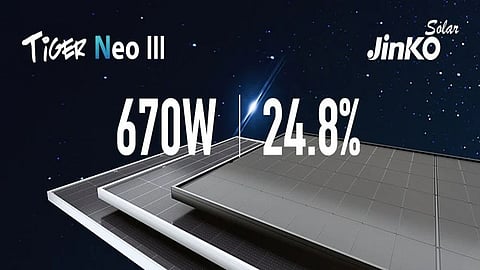
The company states that it uses the latest Tiger Neo module platform for these customizations. This module, featuring 264 pieces of 1/4-cut G12R cells, is rated for a power output of 670 W and 24.8% efficiency, respectively. Additionally, it offers a bifaciality of up to 85%. Sized at 2,382 × 1,134 × 30 mm and laminated with 2 mm front and rear glass, this 32.4 kg module is promoted for utility-scale, C&I rooftops, and distribution markets.

