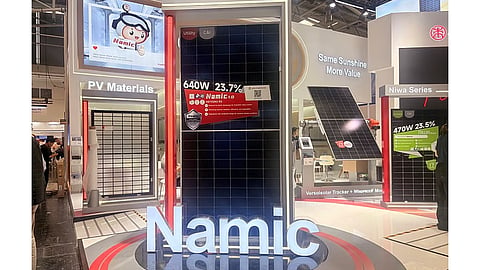


Jolywood showcased its Namic 1.0 cell technology and TOPCon modules at Intersolar Europe 2026
The 640 W Namic module uses cells with silver paste on the front and aluminum paste on the rear
Its windproof module features a coated-steel frame and supports static loads of 8,100 Pa on the front and 3,000 Pa on the rear
Chinese PV materials and module manufacturer Jolywood showcased its Namic 1.0 cell technology and application-specific TOPCon modules at Intersolar Europe 2026. The display included Namic, windproof, anti-glare, and transparent-black module designs.
Namic, short for Nano-Armor Metal Inter-contact, is Jolywood’s approach to reducing silver consumption in TOPCon cells. The Namic 1.0 generation retains silver paste for front-side metallization but replaces silver with aluminum paste on the rear.
The cell incorporates what Jolywood calls a nano-armor layer between the aluminum electrode and the silicon substrate. According to the company, this enables aluminum-based rear contacts while maintaining efficiency compared to conventional silver-based contacts. It also uses a suspended-contact grid-electrode structure, which Jolywood says reduces leakage risk. The company also claims resistance to potential-induced degradation (PID) and UV exposure. Jolywood says its Namic 1.0 cells are commercially available.
The company’s JW Plus JW-HD132N2-R2 module, featuring Namic 1.0 technology, achieves a maximum power output of 640 W and an efficiency of 23.7%. It comprises 132 half-cut cells and has a bifaciality of 70%. It measures 2,382 × 1,134 × 30 mm and weighs 32.6 kg.
Jolywood’s JW-HD132N-R2 windproof module replaces a conventional aluminum frame with a zinc-aluminum-magnesium-coated steel frame. According to the company, the frame is 3 times stronger than a conventional aluminum frame and reduces frame-related carbon emissions by 73.3%. The module also passed a wind-tunnel test at 60 m/s and supports static loads of 8,100 Pa on the front and 3,000 Pa on the rear.
The company also exhibited an anti-glare variant of the JW-HD132N-R2. It uses patterned front glass to diffuse reflected light. It says the design reduces perceived glare intensity by more than 50% compared with conventional modules.
The above 2 modules are built with 132 half-cut cells and use 2 mm glass on both sides. They offer power ratings from 625 W to 650 W and a maximum efficiency of 24.1%. Both measure 2,382 × 1,134 × 30 mm. The windproof module weighs 34.8 kg, while the anti-glare module weighs 32.7 kg.
For applications prioritizing appearance, Jolywood presented the Niwa Black JW-HD96N-R2. It uses a black frame and ultra-thin busbars to create a uniform appearance. Jolywood positions it for BIPV, vertical installations, and regions exposed to snow, sand, or high humidity. The 96-half-cell bifacial transparent-black dual-glass module delivers up to 470 W, with a maximum efficiency of 23.5% and bifaciality of 80±5%.
All four modules have a temperature coefficient of -0.280%/°C. Jolywood offers a 12-year product warranty and a 30-year linear performance warranty.
