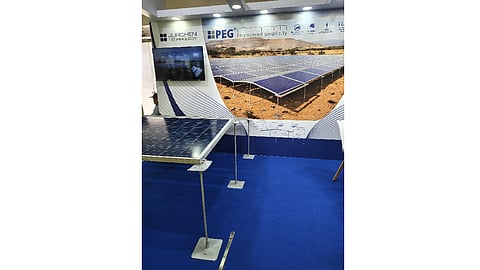

Jurchen claims the PEG system can accommodate about 2.1 MW of PV capacity per hectare, with 225% higher land yield than conventional fixed-tilt or tracking systems
The structure uses driven steel rods and plates and can be installed in several soil types and even rocky ground with some pre-drilling
The system is designed for wind speeds above 298 km/h and snow loads up to 50 psf, subject to project-specific engineering and local requirements
Germany-based Jurchen Technology offers an alternative approach to ground-mounted PV structures with its PEG system. The solution uses slender steel rods and plates instead of heavy steel posts, rails, and crossbeams. It is designed for fixed east-west module orientation and aims to reduce material requirements, installation effort, and the land area needed per MW of solar capacity.
According to the company, its solution can accommodate about 2.1 MW of PV capacity per hectare, which it claims is 225% higher land yield than fixed-tilt or tracking systems. In August 2026, Jurchen reported that its cumulative PEG installations had exceeded 800 MW worldwide.
The relatively simple structure consists of galvanized steel rods, ground plates, and upper and lower plates that secure the modules to the frames. The rods are driven into the ground and connected to the plates, which hold the modules in position. The modules are installed at a fixed inclination of 8° in an east-west arrangement, allowing the rows to be placed close together.
The installation requires fewer pieces of equipment, such as a hammer drill to drive rods into the ground, a pressing tool to secure the plates, and a cordless screwdriver to mount the modules. The structure typically sits around 1 m above ground, with the maximum height reaching 1.4 m depending on site conditions and system design.
Jurchen lists sandy clay and clayey silt, as well as sand and sand-gravel, among the suitable soil types. Rocky sites can also be considered, although pre-drilling may be needed where the ground is too hard for the rods to be driven directly.
Before installation, the site is assessed, and pull-out tests are carried out to check whether the rods can provide sufficient resistance against extraction. For very soft soil or sites where penetration depth is limited, Jurchen offers an alternative using anchor rods. A ballasted version is also available for certain ground conditions where the standard approach is unsuitable.
Jurchen states that its PEG structure is designed to withstand wind speeds exceeding 298 km/h and snow loads of up to 50 psf. Actual compliance depends on project-specific engineering and applicable local requirements. The substructure is UL-certified.

