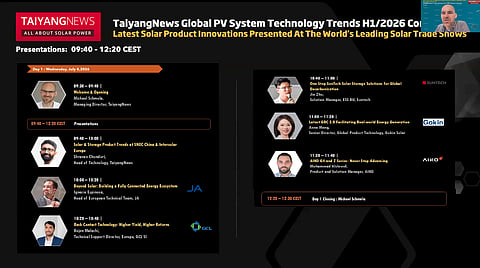


Energy storage emerged as the dominant trend at SNEC, while solar innovation continued in the areas of next-gen TOPCon and BC technologies, application-specific products, and alternative mounting systems
JA positions itself as an integrated PV and storage solutions provider, with related products
GCL SI’s BC platform features innovations across the silicon-to-module value chain
Suntech promoted vertically integrated manufacturing capability and one-stop solar-plus-storage solutions
Building on its wafer-manufacturing expertise, Gokin presented its latest BC based products mainly for residential and C&I
AIKO’s latest-generation ABC portfolio combines higher cell efficiency, denser cell packing, advanced insulation and copper interconnection, while also offering a 40-year warranty for its premium-class residential product
The world’s two largest solar exhibitions – The smarter E / Intersolar Europe in Munich and SNEC in Shanghai – serve as the industry's most important platforms for unveiling new technologies, product innovations, manufacturing advancements, and strategic developments. Each year, these events attract leading solar manufacturers, equipment suppliers, technology providers, developers, and investors from around the world, offering a glimpse of the PV sector’s future.
While the Chinese and European solar markets navigate through a period of more muted, stagnant deployment growth following a massive installation boom in 2025, the booming energy storage sector is a silver lining. Even as overall attendance figures dipped slightly from historical highs, booths showcasing advanced battery storage solutions remained packed, reflecting growing international interest, said Michael Schmela, Managing Director of TaiyangNews, in his opening remarks. European markets continue to stand out as highly accessible hubs for global innovation, attracting considerable Chinese and international representation at Intersolar.
TaiyangNews organized the TaiyangNews Global PV System Technology Trends H1/2026 Virtual Conference to reflect the key product innovations introduced and promoted by the leading solar and storage supplier at these shows. Schmela said the conference provided a focused snapshot of the latest solar and storage innovations displayed at these events. Serving as a crucial mid-year technical checkpoint, the conference brought together leading solar and storage companies to elaborate on the technologies and products that stood out at the industry’s two major exhibitions. Across 2 conference days, industry experts discussed advances in cell and module technologies, application-specific products, integrated PV systems, and energy storage solutions.
Here is a summary of Day 1 of the conference, held on July 8, 2026.
Energy Storage & BC Take Center Stage
If there was one trend that stood out across both shows, it was the rapid rise of energy storage as a core industry focus, emphasized Shravan Chunduri of TaiyangNews in his keynote. At SNEC 2026, for example, battery energy storage systems (BESS) occupied 6 exhibition halls, compared with 4 for solar. This was the first time in the history of this world’s largest solar show where the physical footprint of storage hardware and battery systems exceeded that of the solar segment.
However, solar was by no means sidelined. Continued innovation in high-efficiency technologies, application-specific products, and alternative mounting solutions displayed at the show was a major reflection of ongoing advancements in the segment. Space PV, while not yet a commercial product category, is also emerging as an important area of interest among the leading manufacturers.
The new generation of TOPCon based on rear poly-fingers and edge passivation, and BC are the key developments at the cell level. Equipment manufacturers are closely following these developments, preparing production platforms that can support next-generation TOPCon and BC technologies while also looking ahead to perovskite and tandem cells.
At the module level, multi-cut cells and high-density layouts are increasingly being used together. Another clear trend was the rise of application-specific modules with optimized BOM. Module makers are increasingly developing specialized products for various application scenarios, including dusty environments, deserts, marine locations, anti-glare, and weight-constrained rooftops.
One of the most interesting innovations is the emerging mounting solutions based on cables. This approach is opening new possibilities, such as mountain PV, where traditional mounting solutions simply cannot work. The cable-based mounting solutions are also beneficial for dual-land-use scenarios, such as agrivoltaics and parking lots in urban setups.
Storage innovation was strongly influenced by the rapidly growing power requirements of AI data centers (AIDCs). Suppliers presented systems designed to handle both short-duration power fluctuations and longer-duration energy shifting, including high-rate battery systems and products offering up to 8 hours of storage.
At the residential level, the industry is moving toward an intelligent home energy ecosystem that integrates rooftop PV, storage, electric vehicles (EVs), heat pumps, air-conditioning, and energy management. The segment is also attracting traditional home appliance brands such as Midea, Gree, Haier, and SKYWORTH to enter it.
Reflecting its leading position in module supply and a foothold in storage, JA positions itself as a provider of integrated solar and energy storage solutions. Taking the growing share of renewables in the global energy mix as a lead, Ignacio Espinosa, Head of the European Technical Team at JA, said that more than 80% of new global power capacity now comes from renewables, which account for over 30% of electricity generation in some markets. In this context, storage is gaining significant traction on the grounds of grid stability and as an ancillary service, which is accelerating the deployment of storage to more than fivefold by 2030, according to Espinosa.
JA’s PV + Storage Solutions and AIDC Focus
JA presented modules for six application scenarios at SNEC 2026 and Intersolar Europe 2026. These include JAxPlateau for AIDCs with high energy consumption and high-capacity systems, JAxOcean for marine applications, JAxDesert for arid regions, JAxCity for urban infrastructure, and JAxHome for residential systems. The company also highlighted JAxFuture for next-generation technologies, including space PV.
On the solar side of things, the company’s module portfolio included the residential HyperGen Pro series, offering up to 495 W of output and up to 24.8% efficiency. The DeepBlue 5.0 series covers residential, C&I, and utility applications, with power ratings ranging from 485 W to 670 W and efficiencies of up to 24.8%. The previous generation, DeepBlue 4.0, was also on the list, primarily catering to utility applications and offering a very high power rating of up to 745 W.
As part of the integrated PV and storage solutions, JA has developed product platforms for all mainstream application scenarios – residential, C&I, and utility. However, in his presentation, Espinosa focused more on the utility-scale solution that combines high-power PV modules with large-capacity storage, thereby supporting grid stability and maximizing the value of renewables. The industry buzzword ‘AIDC’ is a prime example of this scenario.
As for the module part of the solutions, JA is promoting its TOPCon-based DeepBlue 5.0, which strikes the right balance between cost and efficiency, says Espinosa. The module features 3-cut cells. In addition, as part of this AIDC solution, JA developed a so-called super module - 6D Robust. The module features high hail resistance, improved fire performance, higher mechanical load capability, hot-spot resistance, higher module efficiency, and anti-dust self-cleaning functionality. This super module is complemented by the company’s JAGalaxy container BESS solution, featuring high-energy-density cells. It is integrated with a liquid-cooled battery system with a 6,261 kWh capacity, together with the JANebula Edge 900 EMS and JANebula SCADA platforms, which collectively provide real-time monitoring, edge-cloud integration, and energy optimization. The solution will be available commercially soon.
GCL SI’s BC Technology with Innovations Across the Value Chain
GCL System Integration’s (GCL SI) presentation focused mainly on its latest BC technology – GPC 3.0 Tech – and on its product showcase at Intersolar Europe and SNEC Shanghai. The technology platform features advancements across the entire value chain.
At the silicon level, GPC 3.0 Tech is based on the company’s proprietary FBR silicon, which has a low carbon footprint and full supply chain traceability. The difference at the wafer level is that it uses half-cut wafers rather than processing full cells and then cutting them into pieces at the module level. This completely reduces the edge losses. In terms of cell architecture, the cell design features multilayer dielectric films that enhance optical performance by improving light absorption. The company also optimized the laser patterning process to reduce damage. The cells also feature a fine-grid design and facilitate 0BB interconnection at the module level. All these advancements lead to a cell efficiency of 27.3%, according to Rojen Malachi, Technical Support Director, Europe, at GCL SI. He also presented the BC technology roadmap, indicating the technology would reach 28.9% cell efficiency by Q4 2028.
The main emphasis at the module level was a full-screen design with hidden rear busbars. This facilitates a larger active area, delivering more than 12 W of power gain. The module layout also features an overlap cell design complemented by a low process temperature, offering additional benefits such as reduced thermal shock and minimized wafer warping, thereby facilitating stable lamination. In addition to aesthetics, the company adopted a data-driven color-sorting process for BC cells, which ensures color consistency not just across a module but also among modules on a pallet.
GCL lists its current commercial product line under the SiRo brand name. It promotes the SiRo B fully black dual-glass module for residential use, offering a power output of 485-500 W. Its all-black aesthetic is enhanced by black mesh. The SiRo B Efficient, intended for C&I applications, features a white mesh and offers options for a metallic or black frame, with a power range of 490-505 W. These modules have been in mass production at GCL’s Chinese manufacturing plant for the past two months, which has an integrated cell and module capacity of up to 1.2 GW, according to Malachi. The utility-scale version is expected to be available by Q4.
Alongside the products showcased at these shows, GCL SI launched a new anti-glare variant of the SiRo series that has received AAA anti-glare certification from TÜV Rheinland. The company also exhibited its 4-terminal perovskite-silicon tandem modules, with BC bottom cells. The large-format modules, measuring 2.4 × 1.15 m, offer a power class of 655-720 W and an efficiency of close to 26%.
One-Stop Energy Solutions from Suntech
Suntech also promoted its solar-plus-storage solutions at the conference. For background, Suntech is now part of HY Solar following HY Solar’s acquisition of the Suntech brand and related assets in 2025. This brings the entire value chain from silicon to module and ESS under one umbrella, according to Zoya Liu, Energy Storage Solutions Manager at Suntech.
Detailing the solar solutions first, Liu began with the technology that backs the company's product line. Suntech’s key technology focus is TOPCon, and it characterizes its current technology as TOPCon 3.0, which is based on rear poly-fingers, edge passivation, and a wafer pre-treatment. The company claims it achieves 27.5% efficiency at the cell level. This is complemented by a quarter-cut layout and optimized encapsulation solutions at the module level. Further emphasizing the quarter-cut design, Liu says that the approach, in addition to minimizing resistive losses that yield a 5 W power gain, also enables optimization of the cell string layout to mitigate hot-spot risk.
Suntech is offering these module products under the Ultra T 3.0 series, suitable for all application scenarios. The company promotes the high-power variant with a 640-670 W rating for C&I and utility applications, and offers 3 variants for residential applications. These include two monofacial modules, one with a black frame and a power rating of 470-490 W, and an all-black product with a slightly lower power rating of 465-480 W. The third is a bifacial module with power specs similar to those of the all-black variant.
The SunStorage series, the company’s storage product range, comprises 3 products. SunStorage HOME, as the name suggests, is designed for residential use, with power capacity ranging from 6 to 54 kWh. The SunStorage PRO is designed for C&I applications, with key features including storage capacities of 500 kW or 1 MW, 98.5% charge and discharge efficiency, millisecond-level grid response, and an industrial-grade BMS that supports peak shaving, valley filling, and grid interaction. SunStorage MAX is the company’s utility-scale solution. These products are available for both AC and DC-coupled configurations.
Gokin’s Latest BC Products for Rooftops
Gokin Solar, a well-known wafer supplier, has quickly evolved into one of the top BC module makers. Anne Meng, Senior Director of Global Product Technology at Gokin, presented the company's BC module portfolio, GBC 2.0, which spans residential, C&I, and utility-scale applications.
One of the key features of Gokin’s technology traces roots to its expertise in wafering. The company’s products are based on ultra-high-resistance silicon, with light doping to increase minority carrier lifetime. Given that it does not make cells in-house, other improvements are reflected at the module level. The company’s BC modules feature a 0BB interconnection layout, which enhances the light-receiving area on the rear side by 0.4%. The module also features a full-screen design with a gapless layout and a hidden interconnection busbar, which collectively increase the active module area by 1.4%, according to Meng.
As for the products, the company offers a fully black, dual-glass, 54-cell module with a 505 W power rating for residential applications. For C&I, Gokin offers a 72-cell module, with a glass-backsheet configuration, rated at 675 W. Both module series feature a full-screen design. As for utility, the company offers modules from a somewhat earlier generation – they have the same dimensions as the C&I product (2,385 × 1,134 mm) but offer a lower power output of up to 660 W. Another key feature for the utility segment is bifaciality, which – according to the company – currently stands at 80% for a BC module.
Latest Generation BC Modules from AIKO
AIKO, a pioneer in commercializing BC technology with a multi-GW-scale manufacturing base, presented products based on its two latest technologies – 4th Generation INFINITE Ultra and Z Series.
The INFINITE Ultra technology platform delivers a 10 W higher output than the previous generation with collective improvements at the cell and module levels, according to Mohammad Alshrouf, Product and Solution Manager at the company. The primary gain comes from an increase in base cell efficiency from 27.2% to 27.4%, compared to the earlier generation. This gain results from several optimizations, including polysilicon enhancement, tunnel oxide engineering, advanced hydrogenation, and front-surface texturing. The improved cell efficiency is reflected in a 5 W increase in the module's power rating. In addition, AIKO has optimized cell packing density by reducing the inactive area by 20%, helping improve module power by 7 W. This is achieved through narrowing the creepage distance and eliminating string spacing. The optimized creepage gives rise to a few issues, such as moisture and oxygen ingress that lead to corrosion, and the formation of bubbles and voids that lead to insulation failure. To address these shortcomings, the company has incorporated nanoscale insulation material along the edges of the module, resulting in an improved dielectric breakdown voltage of more than 12 kV/mm, up from 9 kV/mm previously. The copper-based interconnection technology and waterproof insulation material offer protection against corrosion. The company says it worked closely with equipment makers to find ways to prevent voids or bubbles. Reflecting these developments, the INFINITE Ultra series offers a power output range of 505-690 W, with module efficiencies reaching 25.6%.
Addressing the pain points of premium residential customers, AIKO has developed an exclusive series of residential modules under the Z Series brand. According to Alshrouf, the series offers 500 W of power and 25% efficiency, packed in a standard 54-cell and sub-2 m2 format. The Z Series also limits hotspot temperatures to below 100°C and incorporates self-cleaning glass, according to Alshrouf. An outstanding feature of this product range is its exceptional 40-year product and performance warranty.
