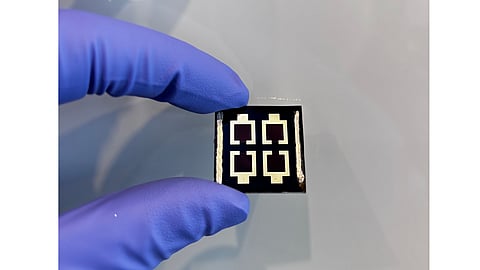


KIER has achieved a certified efficiency of 26.7% for a perovskite-CIGS tandem solar cell
The researchers reduced interfacial damage and unwanted optical absorption within the tandem structure
The team plans to transfer the technology to larger-area modules and explore lightweight terrestrial and space applications
The Korea Institute of Energy Research (KIER) has reported a Fraunhofer Institute for Solar Energy Systems (Fraunhofer ISE)-certified efficiency of 26.7% for a perovskite-CIGS tandem solar cell.
KIER claims the 26.7% result is a world record, surpassing the previous record of 26.3% set in 2025 by researchers from Seoul National University and the Korea Institute of Science and Technology (KIST).
The team developed a tandem device that uses a perovskite top cell and a copper indium gallium selenide (CIGS) bottom cell. However, integrating the two cells may damage the perovskite absorber. Other cell layers may also absorb unwanted light, resulting in optical and photocurrent losses.
To address these issues, KIER researchers analyzed the sources of efficiency loss within the tandem structure. They developed an interfacial layer material and related processing technology to reduce potential damage to the perovskite layer during cell integration.
The team also optimized the structures of the top transparent electrode and charge-transport layer. According to KIER, these changes reduced unwanted light absorption and potential photocurrent loss. The resulting cell achieved an internally measured efficiency of 27%, while Fraunhofer ISE certified it at 26.7%.
The certified result has also been added to the Best Research-Cell Efficiencies Chart maintained by the US National Laboratory of the Rockies (NLR), formerly the National Renewable Energy Laboratory (NREL). The chart tracks the highest confirmed conversion efficiencies across different research-cell technologies.
“This achievement is significant in that both cell efficiency and stability can be enhanced by minimizing potential interfacial and optical losses during the integration of perovskite and CIGS,” said Inyoung Jeong, senior researcher at KIER and leader of the research.
KIER said both materials are suitable for thin-film processing and can be used to produce lightweight, flexible devices. The researchers plan to achieve similar efficiencies in larger-area modules and work with industry partners on mass production, commercialization, and technology transfer.
