
Key takeaways:
Jinchen’s 2 laminator models mainly differ in lamination area, which directly impacts module throughput per cycle
Both systems support large module formats and multi-stack configurations, enabling multiple modules to be processed simultaneously
Lamination is carried out through multi-stage heating and cooling, with cycle times of about 8-10 minutes depending on the process recipe
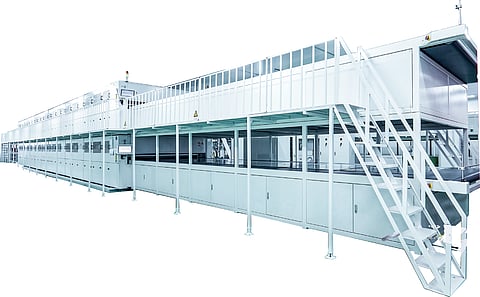
Jinchen, one of the leading laminator suppliers, lists 2 products in the Taiyangnews Market Survey on Solar Module Production Equipment 2026. The company began as a laminator supplier and eventually built expertise in other fields, quickly becoming a one-stop solution provider for module production equipment. For the survey, the company has provided details on 2 products – 2787 and 27115 – that are commercially available since 2020 and 2022, respectively. The key difference between the 2 models is the total lamination area, and therefore, the throughput – the latter, which is the latest, has a higher throughput.
Both are large-area laminators with a total usable lamination area of 2,700 × 8,700 mm for the 2787 model and 2,700 × 11,500 mm for the 27115 model. Both have an optional double-layer or double-stack openings for module inputs.
Each of these models can accommodate a maximum panel size of 2,520 × 1,450 mm. With 182 mm cell-based modules and utilizing both openings of the machine, 2787 can accommodate 14 modules, whereas the 27115 can accommodate 18 modules. Loading is supported by a conveyor belt or a stacked loading, while unloading is supported by a roller conveyor system, in addition to the conveyor belt and stacked unloading. Both machines support a laminate thickness of up to 10 mm and a load of about 50 kg. These machines use oil or electric heating with a minimum heating rate of 1.44°C/ min, and take up to 90 minutes to heat from 20°C to 150°C. The company also offers double-sided heating as an optional feature. They have 2 heating zones. The spec for the temperature uniformity of the metal plates in both cases is an allowed deviation of ±1.5°C. For cooling, both models use either air or water-cooling systems. Both models have a pin-lifting system available on request. An external vacuum system supports the lamination process. The 2787 model measures 47,800 × 4,970 × 3,480 mm and weighs 164 tons, whereas the 27115 model measures 61,370 × 4,970 × 3,480 mm and weighs 214 tons. The longer length of 27115 enables it to accommodate 4 additional modules than 2787.
On the process side, these machines support all kinds of encapsulants, such as EVA, TPO, POE, etc. In addition to glass-glass configuration, they also support glass-backsheet designs. For both of these large-area laminators, the process accommodates 1 or 2 stacks in either a double- or a triple-chamber. The 3-stage process, including evacuation, curing, and cooling, may happen in a 2-chamber or 3-chamber variant. In the dual-chamber variant, evacuation, pre-heating, and curing occur in chamber 1, while cooling occurs in chamber 2. The laminator supports a lamination temperature up to 180°C and pressure as low as -100 kPa. The time from evacuation till cooling is between 8 and 10 minutes for an EVA + POE lamination stack. This implies that the 2787 model can produce 76 modules/h in a 144 half-cell configuration, and 27115 can produce 98 modules/h in the same configuration. Although the gel content of the cured material depends on the encapsulant and the lamination process recipe, Jinchen shared that the degree of cross-linkage for the cured laminate is between 75% and 85%. The mechanical yield and the system uptime for both models are at least 99.9% and 99.5%, respectively. Since both models are large-area laminators, there is no changeover time required to laminate a module of a different size. However, it requires about 10 minutes to change a single silicone membrane after 12,000 cycles of operation.

The text is an edited excerpt from TaiyangNews’ Market Survey on Solar Module Production Equipment 2026, which can be downloaded for free here.
