
Key takeaways:
TÜV Rheinland compared TOPCon and BC modules using LCOE, combining lab measurements, field testing, and long-term system simulations
The BC module showed modest performance advantages in temperature behavior, incident-angle response, and shading losses, contributing to higher lifetime energy yield
Under the study assumptions, BC installation achieved a lower LCOE and higher simulated returns compared to the TOPCon system
Advancements in cell and module technologies, even when commercially available, still need to prove their performance at utility scale, where the ultimate benchmark is the levelized cost of electricity (LCOE). The lower the LCOE of a system, the greater the likelihood of large-scale deployment of that particular cell or module technology.
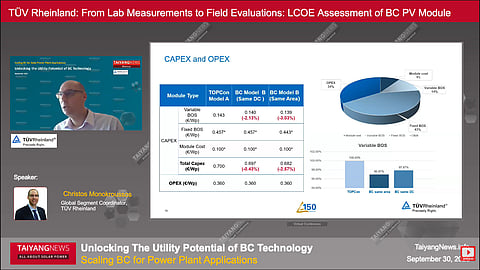
Christos Monokroussos from TÜV Rheinland presented a comparative study evaluating TOPCon and back-contact (BC) modules using LCOE as the main assessment metric at the TaiyangNews Webinar – Unlocking The Utility Potential of BC Technology.
The analysis was carried out as a case study commissioned by LONGi, with the aim of moving beyond simple nameplate comparisons and understanding how module characteristics translate into real project value. He explained why traditional metrics such as $/Wp are often insufficient. Although the upfront cost remains the widely used metric in procurement decisions, it does not consider factors that influence long-term energy yield and project profitability. Parameters such as degradation behavior, temperature response, low-light performance, incident-angle response, and shading losses, which can significantly influence lifetime output, are ignored. LCOE, in contrast, combines CapEx, OpEx, financial assumptions, and total lifetime energy generation to provide a more realistic view of project economics.
The study combined laboratory characterization with outdoor validation. Lab measurements included STC power, temperature coefficients, spectral response, low-light performance, incident angle modifier (IAM), light-induced degradation (LID), and nominal module operating temperature (NMOT). Field testing was used to validate performance under real weather conditions and to estimate first-year degradation. The evaluation consisted of 2 modules: a TOPCon module (Module A) and a BC module (Module B). Both had similar dimensions of 2,384 × 1,134 × 30 mm, but the BC module had higher nameplate power and module efficiency, as was also confirmed by testing.
Temperature coefficient measurements following IEC 60891 showed a small advantage for the BC module, with Pmax temperature coefficients of about -0.27%/°C compared to -0.29%/°C for TOPCon. Although the difference was modest, it contributed slightly to improved energy yield. The incident-angle modifier, measured according to IEC 61853-2, showed a more noticeable difference. At high incidence angles (around 75°), the BC module performed about 5% better. Monokroussos noted that this advantage was likely related to module optics, such as glass and coating design, rather than cell architecture alone.
Outdoor testing also provided NMOT estimates, with the BC module operating roughly 0.5°C below the TOPCon module on average. This was expected to have only a minor effect on energy yield. A more significant difference appeared in shading behavior. Using TÜV Rheinland’s internal shading assessment method and the A-reverse coefficient used in PVsyst modeling, the BC module showed lower shading losses. According to the presentation, this is linked to the electrical behavior of the BC cell design, which allows current to bypass shaded regions more effectively.
A site in Southampton, UK, was selected for the energy yield simulation, using Meteonorm weather data. The location has an annual irradiation of roughly 1,120 kWh/m², with temperatures ranging from -12°C to +36°C. The simulation modeled 3 installation scenarios:
TOPCon system with about 18.5 MWp installed,
BC system with similar installed DC power (~18.6 MWp), and
BC system using the same installation area as the TOPCon case, resulting in higher total installed power due to higher module efficiency.
All scenarios used fixed-tilt mounting facing south at 20°. Energy yield simulations over a 30-year lifetime showed that the BC system produced slightly more energy even at equal DC capacity, with roughly a 1% first-year gain. Over the full lifetime, the difference increased to above 2%. When comparing systems with the same area, the BC configuration achieved more than 5% higher lifetime energy yield due to higher installed capacity.
The main contributors to the performance gap were identified as improved IAM behavior, slightly lower thermal losses, and better shading performance. These gains translated into lower LCOE values for the BC system. Based on the assumptions provided for CapEx and OpEx, the BC module showed an LCOE approximately 3% lower in the same-area scenario. Internal rate of return (IRR) also improved, with differences of roughly 2.5% for equal-power installations and up to about 4.5% for the fixed-area installations.
Monokroussos emphasized that these results should be interpreted carefully. The comparison reflected a specific pair of modules and assumptions, and therefore should not be generalized to all TOPCon or BC products. Module design choices beyond cell technology, including encapsulation, glass, and optical coatings, also play an important role in final system performance.
To access the full presentation video, titled LCOE Assessment of BC PV Module, click here.

