
Key takeaways:
Leadmicro’s edge passivation technology uses a low-temperature ozone-based method that is compatible with multi-cut cells
The company’s PECVD tool targets HJT, BC, and tandem cell manufacturing
The PECVD system supports deposition of a-Si, µc-Si, and SiNx thin films
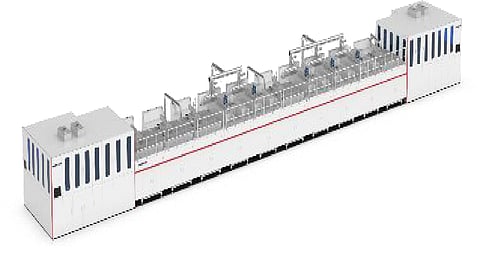
Leadmicro, a leading cell equipment maker that also caters to multiple technologies including TOPCon, back-contact (BC), perovskite, and tandem production, presented two individual pieces of equipment at SNEC 2026: an edge passivation tool and a plasma-enhanced chemical vapor deposition (PECVD) system.
The company’s JingWei Series Tubular Edge Passivation Technology (EPT) is designed for half- and multi-cut cell processing and compatible with different architectures, such as TOPCon, BC, perovskite, and tandem. The platform also supports different sizes and cut specifications without additional equipment modifications. The system can switch to a different product specification within 2 hours. The company states that its production capacity is 20%-50% higher than that of comparable systems.
For passivating the edges, the tool employs a low-temperature ozone process conducted below 200 °C, making it also suitable for emerging silver-coated copper and copper paste metallization.
In addition to the EPT, Leadmicro introduced its ShuoGuang Series plate-type PECVD, designed for HJT, heterojunction BC, hybrid BC, and HJT-perovskite tandem cell manufacturing. The tool can support nano-scale deposition of amorphous silicon (a-Si), microcrystalline silicon (µc-Si), and silicon nitride (SiNx). The company states that the tool uses a unique gas-electric integrated electrode feed-in design to achieve a uniform electric field distribution and improve plasma stability. The showerhead structure is also optimized to mitigate plasma-induced damage to the silicon and the interface. Leadmicro reports a minority-carrier lifetime of about 8 ms after passivation following a double deposition of intrinsic layers.

