

TaiyangNews will host its next virtual conference tomorrow, April 22, 2026, from 09:30 - 13:50 CEST, focusing on silicon-perovskite tandem solar technology.
The session will bring together industry and research stakeholders to discuss recent progress in tandem cell development, key challenges, and pathways toward commercialization. Register for free here.
The panel discussion focused on the gap between Europe’s strong research capabilities and the challenge of translating these into large-scale manufacturing.
Michael Schmela, Managing Director, TaiyangNews, opened the discussion by noting that while Europe remains strong in R&D, regions such as China and, increasingly, India are advancing faster in manufacturing scale and production equipment.
From a manufacturer’s perspective, Skirmantė Balėzentienė from Metsolar emphasized that innovation remains the key differentiator. She pointed out that manufacturers need to innovate faster than they are being copied to stay competitive. While Europe still has a strong technological base and some manufacturing presence, sustaining this position requires continuous and rapid innovation. Özlem Coşkun from Kalyon PV added that research alone is not sufficient; industrial learning, pilot-scale projects, and early production are critical to reduce risks and bridge the gap between lab results and full-scale manufacturing.
On cell manufacturing, Philippe Macé from the Becquerel Institute discussed whether BC technology could help accelerate Europe’s progress. He noted that while TOPCon can support current production, it may not be enough for long-term competitiveness. BC offers advantages in performance and differentiation. However, Europe is likely to rebuild manufacturing starting from modules, with cell production following once scale and market confidence are established.
The discussion also covered tandem technologies. While Europe has strong R&D capabilities, commercialization is still some distance away. Florian Buchholz noted that new technologies typically take several years to move from initial industrial results to bankable production. BC, on the other hand, is seen as a nearer-term opportunity, while tandem is unlikely to reach significant scale within the next 3 to 5 years.
On the supply side, Balėzentienė noted that sourcing BC cells remains more challenging than PERC or TOPCon cells. BC cells are available at a higher cost, require earlier planning, and their supply is not yet as flexible as that of mainstream technologies. She also mentioned that while setting up stringing for BC cells was not particularly difficult, maintaining consistent quality control is more challenging.
Regarding reliability, Buchholz stated that products currently in the market are generally reliable. Some claims around shading advantages are difficult to achieve in practice, and reliability remains an important topic.
The panel also discussed BC's role in the utility-scale segment. Philippe Macé noted that current demand in Europe is mainly driven by residential and C&I applications, with limited presence in utility-scale. However, this could change if bifacial performance improves. Buchholz added that front-side efficiency has a stronger impact on energy yield and noted that BC modules have already reached around 80% bifaciality. It was also suggested that some manufacturers may position BC as a premium product due to limited margins in mainstream modules.
On policy, the panel raised concerns around the Net-Zero Industry Act (NZIA) and the Industrial Accelerator Act (IAA). The delayed implementation and limited scope of these policies could negatively impact European manufacturing.
In conclusion, the panel emphasized the need to build momentum across stakeholders, including the public, policymakers, and R&D institutions, to strengthen domestic manufacturing and move toward greater energy independence in Europe. As Balėzentienė concluded, the industry should aim to 'make back contact great'.
On the policy side, Philippe Macé highlighted that if the Net-Zero Industry Act (NZIA) is effectively implemented across all 27 EU member states, it could create additional demand of around 4-9 GW in the residential segment, 6-9 GW in the C&I segment, and 8-17 GW in the utility-scale market.
However, he also pointed out a gap between policy intent and actual implementation, identifying 4 key challenges. First, the International Procurement Instrument (IPI/IAA) is not limited to the EU market; it may also apply to countries with trade agreements with the EU, which could complicate its application. Second, the solar-related provisions under the IAA are only expected to come into effect from 2030, and their scope is relatively narrow, covering mainly cells and inverters. Third, the mechanisms currently defined by member states remain limited and may not be strong enough to support robust investment decisions. Finally, there is a noticeable gap on the supply side, especially when compared to other regions that have relied on strong supply-side measures such as guarantees, production-linked incentives (PLIs), and similar support schemes.
Philippe Macé, COO at Becquerel Institute, said that Chinese oversupply has pushed solar module spot prices sharply lower across the value chain. He noted that prices have dropped from around $0.20/W to below $0.10/W over the past 2 years, putting sustained pressure on manufacturers. This has resulted in significant cumulative losses, with several leading PV companies reporting losses exceeding $1 billion.
The presentation from Kalyon PV highlighted progress on POLO IBC cell development using p-type industrial wafers. It covered experimental studies across key steps, including texturing, cleaning, and passivation. It also addressed process recipes for compatibility with existing production lines, including the M10 format cell design, pointing toward scalable manufacturing.
According to Özlem Coşkun, R&D Executive – PV Technologies and Applications at Kalyon PV, a key strength of the IBC4EU initiative is its value chain integration. It covers ingot and wafer production, cell processing, and module-level validation. The project also includes digitalization and sustainability aspects. These support the transition of back-contact technologies toward industrial-scale manufacturing.
Metsolar is a custom BIPV manufacturer that has been active since 2015. In 2025 alone, the company has achieved around 42,000 sq.m. of production. Its products are engineered and manufactured in Lithuania, with about 98% of the output exported.
The company’s portfolio includes BIPV solutions for roofs, façades, skylights, and Agri-PV applications. During the presentation, Skirmante Belezentiene introduced several products such as Kovas Tile, Laume Roof, and Skin+ façade, all designed to integrate with building architecture.
These products are developed for ease of installation. For instance, the Laume Roof features a metal backsheet and an integrated frame, allowing it to be directly mounted onto the roof without requiring an additional base structure beneath the modules.
Metsolar's Skirmante Balezentiene presented a BIPV case study comparing BC and PERC modules using M10 cells. The BC-based module delivered 101.6 W, compared to 84 W for the PERC variant under similar conditions. This translates to a 20.59% increase in efficiency at the product level.
The company also noted a ~6% trade-off linked to improved aesthetics, highlighting the balance between design and performance in BIPV applications.
The IBC4EU project, funded by Horizon Europe with a budget of over €17 million, has now completed its 42-month duration. The primary objective of the project was to implement a pilot manufacturing line in collaboration with all project partners.
One of the key findings from the work is that both p-type and n-type wafers show potential for being developed into IBC cells, indicating flexibility in material choice for this architecture.
At the same time, TOPCon has served as the backbone of most recent capacity expansions worldwide. For technologies like TBC, several requirements must be addressed, including reducing metal-induced recombination, achieving high-quality surface passivation, ensuring a low breakdown voltage, minimizing silver consumption, and maintaining industrial feasibility.
Florian Buchholz of ISC Konstanz highlighted silver reduction as a key enabler for back-contact (BC) technology. He showed how conventional silver-based busbars and fingers can be partially replaced with copper. The approach limits the use of silver to critical contact points. Copper takes over the main current transport. This reduces material consumption significantly. The hybrid metallization strategy lowers costs without affecting cell performance. It strengthens the case for scaling BC manufacturing
Michael Schmela, Managing director, TaiyangNews, highlights the latest TOP SOLAR MODULES ranking, showing back-contact (BC) technology at the top of the efficiency table.
AIKO’s ABC module and LONGi’s HIBC module currently lead the list, indicating the efficiency advantage of BC architectures over other mainstream technologies.
The update shows how back-contact designs are not only pushing efficiency boundaries but also shaping the direction of next-generation module development.
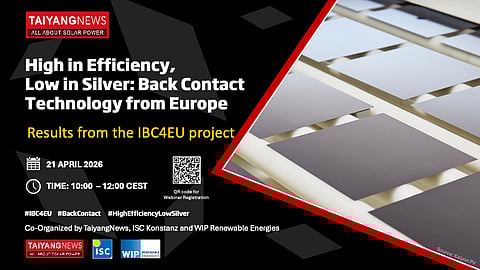
The TaiyangNews session on back-contact technology is now underway. The focus is on improving efficiency while reducing silver usage, a key challenge as the industry scales further.
Today’s session brings together speakers from across Europe’s PV ecosystem, including research institutes and manufacturers.
Experts from ISC Konstanz, Metsolar, Kalyon PV, and the Becquerel Institute will share insights on back-contact technology, covering developments from lab to manufacturing and market outlook.
The discussion will conclude with a panel exploring the future of BC module production in Europe
TaiyangNews is back with another deep-dive session, this time focusing on BC solar technology and its role in driving the next wave of efficiency improvements. The virtual conference explores how European research and industry initiatives are working to reduce silver consumption while pushing cell performance to new levels. From material innovation to metallization strategies, today’s session highlights how BC technology is evolving as a strong contender in the high-efficiency solar landscape.
Stay tuned for live updates throughout the event. Session starts at 10:00 CEST.
