

In his closing remarks, TaiyangNews Managing Director Michael Schmela said that all major solar technologies remain present in the market, with TOPCon currently leading on efficiency and cost. He noted that 25%-efficiency modules will soon be commercially available, while HJT is also advancing with larger 760 W products. He added that IP issues, regional manufacturing ambitions, and renewable energy advantages in regions like Europe and the US will influence future choices. Overall, he said it is too early to declare a single winning technology, with further developments – including tandems – expected in the coming years.
During a panel discussion with TaiyangNews’ Shravan Chunduri, Forschungszentrum Jülich’s Kaining Ding and Huasun Energy’s Christian Comes emphasized the long-term potential of HJT as a competitive mainstream PV technology. Comes noted that while HJT remains a niche today due to limited production capacity, the technology is strong and is expected to achieve meaningful performance gains within the next 2-3 years. Ding said one or two breakthrough innovations could significantly shift the landscape for HJT or BC technologies, adding that current competitiveness is shaped more by political frameworks than by technical limits. He stressed the need to look beyond the noise and recognize HJT’s high growth potential.
Risen Energy’s Po-Chuan Yang described HJT as the 'greenest' solar cell technology, citing its low carbon footprint along with minimal water and electricity use – qualities he said align with future sustainability needs. He noted that after 2026, continued innovation could push HJT bifaciality to about 95% with wafer thicknesses below 110 μm, paving the way for tandem applications. At that stage, HJT module costs would be $0.02/W lower than TOPCon.
3SUN’s Head of Advanced Technology Development, Marina Foti, said the company remains the only GW-scale HJT manufacturer in Europe, noting that while this makes 3SUN unique, it also hopes others will join to build a stronger manufacturing ecosystem in the region. She emphasized that 3SUN has already proven it is possible to produce cells and modules at GW-scale in Europe, and expressed hope that NZIA implementation across EU member states will encourage similar initiatives beyond Italy. The company is also advancing R&D on HJT-perovskite tandem technology.
Huasun Energy’s Christian Comes outlined the key features of the company’s newly announced 760 W G12+ HJT modules, set for mass production in 2026. The modules are designed to deliver up to 24.5% efficiency and support a 2,000 V system voltage. They incorporate several innovations, including anti-migration and light-converting films and butyl rubber encapsulation. Huasun aims to reach 4 GW of Himalaya PLUS 760 HV module capacity by Q4 2026. Comes added that by December 2026, an 800 W HJT module is expected to enter mass production, with further advancements that will widen the efficiency gap with other technologies.
Kaining Ding, Head of PV-ThynC Lab at Forschungszentrum Jülich, says he doesn’t believe HJT is dead as some would like to believe. There may be a limited number of players as of now, but the number is set to rise as even some of the largest solar manufacturers with TOPCon or BC focused production are running HJT in pilot lines. HJT now needs to compete with BC on efficiency and with TOPCon on cost. It has the potential to bring down OpEx and CapEx, he says.
After delving deep into back contact and TOPCon on Days 1, 2, and 3, Day 4 of the TaiyangNews High-Efficiency Solar Technologies 2025 virtual conference is dedicated to another high-efficiency cell technology, heterojunction (HJT). TaiyangNews Head of Technology Shravan Chunduri kickstarts the conference.
Meanwhile, block your dates for February 5 and 6, 2026, for the 2nd edition of the TaiyangNews Solar Technology Conference India (STC.I 2026). After a super successful inaugural edition in April 2025, TaiyangNews will be back with a focus on India's solar PV manufacturing scene, in Aerocity, New Delhi. Registrations will open soon. Watch THIS space!
The event will wrap up with a panel discussion featuring Huasun Energy’s Christian Comes and Forschungszentrum Jülich’s Kaining Ding, who will discuss strategies to generate fresh momentum for HJT with TaiyangNews’ Shravan Chunduri.
Welcome to the final stretch of the 4-day TaiyangNews High Efficiency Solar Technologies 2025 Conference. As the agenda shows, today is all about heterojunction (HJT) with leading industry names in the space coming together virtually to discuss HJT’s current status and the path forward. Last-minute registrations are still open: Register here
The TaiyangNews High-Efficiency Solar Technologies 2025 Conference continues tomorrow, December 10, for its final day. The spotlight will be on heterojunction (HJT) technology. Join us again at 9:30 a.m. CET. See you soon!
Moderated by TaiyangNews Head of Technology Shravan Chunduri, the panel discussion with Alex Barrows, Head of PV at CRU/Exawatt, and Josua Stückelberger, Director of Technology – International Business Unit at LAPLACE, focused on the future of PV technology. Panelists see HJT likely remaining a niche technology, with some manufacturers adopting it mainly for markets outside China. They noted that TOPCon still has room for improvement, particularly in raising efficiency and reducing metallization costs. Regarding future technologies, they suggested that delays in tandem cells could give back-contact more time to advance, though tandem could become mainstream once commercially ready.
CRU/Exawatt Head of PV Alex Barrows said soft demand in China points to a likely market contraction in 2026, with the country’s annual installations expected to fall below 2025 levels, and even 2024 levels, pulling global totals down as well. He noted that module prices should remain low based on fundamentals, though rapid shifts are possible if the Chinese government intervenes. On technology, Barrows said manufacturers are preparing for BC, but new TOPCon products are narrowing the efficiency gap. He added that TOPCon is set to dominate in the near term, as few manufacturers are making major moves toward BC, and transitions historically happen only when higher-efficiency technologies achieve lower integrated cost per watt. Barrows believes BC could approach cost parity with standard TOPCon around 2028-2030.
JTPV's R&D Manager, Xinrui An, outlined the company’s technology upgrades aimed at increasing module power to 650 W and beyond, highlighting advances such as steel-stencil metallization, silver-coated copper on the rear side, multi-cut cells, and new cut line technology. An said the cut line approach, a substitute for Half Edge Passivation, is especially effective for multi-cut cells and can fully repair laser-cut edges.
Josua Stückelberger, Director of Technology – International Business Unit at LAPLACE, explained why the company holds a leading position in TOPCon+ and xBC manufacturing. He said both technologies depend on a stable, uniform SiOx thermal layer and noted that lasers are the most cost-efficient option for patterning localized poly-Si structures. He added that implementing TOPCon+ and xBC requires LPCVD for depositing tunnel SiOx and polysilicon layers. Stückelberger highlighted that LAPLACE has developed advanced laser tools for all key steps and that compatible equipment is already running successfully in production lines.
Tongwei's Aran Huang said the TNC 3.0 multi-cut module uses an overlapped cell layout, as well as Tongwei Passivation Edge (TPE) and Zero Busbar technologies on the cell side, which helped it increase optical efficiency and match the performance of leading back-contact technologies, setting a new benchmark. She noted that TNC 3.0 delivers about 40 W more than standard TOPCon modules and 20 W more than TNC 2.0.
JA Solar Product Manager Djamel Eddine Mansour highlighted the upgraded DeepBlue 5.0 module (670 W, up to 24.8% efficiency, 85% bifaciality), noting improvements across wafer, cell, and module levels. The module integrates 5-in-1 technology that boosts power by over 20 W and raises efficiency by 0.74%. It offers better shading tolerance, enhanced reliability, optimized interconnection and packaging, an ultra-high 749 mV open-circuit voltage, and a low temperature coefficient of -0.26%/°C, with linear degradation of 0.35% per year.
Keynote speaker Peter Fath, CEO of RCT Solutions, says global PV manufacturing costs vary sharply by region due to several key factors. He noted that CapEx for equipment is highest in the US, and building new facilities is particularly expensive in both the US and Europe. India maintains a strong advantage in labor costs, while they are significantly higher in the US and Europe due to wage structures and shift requirements. China, of course, leads with the lowest costs in most categories, which makes it the most cost-competitive.
Day 3 of the event will conclude with an insightful panel discussion on the road to profitable solar PV cell and module manufacturing. TaiyangNews Managing Director Michael Schmela will speak with CRU/Exawatt Head of PV Alex Barrows and LAPLACE Director of Technology – International Business Unit Josua Stückelberger to explore key market dynamics, technology pathways, and strategies manufacturers can adopt to stay competitive. Stay tuned!
After discussing Back Contact on Day 1 (December 3) of the TaiyangNews High-Efficiency Solar Technologies 2025 Conference, Day 2 (December 4) was devoted to TOPCon. Today’s agenda will pick up the thread of TOPCon once again, simply because one day is not enough to dissect the current industry workhorse and what more it has to offer. Today’s presenters include solar PV manufacturers, equipment suppliers, and industry experts. Take a look.
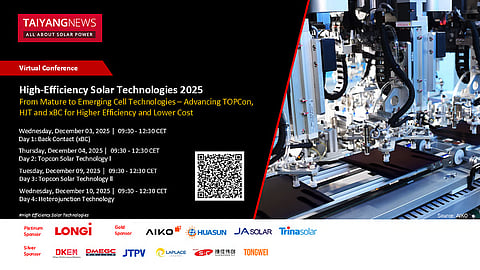
TaiyangNews is back with 2 more days of extensive discussions with the industry leaders on the present and future of solar PV technology as part of our annual flagship High-Efficiency Solar Technologies 2025 Virtual Conference. Registrations are still open, and they are free here: https://taiyangnews.info/our-events/dec-3rd4th-and-dec-9th10th-high-efficiency-solar-technologies-2…
Homer Chen, the Associate Dean of Research Institute, Shenzhen S.C New Energy, bats for TOPCon as he sees this cell technology being a major trend for the next 10 years, even as the company also caters to HJT and perovskite customers globally. He believes TOPCon provides the lowest cost of ownership (CoO) at 2 cents/W, compared to HJT (2.8 cents/W) and XBC (2.6 cents/W). It also delivers the fastest return on investment, within 2-3 years, compared to around 5 years for HJT.
With this, we wrap up Day 2 of the TaiyangNews High-Efficiency Solar Technologies 2025 Conference. The conversation around TOPCon, however, will continue on Day 3, December 9, 2025, as we are joined by industry leaders and experts to understand more about the industry’s current hot favorite solar cell technology.
TOPCon still has room for meaningful efficiency gains before reaching its theoretical limit, giving the technology several strong years ahead as the industry’s mainstream choice. This shared view came from Fraunhofer ISE’s Jochen Rentsch, S.C New Energy’s Homer Chen, and DKEM’s Fangqing Guo during the panel discussion with TaiyangNews’ Shravan Chunduri. They stress that TOPCon is robust enough for manufacturers to shift directly from TOPCon to tandem cells, without first adopting back-contact architectures.
DKEM’s Director of New Technology Development, Fangqing Guo, outlined the company’s latest high-efficiency, cost-effective metallization pastes designed for next-generation TOPCon 3.0 cells. Using a laser-enhanced firing approach, DKEM continues to improve front and rear finger contact resistivity (ρc) and recombination performance (J0,m), ensuring compatibility with advanced cell architectures and enabling mass production. The company also provides a range of silver-lean and silver-free metallization options tailored to different efficiency and cost needs, supporting the PV sector’s long-term sustainability.
Roy Ren, Solar Cell Technology Director at DMEGC Solar, outlined the company’s various technology solutions for optimizing TOPCon cells. While he discussed a long list of optimization opportunities, the Defect Elimination Technology (DET) is somewhat special. Although it follows the trails of edge passivation, Roy emphasizes that the repair of the defects at the cut edges is much more intensive.
Trinasolar Product Manager Ling Zhuang outlines how TOPCon 2.0 boosts energy yield through i-TOPCon Ultra technology, higher bifaciality, and better low-irradiance response. The design delivers 1.7% more backside power and 7% higher output than xBC in low light. Citing case studies, she shares that in ground-mounted installations, both BC and TOPCon modules show similar shading losses in real field conditions.
NexWafe’s Co-Founder and SVP of Business Development, Frank Siebke, highlighted the company’s epitaxial wafers made with a direct gas-to-wafer process that eliminates 6 conventional production steps. He said the wafers have 20-40× lower oxygen content than Cz wafers. NexWafe aims for mass production in early 2027 and is positioning its 50 MW Bitterfeld facility to supply thin p-type wafers for high-margin space applications.
TOPCon is now the dominant solar cell technology, delivering 25-26% mass-production efficiency and a 27.79% record. Passivated contacts, the basis of TOPCon, originated in the 1980s and were first industrialized in SunPower’s Gen III IBC cells. Fraunhofer ISE christened it as TOPCon in 2013, with Jolywood and First Solar beginning industrial production soon after. The 2019 LECO breakthrough enabled modern TOPCon, followed by mass scaling from 2020-22. As silicon nears its practical limit, future gains will come from >30% perovskite-silicon tandems, with hybrid routes most promising, said Keynote speaker Fraunhofer ISE Head of Technology Transfer Jochen Rentsch.
TaiyangNews Head of Technology Shravan Chunduri kickstarts Day 2 of the High-Efficiency Solar Technologies 2025 Conference, providing a recap of Back Contact technology presentations from Day 1. With that, we head to Day 2 presentations.
Esteemed speakers from Fraunhofer ISE, Shenzhen S.C New Energy, and DKEM are on board to discuss what’s next for TOPCon solar technology as panelists today. Not to be missed!
Day 2 is devoted to the current industry workhorse TOPCon. Starting with Fraunhofer ISE tracing the origins of this technology that replaced PERC in record time, we have a range of presenters from leading solar PV companies in manufacturing and equipment supplies to show what’s latest in the space.
And we are back! TaiyangNews is happy to host Day 2 of our annual flagship event, High-Efficiency Solar Technologies Conference 2025. The virtual conference starts at 9:30 a.m. CET. In case you haven’t registered yet, click this link for free last-minute registrations.
Leadmicro CTO Jerry Liao outlined recent advancements from TOPCon to TBC solutions, highlighting 3 main process routes – LPCVD, hybrid LPCVD + PECVD, and the new PECVD route – alongside evolving TBC equipment options. Leadmicro’s TBC equipment solutions include ALD, which helps improve capacity by about 50%, and the LPCVD route that now delivers about 40% capacity gains. The new PECVD process shows roughly 20% higher capacity and improved uniformity. Additional upgrades come from edge passivation and laser steps. TBC equipment investment intensity has fallen from about RMB 350 M/GW to ~230 M/GW.
We’d be back with Day 2 of the TaiyangNews High-Efficiency Solar Technologies Virtual Conference on December 4, 2025, to discuss TOPCon solar cell technology. Expect an interesting lineup of speakers from Fraunhofer ISE, NexWafe, Trina solar, DMEGC Solar, Shenzhen S.C New Energy, DKEM, along with a panel discussion. Stay tuned!
In a fireside chat with TaiyangNews Head of Technology Shravan Chunduri, Leadmicro CTO Jerry Liao said that among the main challenges for back contact to become a mainstream technology are higher costs and penetrating the utility-scale segment. He nevertheless expects its market share to increase, but at a slower pace than witnessed for PERC to TOPCon.
AIKO says its ABC modules now achieve over 80% bifaciality thanks to reduced finger width, thinner n-poly layers, ultra-small structures, and ZBB design. Guillermo Estébanez claims the modules deliver higher energy yield at the same installed capacity, cut BOS costs by 1.1 cent/W, and lower LCOE by 5.77%.
AIKO’s Senior Product Solution Manager, Guillermo Estébanez, presented the company’s All Back Contact (ABC) modules for residential, utility-scale, and C&I segments, with a power output ranging from 480-490 W to 770-805 W, claiming around 30 W more yield than conventional panels.
LONGi’s Product Marketing Manager Dante Zeng traced the growth of BC technology, saying it has leapfrogged through structural revolution and extreme efficiency. LONGi, he shared, equips its BC modules with a 4-layer protection system to improve crack resistance, including the TaiRay wafer, high wafer thickness, one-line welding, and high-quality grammage adhesive film.
Chinese manufacturers are not adding many new factories as of now, but instead boosting output with higher-efficiency technologies. In his keynote, ISC Konstanz’s Radovan Kopecek said this is where BC technology will play a key role. If China commits to BC, the market transition could accelerate rapidly, he added.
ISC Konstanz Co-Founder & Director Radovan Kopecek says solar is expected to dominate future power systems, with PV-plus-storage eliminating the nuclear lobby’s arguments about intermittency. Average BC efficiencies are likely to reach about 25.5% within 5 to 6 years. TOPCon may be leading now, but the future will belong to BC and tandem.
Shravan Chunduri outlined new insights from the TaiyangNews TOP SOLAR MODULES Listing, which includes only commercially available modules with efficiencies of at least 21.5%. BC technology continues to dominate the efficiency charts. AIKO holds the top position, increasing module efficiency from 22.8% in 2023 to 24.4% by September 2025 – a 1.6% jump. While BC remains the clear leader, the number of BC manufacturers is still limited to 4, though this is expected to expand as adoption grows, he added.
TaiyangNews Head of Technology Shravan Chunduri opens the 4-day High-Efficiency Solar Technologies Conference 2025, noting that today’s solar landscape is defined by 3 leading commercial technologies. With rising interest in back-contact (BC), Day 1 is dedicated to BC research, manufacturers, and equipment suppliers
Today’s sessions will end with Leadmicro CTO Jerry Liao engaging in a fireside chat with TaiyangNews Head of Technology Shravan Chunduri, as they deliberate on what’s needed to turn Back Contact into the next mainstream technology. Don’t miss it!
A short agenda for Day 1, but expect insightful presentations from leading industry names and experts advancing Back Contact technology. We’ll be joined by ISC Konstanz, LONGi, AIKO, and Leadmicro to discuss the various advantages that Back Contact brings to the table.
Welcome to TaiyangNews High-Efficiency Solar Technologies 2025 Conference, our annual flagship event that’s spread across 4 days and various technologies. Over the course of this conference, Team TaiyangNews will share real-time updates from the event in this LIVE BLOG, starting TODAY, 9:30 a.m. CET.
