
- Markets
- Business
- People
- Opinion
- Technology
- Storage+
- Reports
- Our Events
- Tenders
- Price Index
- Top Modules
- ServicesServices
- AnalysisAnalysis
TaiyangNews is back with its 2nd edition of the Solar Technology Conference India (STC.I) 2026, once again bringing together the who’s who of the Indian solar PV manufacturing industry along with international solar stakeholders interested in this burgeoning market.

If you missed our weeks of incessant emails, calls and social media pings to apprise you of the STC.I 2026 conference, here’s your last chance to still make it if you aren’t already registered. If you are in the vicinity of Aerocity, New Delhi, you can head straight to our registration desk at Pride Plaza Hotel and we’d check you in!
Team TaiyangNews set up base at the venue yesterday, brainstorming, dealing with last-minute hiccups, celebrating a colleague’s birthday, attending to calls from vendors, attendees, speakers, and fine tuning every detail to ensure a smooth and impactful conference experience over the 2 days.
STC.I 2026 will be a high-level gathering of technologists, manufacturing specialists, R&D experts, suppliers, and market enablers from the policy field, as they brainstorm about India building a globally competitive, high-performance PV production. Leading equipment makers from China, India, and Europe will be here as well.
Time for a quick hello and exchanging visiting cards before taking a seat in the conference room. This is what is always great to see at STC.I – the conference is a meeting point for global solar PV industry colleagues, for networking, getting to know each other, and building bonds to grow together as a strong PV industry.
TaiyangNews Managing Director Michael Schmela opens the STC.I 2026 to welcome everyone. He takes the opportunity to launch the latest TaiyangNews Market Survey Report on Solar Module Production Equipment 2026.
Kicking off the conference, keynote speaker Peter Fath, Founder and CEO of RCT Solutions GmbH, begins by thanking the Indian manufacturers for their resilience and bravery. He calls India the hope and the powerhouse of the world. And solar is an opportunity no one wants to miss. He projects India to become the 2nd largest solar PV manufacturing hub in the world as it will grow from 80 GW annual module capacity in 2025 to 160 GW by 2030, when cell, wafer, and polysilicon capacities will expand to 120 GW, 100 GW, and 100 GW, respectively.
Although TOPCon is widely considered the workhorse at present, RCT Solutions Founder & CEO Peter Fath urged Indian PV manufacturers to reserve some space in their factories for the upcoming cell technology – Back Contact. Those with money and resources must also make space for a small laboratory to explore perovskite tandem technologies and generate their own IP. He also stressed that India should make more glass and cables, as it gets the opportunity to reshape the global clean energy clean tech value chain, especially in the wake of the EU-India 'Mother of All Deals' and the US lowering its tariffs
Let us leverage the EU-India Free Trade Agreement, the Mother of All Deals, to make solar PV production equipment ourselves, stressed National Solar Energy Federation of India (NSEFI) CEO Subrahmanyam Pulipaka. Let us also invest in technology R&D in collaboration with European partners.
India has around 144 GW of cumulative installed solar module manufacturing capacity, even though power installations don’t match this scale. TERI Director, Electricity & Renewables, Alekhya Datta, and TERI Associate Researcher, Aniket Tiwari, recommend that Indian manufacturers diversify into markets beyond the US alone to utilize this capacity. Furthermore, vertical integration is nowhere near the module capacity as of now, as India continues to depend on imports. Various policy-driven steps (PLI, ALMM, BCD, etc.) have helped, but they were designed for scale, not to build an ecosystem, which is now required to build a competitive scale.
Group CTO Waaree Group Mahesh Murthy calls for ALMM List-III for solar wafer compliance deadline to be advanced from June 2028 to June 2027, while also recommending strengthening of ALMM enforcement and compliance monitoring. Murthy stressed the need for the government to create more demand for Make in India DCR modules to enable the Indian solar PV manufacturing industry to thrive and contribute to India’s growth.
By 2047, India’s cumulative solar waste would increase to 11 million tonnes. CEEW Programme Associate Ajinkya Kale says this presents an opportunity for the country to enhance energy security, attract investments, and create new jobs. Right now, module recycling is financially unviable due to high operating costs. However, if manufacturers provide waste solar modules to recyclers at no cost, mechanical recycling would generate a revenue of INR 17,000 per tonne, and chemical recycling INR 15,000 per tonne.
Debajyoti Sarangi, a Private Consultant, shared insights into common quality risks (LID, LETID, PID) related to module performance and the influence of BOM on quality. Additionally, he points to power deviation from the nameplate and the real-time figures that need to be addressed.
A policy panel moderated by TaiyangNews Managing Director Michael Schmela, along with Shubhang Parekh, Assistant Director (Strategy, Manufacturing & PR) at NSEFI, discussed India’s strategy for achieving solar PV manufacturing autonomy. CEEW Fellow Rishabh Jain stressed the need to build upstream capabilities and collaboration between Indian academic institutions and global technology centers to develop talent. Landsmill Group CEO Sandeep Garg said solar autonomy must extend into the grid, noting that overcapacity can be positive if risks are managed. NISE Deputy Director General Jai Prakash highlighted India’s climate commitments of 500 GW of renewable energy and 292 GW of solar by 2030, adding that all the government’s efforts are aimed at supporting the achievement of these aims. Panelists agreed that long-term policy consistency and strategic guardrails are essential to the continued growth of the industry.
COO of Navitas Solar, Vijay Menon presented perspectives of the buyer and the manufacturer side of PV and discussed that Navitas offers as solutions. The common trends being upstream quality control, strong equipment integration, digitization, in-house reliability, and vertical integration. He also shed some light on the common problems with the practices on the installation sites, that lead to poor performance of the overall system. He shared how Navitas solar implements these trends for to fulfil the quality standards in processes and products.
Manu Gaurang, CEO of Mondragon Assembly India, discussed the Spanish manufacturer’s production equipment tools, especially for the ‘flavor of the season’ – back contact, including Laboratory Stringer, and BC Stringer developed within EU-funded SEAMLESS, upgradable from TOPCon. Mondragon is also offering PV circularity solutions now, namely the disassembly unit, glass recovery unit, and reusing the equipment.
Dronveer Kaura, the Sales Director of India for Hangzhou ConfirmWare Technology, presented the Chinese PV equipment manufacturer’s turnkey solutions for high-efficiency solar module manufacturing. Kaura specifically highlighted the 1.2 GW PV module production line as a turnkey solution with a capacity o f2,300 to 3,000 modules/shift. He touted that the equipment has a high compatibility with high and next-generation technologies such as TOPCon, XBC, HJT, and 0BB.
Purushothama A, Senior Technical Manager at TÜV Rheinland, showcased various PV module testing standards developed by the company. These standards cover environmental, general inspection, electrical shock hazard, fire hazard, and mechanical stress. The test flow for all these standards were also presented along with the process specifications and test conditions. He also presented test results and trends comparing PERC, TOPCon, HJT, and BC for various test types. In addition to the above, TÜV Rheinland also offers extended bankability certifications, which rate the modules with scores ranging from AAA, AA, and A. Towards the end, the presentation also demonstrated examples of common issues with various installation faults that are often overlooked but pose serious fire and electrical hazards.
Frank Tannhäuser, Senior Sales Manager at Kontron, said the company offers Manufacturing-Execution-Systems (MES) solutions across the full PV value chain – from ingot and wafer to cell and module manufacturing – covering end-to-end automation in module production with complete material tracking, process, and equipment data acquisition. He added that Kontron’s MES supports inspection, rework, grading, and ERP integration to improve transparency, quality, and production control. Integrating Vision AI with MES enhances its capabilities.
Autowell Overseas Sales Director Senthil Raj presented the lineup of PV manufacturing tools from the leading Chinese manufacturing equipment supplier, covering ingots through modules. Raj also claimed to hold a significant market share in India, where he sees further interest
Parth Bhatt, Senior Engineer from the Solar Technology team at DNV, provided a detailed understanding of what Technical Bankability is and how the reliability of long-term performance predictions and models is assessed. He addressed the shortcomings of accelerated tests or how other assessments, such as NASA's TRL or TPL, however robust, cannot be applicable to renewables and do not address the technical bankability. He presented DNV's Technical Bankability Level (TBL), which is based on 6 core pillars of technology evaluation, such as reliability and high accelerated lifetime test (HALT), IQC, IPQC, equipment management, safety & toxicity, and energy prediction & modeling. He also applied the TBL to PERC, TOPCon, and HJT modules and presented the rankings derived from this assessment.
Margaux Plurien of the Solar Stewardship Initiative defined quality in today's terms as a combination of performance, transparency, consistency, and credibility across sites and suppliers. She emphasized how evidence-based assurance is essential for bankability, as due diligence is shifting from self-reporting to regulatory enforcement. She highlighted that, in addition to product certification, process- & site-level assurance and supply chain traceability add to the bankability of the modules and their access to market, especially amid increasing regulatory policies.
ISC Konstanz has one message: BC will become the emperor of energy markets after 2028. He highlighted ISC's cooperation with Solex in India for BC manufacturing. Showcasing ISC's new product, a BC module for space, The Phoenix (ISC's ZEBRA version for space), he spoke about the self-healing properties of this module in space. Kopecek presented how BC followed its roadmap and became bifacial-capable to some extent, also adding to the simplicity of the process, especially when using copper paste/plating. He also highlighted key advantages of BC over TOPCon: cell and module efficiency, comparable bifaciality and COO, and a potential low LCOE of less than 1 ct/kWh. Kopecek noted that ISC's BC technology will not have any IP conflicts for manufacturing.
ISC Konstanz's Raphael Shanmugam presented gapless BC modules, achieved by overlapping cells within a string and then overlapping strings within a module. ISC produced full modules using copper metallization, as it is currently researching lamination interconnection, which occurs in the lamination step. This is carried out by using a tape carrying ribbons and low temperature soldering. It uses a different ribbon handling tool than what the mainstream CTS uses to achieve this. He also spoke about the possibilities to achieve this type of stringing at scale requiring only minor adjustments to the software at stringing and process parameters at the lamination steps
Bhupendra Singh Rawat, the CEO of India’s ‘largest component manufacturer’, DhaSh PV Technologies, claims the company has 63 GW of solar junction box capacity. Referring to the policy-driven scale-up environment for the solar PV industry where module capacity is reported to have reached around 144 GW, Rawat calls for similar support for the ancillary industry. He said the government should consider introducing an Approved List of Ancillary Manufacturers (ALAM) and also a minimum 20% BCD for solar junction boxes.
Mohammad Asif Patel, AVP Sales & Marketing, DhaSh PV Technologies, discussed the crucial role of junction boxes in safe, reliable, and long-term optimum module performance. In the event of failure, it directly degrades module performance and can make the system a fire hazard. Keeping this in mind, Patel shared that DhaSh ensures safety with its junction boxes by adopting innovative technologies. It is now also offering composite frames, targeting the emerging PV application of floating solar in India.
Jerry Liao, CTO of Leadmicro, began by highlighting a trend indicating potential for BC to increase its market share in the future. He presented several routes, using PE, LP, and PE + LP, to upgrade existing TOPCon lines to TOPCon BC (TBC) compatibility. Sharing progress on PECVD, ALD, EPD & laser processes, Liao also highlighted a new PECVD route for TBC that deposits tunnel oxide and poly through PE, with an additional annealing step. Turnkey solutions for TBC will most likely be available this year, said Liao.
A rockstar Executive Panel on choosing the right strategy for Solar Manufacturing in India, moderated by TaiyangNews MD Michael Schmela and RCT Solutions Founder & CEO Peter Fath, had the senior executives from leading solar PV manufacturers: Grew Energy COO Hardip Singh; Indosol Solar COO Balachander Krishnan; Premier Energies Limited Chief Strategy Officer Sudhir M Reddy; Reliance New Energy CTO Omkar Jani; and Emmvee CMO Narayanaswamy Devendiran.
Panelists agreed that large-scale, vertically integrated manufacturing is essential to remain competitive, as it provides control over the BOM. As India ramps up capacity, strong R&D is a must to differentiate. While cell and module capacity are expanding rapidly, speakers flagged gaps in equipment manufacturing, skilled talent, and short-term cell availability, stressing the need for continued policy support and long-term demand visibility to compete with China and expand exports.
What better way to start another day of new dialogues and insightful talks than with an energising cup of coffee. Thanks halm!
Welcome! After a super Day 1 full of amazing discussions, Team TaiyangNews is all set to welcome all solar PV industry colleagues and stakeholders to Day 2 of STC.I 2026. Stay tuned for all the action today!
TaiyangNews Head of Technology Shravan Chunduri opens Day 2 of STC.I 2026 in New Delhi, sharing the agenda and what to expect on the final day of the 2-day conference
PERC (14.17 GW) and TOPCon (11.08 GW) remain the high-efficiency cell technologies in operation in India, along with 3.4 GW of CdTe, but no HJT to date. However, the government is nudging the domestic industry towards higher-efficiency products, said Jai Prakash Singh, Deputy Director General of the National Institute of Solar Energy (NISE). For ALMM enlistment, MNRE has mandated at least 20% efficiency for the utility-scale segment for c-Si and 19% for CdTe thin-film modules. By January 2027, the cut-off efficiency is proposed to rise to 21%, and to 21.5% by January 2028, in a bid to phase out obsolete technologies, he shared. The government is also collaborating with research institutes and international R&D institutions/technology centers to prepare a skilled workforce to support the industry’s growth.
Abhyuday Tewari from S&P Global noted that the renewables share of generation remains low despite increased capacity. He discussed the drivers and preferences of offtakers in purchasing new capacity. Tewari also discussed renewable energy curtailment, with solar being curtailed the most at about 8%-10% in 2025. On the other hand, 5 GW of coal capacity is set to be added annually starting in 2026 to cater to the increase in overall energy demand.
Dinesh Kabra, the Forbes Marshall Chair Professor for Energy Science & Engineering, Department of Physics, IIT Bombay, shared the latest updates from the institute’s R&D work on the development of perovskites for tandem solar cell technology. It is now progressing the development of space-grade PV solution via Si-PVSK tandem cell technology (10 × 10 cm) with a power conversion efficiency >30% within 12-18 months. Another target is to develop M10/G12 half-cut cells with PCE >30% over the next 24-30 months. It is also setting up a 20 MW R&D pilot line solution over the next 36 months.
Sureet Singh from Wood Mackenzie discussed Indian manufacturers' reliance on Chinese polysilicon, which is likely to continue until they resume exporting to the US. He stated that China is also pushing to reduce its carbon footprint, highlighting GCL's granular Si, which is less energy-intensive and has a lower carbon footprint. Chinese manufacturers increasing prices, Indian manufacturers doing the opposite, and EU countries – like Italy – banning Chinese equipment are all creating opportunities for Indian manufacturers.
Selvaraj Venkataraj, Senior Scientist at SERIS, believes upgrading single-junction silicon solar cells to tandem cells using a low-cost perovskite top cell is presently the most realistic option to achieve 30% efficiency industrial PV modules at low cost. SERIS has developed M2-size (244 cm²) tandem cells with HJT bottom cells and achieved 24.1% (measured in-house) 2T efficiency. It now targets to achieve > 28% efficiency in 2026.
Rajan Kalsotra of EUPD Research outlined the current state of Indian PV manufacturing and how it is still linked to Chinese manufacturing, particularly upstream. He discussed the capacity growth projections and the potential boost in exports to the US. For the US market, Kalsotra compared Indian-made modules with Southeast Asian ones, explaining that Indian products are priced higher due to recent tariffs. He also analyzed the scope of Indian module exports to the EU and explained how they are better than Chinese modules in terms of carbon emissions. He presented the benefits for the Indian solar industry in light of the recent India-EU trade agreement. Finally, Kalsotra outlined the priorities for achieving manufacturing competitiveness in India's solar industry
ISC Konstanz Co-Founder and Director Radovan Kopecek sees potential in tandem solar technology and its commercial prospects, but he cautions against promising too much too soon, as it may not become a mass-produced technology anytime soon. He bats for Back Contact as a strong contender to take over the market for high-efficiency technologies in the future, even for tandem configurations.
Leadmicro CTO Jerry Liao shared the company’s TOPCon 4.0 equipment solutions with rear poly-finger and edge passivation and stressed the excellent compatibility of its tools with TOPCon/Poly Finger/TBC, Half, 1/3, 1/4 Cells, in M10, G12R, and G12 formats. In the near future, Leadmicro targets zero-wraparound technology for EPD on 1/3, 1/4-cut cells.
Solamet Senior Technical Engineer Daniel Lim discussed metallization paste requirements for advanced TOPCon emerging technologies, with a focus on silver-coated copper solutions. Solamet’s PV43A Ag/Cu Paste, he shared, is compatible with 100% open stencil screens. It comes at a lower cost, while offering high efficiency and reliability. External testing demonstrates comparable efficiency for 20-30% Ag-content PV43A vs. standard TOPCon metallization.
Ravinder Bhardwaj, VP Sales & Business Development at NMTronics India Pvt. Ltd., talked about high-precision laser processing equipment from China-based DR Laser Technology Corp. Its solutions for TOPCon polyfingers are available for both LPCVD and PECVD-based production processes with more or less similar bifaciality in both cases. Calling back contact the ultimate architecture of high-efficiency c-Si solar cell, thanks to its higher VOC and lower shading loss, DR Laser is also rolling out laser processing equipment for XBC.
Solar module testing and simulator company WAVELABS Eternal Sun GmbH's Director, Samuel Raj, said the company's LED Flasher performance consistently provides reliability, precision, and ROI advantages. There is no degradation in the special lens system, as uniformity classification remains valid for several years. Its tools, as Raj claimed, are also compatible with tandem and BC technologies.
The lion’s share of solar PV manufacturing capacity is located in China. The Xinjiang region alone produces 50% of the world’s polysilicon. This is primarily due to the abundant availability of electricity at as low as $0.02/kWh. China may dominate upstream today, but it faces structural gaps and geopolitical risks. India, with its competitive energy pricing and policy support, has a strong window of opportunity if it can match these factors with disciplined project execution and ramp-up control, said RCT Solutions Director of Technology Dr. Wolfgang Jooß.
India has the potential to become the region’s first large-scale polysilicon supplier, outside China, given its strategic location for global markets and competitive energy costs. Indian producers can bank on initial interest from leading Asian, American, and EU manufacturers, noted Dhruvit Lathiya, Chemical Engineer & Project Manager at Silicon Products Technologies GmbH. Polysilicon production will be viable and competitive in India. He recommends that the country look at >25,000 t/year of high-quality polysilicon capacity to maximize scaling effects, but with expert help to ensure the success of this capital-intensive investment.
Once India’s entire value chain is developed domestically, module cash costs can fall to $0.063/W, and the LCOE can reach 0.01/kWh, with 250 GW of capacity. For this, vertical integration at scale is crucial, stressed Milind S. Kulkarni, Chairman & CEO of RSOLEC, while arguing for a crystal-clear polysilicon, crystal growth, and wafering roadmap for the country. A thorough understanding of the processes is crucial. It is necessary to work with the right engineers and technology suppliers.
He also stressed that it will take 7-8 years for an Indian company to become competitive with China in polysilicon and crystal growth. But over this period, it can always differentiate itself from other Indian players by indigenizing the relevant supply chain within 3 years by developing design capabilities.
Zhixin Li, CEO & CTO of Linton Technologies Group & Linton Crystal Technologies, said integrated PV ingot and wafer lines at scale are what India needs now. For this, manufacturers should factor in key factors such as power requirements, consumption, and manpower, among others. For instance, a 10 GW annual ingot-wafer production capacity requires 75,000 kW of power, or 505,000,000 kWh/year of power consumption, and over 600 personnel. He stressed that integrated PV ingot and wafer lines enhance automation and productivity.
UHP Technologies MD Manjunath Jyothinagara stressed the need for solar PV manufacturers to have a reliable local value-chain partner, calling local support extremely crucial for operating and managing capital-intensive projects. A local team ensures there is a single point of contact, quick resolution, and accountability for peace of mind.
TOPCon will forecast to be the dominant technology for at least till the end of this decade, said S.C. New Energy Associate Dean of Research Institute, Homer Chen. Therefore it makes sense for Indian manufacturers to continue investing in TOPCon for which his company, added Chen, provides in-house peripheral tools for boat cleaning and recycling to extend their lifetime, in addition to providing complete TOPCon production line. He also discussed R&D innovations in maximizing mass production for solar PV cell line.
Rapid technological evolution, dependence on imported raw materials, limited manufacturing equipment and upstream manufacturing capacity, a shortage of skilled talent, and high logistics costs are among the challenges Indian solar cell manufacturers currently face. Jakson Solar's Vice President - Technology & Innovation (Solar Modules & Cells), Vikas Arya, said that the company is determined to overcome these challenges as it ventures into GW-scale cell manufacturing.
Damian Brunner, Senior R&D Manager Solar & Battery at RENA Technologies, said that Indian manufacturers entering or scaling up TOPCon production lines must prioritize quality above all else to ensure a competitive and sustainable product rollout. He outlined the path to smooth scaling of TOPCon production, noting that RENA offers wet-processing solutions – from wafer to cell. He especially discussed the benefits of smart cleaning with ozone, claiming it reduces OpEx as well as waste.
Supplying PV ribbon solutions for various module applications to leading Chinese manufacturers, YourBuddy’s After-sales Service Engineer Rajesh Sharma described the benefits of copper PV ribbon vis-à-vis conventional PV ribbons for zero busbar-based metallization.
Peter Fath RCT Solutions CEO urged India to deliver cells at a competitive level for the world to secure a supply destination beyond a single dominating market which today is China. He added in his closing remarks, “This should be the year of India.”
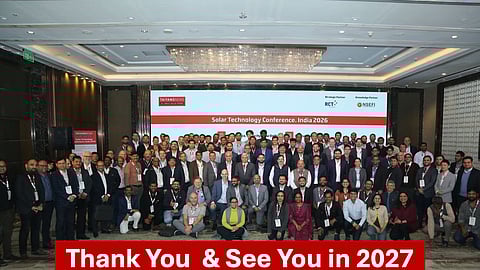
TaiyangNews Managing Director Michael Schmela thanked all sponsors, presenters, speakers, and attendees for making the 2nd edition of STC.I another successful endeavor. “We are already planning the 3rd edition,” he promised.
Team TaiyangNews expresses heartfelt gratitude to everyone who contributed to making the 2nd edition of STC.I 2026 insightful and memorable — from our speakers, partners, sponsors to attendees and supporters who brought the energy, ideas, and great conversations that made it all come alive. See you at the next one!
