
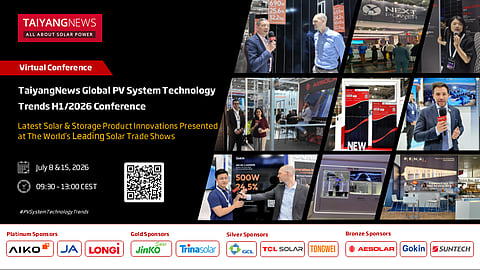

Thank you for joining us for the TaiyangNews Global PV System Technology Trends H1/2026 Conference. We hope you found the discussions and product insights valuable. We look forward to welcoming you next month for the TaiyangNews Cell & Module Production Equipment and Processing Materials Conference on August 25, where industry experts will discuss the latest developments in PV manufacturing equipment and processing materials.
Moderated by Shravan Chunduri, the panel discussion brought together experts from CRU, Trinasolar, AESOLAR, and TCL Solar. Looking into the biggest technology and market trends at SNEC and Intersolar Europe 2026, the panel identifies energy storage, TOPCon 3.0, the emergence of BC technology, and application-specific modules as the key trends. CRU’s Alex Barrows noted that while TOPCon 3.0 is likely to become the mainstream technology over the next few years, BC and advanced metallization have strong prospects.
Discussing future technology development, the panel highlighted that TOPCon and BC still have room for incremental improvements, while tandem technology is expected to deliver the next major efficiency breakthrough. A recurring theme throughout the discussion was that 'the power doesn't matter; energy matters'. Future customer value will be driven by real-world performance, reliability, and levelized cost of electricity (LCOE) rather than by module power alone. Trinasolar's Adele Zhao said the industry should move from a 'mass-production industry' to a 'value-driven industry', focusing on maximizing customer revenue instead of simply increasing module wattage.
The panel also touched on the growing importance of application- and climate-specific solutions. Hamed Hanifi distinguished climate-specific modules, such as desert modules, from application-oriented products, while Xiao Geng said manufacturers are increasingly customizing modules to meet different customer and project requirements.
Yang presented Risen's Hyper-ion Pro HJT module for utility-scale applications. The module delivers 720-745 W of power with up to 24.0% module efficiency. It features 90±5% bifaciality and a -0.24%/°C power temperature coefficient. It is backed by a 15-year product warranty.
Pochuan Yang, Vice President and CTO of Risen Energy, said the company has achieved mass production of 100-110 µm HJT silicon wafers, resulting in a cell thickness of about 95 µm. He added that Risen also has the capability to develop sub-70 µm ultra-thin solar cells.
Concluding his presentation at the TaiyangNews Conference, Hanifi said that cell technology alone is not sufficient to improve PV performance under shaded conditions. While BC cells perform better than TOPCon under shading, he said module design has a greater influence on shade tolerance than cell technology itself. He concluded by emphasizing that customers ultimately value energy generation rather than only module power ratings.
Hamed Hanifi, Director of Technology and Innovation at AESOLAR, explains the features of the company's ShadeStar, a residential module designed to improve performance under partial shading. The full-black module features a patented segmented cell design with integrated bypass diodes. Built with G12 format and 80 half-cut cells, the module is available in power classes ranging from 420 W to 440 W, with efficiency reaching 22.04%. The module is backed by 30-year product and performance warranties.
TCL Solar's latest BC module portfolio includes utility-scale G12R bifacial modules with power ratings ranging from 650 W to 680 W, up to 25.2% module efficiency, and 75±5% bifaciality. For the residential segment, the portfolio also features an all-black shingled BC module rated at 505 W with 24.7% module efficiency and a full-screen design.
Xiao Geng, Deputy Chief Engineer of Project Planning at TCL Solar, presents the BC technology roadmap, illustrating the evolution of its IBC platform from 21.5% mass-produced cell efficiency in 2004 to 25.6% in 2023. Geng said the company's next-generation C2 BC platform targets more than 27% mass-production cell efficiency. He added that future BC modules will incorporate zero busbar (0BB), optimized polysilicon passivation, and high-density packaging. According to the company, these technologies are expected to deliver more than 25% module efficiency, up to 80% bifaciality, and narrow the cost gap with TOPCon modules.
Tongwei incorporates several module-level innovations in the TNC 3.0 platform. According to Yang, the quarter-cut cell design reduces electrical losses and contributes more than 4 W of additional module power, while the louvered interconnection increases the active cell area and adds more than 5 W. Yang said the optimized module design also delivers up to 90% bifaciality. These technologies have been incorporated into its latest 670 W G12R-66 and 770 W G12-66 modules, both with 24.8% module efficiency.
Jason Yang, Product Manager at Tongwei, introduced the company's 360° passivated cell for the TNC 3.0 platform. The cell combines photon-hydrogen steady-state passivation, poly tech, advanced MCR cell technology, TPE edge repair, and ultra-fine fingers. He said these technologies reduce parasitic absorption and shading losses while improving bifaciality and cell efficiency. Tongwei reported a cell efficiency of more than 26.3% for this cell, compared with more than 25.5% for its conventional localized-passivation TOPCon cell.
According to JinkoSolar, TOPCon modules maintain higher energy output as ambient temperatures rise. Compared with IBC modules, TOPCon modules showed a 0.7% to 1.4% higher increase in power output for every 5°C rise in ambient temperature below 15°C, says Yan. The results are based on measurements from the Daqing field test platform.
JinkoSolar’s Senbo Yan, Senior Manager of PV Solutions, shares long-term field test results from China's National PV and Energy Storage Experimental Platform in Daqing. He said the first phase of the project includes 29 module types from 12 manufacturers with a total installed capacity of 24.25 MW. According to Yan, the 4-year data show that 182 mm TOPCon modules achieved an average 2.27% higher power generation per watt than IBC modules, with the performance advantage increasing over time.
Zhao highlighted the company's Vanguard 1P Terrain+ tracker, designed for deployment in complex terrain while reducing the need for site grading and civil works. The design helps maintain natural topography and lower installation costs. She highlighted a new shrink-tube connection design that reduces tube connection time by 50%, helping simplify and speed up tracker installation.
Adele Zhao, Head of Marketing, Product and Services (EU & LAC) at Trinasolar, presented the company's upgraded Vertex S+ G3 and Vertex N G3 module portfolio for residential, C&I, and utility-scale applications. She said the G3 series includes residential modules with power ratings of up to 485 W and 535 W, while the utility portfolio offers modules rated up to 670 W and 760 W. Zhao noted that around 50% of Trinasolar's European business is in the rooftop segment.
LONGi’s Chen showcased a ribbon-free integrated backsheet that replaces conventional ribbon-based current collection with conductive foil integrated into the backsheet. He said the design reduces mechanical stress at cell interconnections, improves resistance to moisture ingress, and increases module power by approximately 3-5 W.
Barry Chen, Senior Product Solution Manager at LONGi, highlights the company's Full-Screen Technology for HPBC 2.0 modules, which combines a gapless cell layout, hidden busbars, and high-density encapsulation. According to Chen, the design increases the active cell area while improving module efficiency, reliability, and aesthetics. He added that the linear soldering approach distributes mechanical stress more evenly than conventional overlapping cell connections, helping reduce the risk of latent microcracks
TOPCon 3.0 to remain the leading cell technology in the near term, supported by continued efficiency improvements, says Alex Barrows. Innovations such as poly-fingers, multi-cut cells, EPD, and cell overlap will drive the next phase of TOPCon development. He added that BC technology is expected to coexist with TOPCon, while its adoption will depend on the efficiency gains it can achieve.
CRU forecasts global PV installations to decline by around 12%, from approximately 670 GW in 2025 to about 590 GW in 2026. Presenting the outlook, Alex Barrows, Head of PV Analysis & Forecasts at CRU, attributed the slowdown primarily to weaker installations in China, which continue to weigh on global demand. CRU expects the market to return to growth after 2026, although at a more moderate pace than in previous years.
Shravan Chunduri highlighted the steady improvement in BC module efficiency over the past 2 years. According to TaiyangNews' TOP SOLAR MODULES, the highest BC module efficiency increased from 24.0% in early 2024 to 25.0% by H1 2026, reflecting the rapid progress in BC technology.
Shravan Chunduri, Head of Technology at TaiyangNews, opens Day 2 of the TaiyangNews Global PV System Technology Trends – SNEC & Intersolar Product Review. He begins with a recap of the key technology highlights from Day 1, reviewing notable innovations across modules, energy storage, and mounting systems before introducing today's lineup of expert presentations.
Day 2 agenda features CRU's global PV market outlook, LONGi's back-contact (BC) technology, Trinasolar's utility-scale module innovations, JinkoSolar's TOPCon advancements, Tongwei's integrated cell-to-module manufacturing, TCL Solar's next-generation PV technologies, AESOLAR's shade-resistant module design, and Risen's heterojunction (HJT) technology.
Day 1 of the TaiyangNews Global PV System Technology Trends H1/2026 Conference highlighted the industry's continued focus on improving PV performance while broadening solar's role in integrated energy systems.
Day 2 of the conference resumes on July 15, with another lineup of product-focused presentations featuring the latest developments in high-efficiency modules, BC, TOPCon performance, intelligent tracking, and application-specific PV solutions.
Mohammad Alshrouf of AIKO presented the company's latest advancements in its All Back Contact (ABC) technology, highlighting the engineering improvements behind the latest efficiency gains. According to AIKO, several optimization steps have increased cell efficiency from 27.2% to 27.4%.
At the module level, he explained the reduction of non-cell areas and creepage distance by 20% to increase the active area. Creepage distance reduction introduces challenges such as insulation failure, moisture and oxygen ingress, and encapsulation bubbles at the module edges. AIKO addresses these through nanoscale insulating materials, a fully passivated cell structure, copper interconnection, waterproof insulation materials, and optimized manufacturing processes to minimize bubble formation.
Alshrouf reported an increase in module bifaciality to 85%, achieved through a 20% reduction in grid lines, a 5% reduction in gridline width, and a zero-gap module design
He also showcased AIKO's latest Z-Series residential module, designed for rooftop applications. The product delivers up to 500 W and 25% module efficiency in a 54-cell format, is available in both mono-glass and dual-glass versions, and features a module area of <2 m².
Anne Meng of Gokin Solar presented the company's GBC 2.0 back-contact module portfolio spanning residential, C&I, and utility-scale applications. Meng explained that Gokin's BC technology combines several design improvements, including ultra-high-resistance silicon, light doping to increase minority carrier lifetime, and zero-busbar (0BB) interconnection. 0BB further increases the light-receiving area by around 0.4%. With the hidden-busbar full-screen design, the active module area further increases by approximately 1.4%.
Meng also shared field performance data from 4 test sites across China during the first half of 2026. According to Gokin, its BC modules generated around 6% more energy per unit area than comparable TOPCon modules. She further reported bifaciality of up to 80% for its utility-scale BC module and presented comparisons showing approximately 2% lower BOS costs and 1.4% lower LCOE than TOPCon systems.
Suntech's Zoya Liu presented the company's core technologies behind Suntech's Ultra T 3.0 platform, including multi-cut cells, edge passivation, and poly-finger metallization. According to the company, these improvements contribute to higher cell efficiency and module power, lower BOS costs, reduced LCOE, and improved land utilization compared to the previous Ultra T 2.0 generation.
Besides solar, Zoya also introduced Suntech's expanding SunStorage portfolio, covering residential, commercial & industrial, and utility-scale applications. The company is positioning itself as a one-stop provider of PV and storage solutions, offering integrated battery systems alongside inverters, EMS, PCS, and BMS. Among the products presented was the 1 MWh/500 kW SunStorage Pro containerized ESS, featuring integrated liquid cooling.
Rojen Malachi from GCL SI outlined the company's latest developments in BC technology and perovskite-silicon tandem manufacturing. According to him, BC production has already been running for more than 2 months, with deliveries of its utility-scale GPC 3.0 BC modules scheduled to begin in Q4 2026.
The company reported a BC cell efficiency of 27.3%. Its GPC 3.0 utility module, rated at 655 W to 690 W, adopts a full-screen design to maximize the active area and improve power density. Malachi also highlighted the company's manufacturing approach of processing half-wafers directly in the production line, eliminating post-cutting and the associated edge losses.
On the tandem front, Malachi said Phase 1 of GCL's 1 GW perovskite manufacturing facility in Kunshan, representing 500 MW of capacity, is already online. Full production ramp-up is expected by the end of 2026. He also reiterated the company's focus on large-format tandem modules, including the 2.4 m × 1.1 m module showcased earlier this year at SNEC and Intersolar.
Ignacio Espinosa revealed JA Solar's plans to launch its Hycium BC module portfolio later this year. He emphasized that TOPCon will remain JA's mainstream technology, particularly for utility-scale projects where bifaciality and low-light performance continue to offer strong advantages. According to Espinosa, JA's Hycium BC cell has achieved a conversion efficiency of 28.2%. He noted that BC modules are better suited to residential applications, where aesthetics, lower module weight, and front-side performance are valued. Looking further ahead, he briefly touched on the company's Space PV research program, which explores photovoltaic technologies for space applications.
The transition beyond conventional silicon solar cells is also reshaping equipment development. An increasing number of equipment suppliers are expanding their portfolios beyond TOPCon and BC technologies to support silicon-perovskite tandem manufacturing. Alongside BC-compatible equipment, companies are now introducing integrated turnkey pilot lines and also commercial lines for perovskite and tandem manufacturing.
Recycling is another emerging topic for equipment vendors that offer solutions for ease of end-of-life recycling.
Today's presentation begins with an overview of the key product trends observed across SNEC 2026 and Intersolar Europe 2026. At the cell level, TOPCon manufacturers are increasingly adopting edge passivation technologies, marketed as TOPCon+ or TOPCon 4.0. At the same time, BC continues to gain momentum with Trinasolar and GCL SI, among others, launching new products.
At the module level, manufacturers are moving towards multi-cut cell layouts and high-density layouts with reduced cell-spacing to maximize the module's active area. The trend complements advances in edge passivation, which reduces edge-related losses.
The first day focuses on solar-side innovations spanning cells, modules and integrated energy solutions. Presentations from JA Solar, GCL SI, Suntech, Gokin Solar and AIKO will cover topics from connected home energy ecosystems, one-strop storage solutions, to back-contact.
TaiyangNews Managing Director Michael Schmela kicks off today's conference. Get ready as our presenters provide deep insights into the latest PV technologies shaping the future of solar.
We are getting ready to go live with today’s TaiyangNews Global PV System Technology Trends – SNEC & Intersolar Product Review. The conference will focus on the product launches, technologies, and manufacturing developments unveiled and showcased at SNEC 2026 and Intersolar Europe 2026.
Stay tuned for live updates as we begin at 09:30 CEST.
