
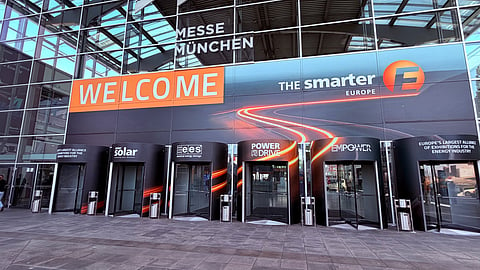

Over the past 4 days, we have followed market discussions, technology demonstrations, industry conversations, and product launches from every corner of The smarter E and Intersolar Europe 2026. From energy storage systems to inverters, next-generation PV modules, intelligent software solutions, and BoS systems, the exhibition once again highlighted how rapidly the solar industry is evolving.
Thank you for following our live coverage from Munich. We hope you enjoyed the updates as much as we enjoyed bringing them to you. See you at the next event!
EcoFlow is demonstrating its STREAM Series Full System at Intersolar Europe 2026, bringing together battery storage, energy management, and smart home integration into a unified solution for residential solar applications.
The STREAM series comprises the STREAM 5000, STREAM AC 5000, STREAM Expansion Battery, STREAM Gateway, and STREAM Smart Meter Dual CT. The complete system supports up to 90 kWh of storage capacity, 30 kW of PV input, and 18 kW of grid-tied output. The STREAM 5000 battery offers 5.024 kWh of storage capacity and features 4 MPPTs, while the modular design enables system expansion to meet different household energy requirements.
Ahead of its planned European product launch in November 2026, Huawei showcased its LUTERRA inverter and storage product. It is an all-in-one system designed for smart home energy management, combining residential solar, battery storage, and intelligent energy control.
LUTERRA S2 introduces the industry's first residential ESS with full natural cooling, along with fully wireless communication and a silicon carbide (SiC)-based power architecture. The company says the system is up to 17% lighter than comparable products, requires 43% less space, and can be installed wirelessly in less than 10 minutes, with commissioning completed in under 5 minutes. Huawei also highlights AI-assisted energy management, including an AI assistant for system diagnostics and recommendations. Additional software features include AI Scheduling 2.0 for optimizing household energy use and monitor temperature throughout the individual battery cells and ESS to help prevent overheating. Commercial rollout will begin in Europe in November 2026.
Haier Energy is presenting its E-Tower Ultra all-in-one energy storage system, a modular platform designed for both residential and retrofit projects.
The system combines a hybrid inverter and battery packs into a single unit without requiring an external BMS. The modular design supports capacities ranging from 8 kWh to 64 kWh. According to the company, it is suitable for both indoor and outdoor installation with an IP66-rated enclosure, and is compatible with both single-phase and 3-phase systems. Haier also highlights AI-enabled energy management features, including dynamic tariff integration and intelligent charging and discharging strategies, alongside active and passive fire protection and integrated heating that enables battery charging and discharging at temperatures as low as -20°C..
Renusol Europe is featuring its FS Pro 0 flat-roof mounting system at Intersolar Europe 2026, highlighting a new ridge connector that enables penetration-free installation on pitched roofs with inclinations of up to 20°.
The mounting system is designed to create ridge-spanning installations with modules on both sides of the roof using a common rail system. According to the company, the design eliminates the need to drill into the roof while supporting standard, third-rail and hybrid system configurations. The platform is compatible with most components in the existing FS Pro portfolio, allowing installers to combine accessories and system elements while simplifying installation through standardized parts.
TreeSystem is exhibiting its modular Solar-Carport mounting solution at Intersolar Europe 2026, designed for commercial parking areas and pedestrian walkways.
According to the company, the structure features a modular design with a 5° tilt angle and is available in galvanized or galvanized-and-painted finishes. It can be installed using either TreeSystem's patented anchoring system or using plates for concrete plinths, offering flexibility for different site conditions. The company says the carport is manufactured in accordance with EN 1090 structural steel standards and is designed to support solar installations while providing covered parking.
MKG Göbel is exhibiting its GMS Core ground-mounting system at Intersolar Europe 2026, highlighting a design intended to accommodate a variety of utility-scale solar project requirements and site conditions.
The steel mounting system features corrosion-resistant C-profile posts and closed main and long beams to improve structural stability. According to the company, it supports both south-facing and east-west array configurations, while offering stepless tilt and height adjustment. The system can be installed using multiple foundation options, including rammed posts, concrete foundations, ballast systems and drilled foundations for rocky terrain. MKG Göbel is also demonstrating accessories for cable management, grounding and mounting string inverters or string combiner boxes.
Oxford PV offered a glimpse of its next generation of its commercial tandem modules at Intersolar Europe 2026 with the Centaur 3 prototype. The prototype forms part of the company's roadmap toward commercial deployment and is targeted for market availability by the end of 2026.
The module is rated at 550 W with a 26% module efficiency and a 15-year operational lifetime, representing the next step beyond the company's current Centaur 2 products. According to Oxford PV, the Gen 3 design is intended to deliver higher energy generation from the same installation area while continuing to improve long-term reliability. The company also outlined a roadmap targeting 27% module efficiency and a 20-year operational lifetime by 2027, progressing toward 30% efficiency and a 30-year lifetime by 2030.
CATL is showcasing its newly launched TENER Sodium battery energy storage system at the Intersolar Europe 2026. The system was officially unveiled in Munich on June 22, just ahead of the exhibition.
According to CATL, TENER Sodium is the world's first commercially validated sodium-ion energy storage system. The company says the system is designed to complement lithium-ion batteries in utility-scale storage by using sodium, a more abundant raw material with a more stable supply chain. It is engineered to operate across a wide temperature range from -40°C to +55°C, retains over 90% of its usable energy at -40°C, and achieves 15,000 charge-discharge cycles. CATL also states that the system supports modular maintenance by allowing individual modules to be replaced independently, helping reduce operating and maintenance costs. Initial shipments are expected to reach 1 GWh by the end of 2026, with global deliveries scheduled to begin in June 2027.
Hungary-based Fox ESS presents its residential and commercial energy storage portfolio, with new products spanning hybrid inverters and commercial battery storage systems. Among the highlights is the PQ H3-Ultra 3-phase hybrid inverter for residential applications. It is available in power ratings from 5 kW to 15 kW with up to 3 MPPTs and supports whole-home backup, and achieves a maximum efficiency of 98.4%, according to the product datasheet.
For commercial and industrial applications, Fox ESS is presenting the G-MAX Plus all-in-one energy storage system. The liquid-cooled platform integrates the PCS, LFP battery, battery management system and energy management functions into a single outdoor cabinet. It is available with PCS ratings from 50 kW to 125 kW, paired with a 241 kWh battery, and supports applications including peak shaving, load shifting, backup power and frequency regulation.
The company is also displaying its Stackable AIO residential energy storage system, which combines a three-phase hybrid inverter and modular battery storage in a single unit. In addition, Fox ESS is exhibiting the PQ3 Ultra all-in-one hybrid/AC residential storage platform, which was unveiled earlier this month at SNEC 2026, bringing it to the European audience at Intersolar Europe.
In a special exhibit called 24/7 Renewables. Dr Tim Meyer, a renowned energy expert busted myths around energy transition stressing that powering Germany with renewables 365 days a year is very much possible. With flexibility resources, it is all the more easier to do so. Flexibility is the new gold, he said as it turns energy from a cost Center to a business opportunity. Modernise the grid, he stressed, so the market can play around with innovation.
EcoFlow showcases its residential energy ecosystem, bringing together battery storage, heat pumps, EV charging and smart home devices under a unified home energy management platform. Central to the demonstration is the company's latest OASIS 3.0 energy management system and EcoBot AI assistant, introduced during its European product launch this week.
According to EcoFlow, OASIS 3.0 analyzes electricity tariffs, weather forecasts, household consumption and solar generation to automatically optimize battery charging, EV charging and heating operation. The platform also supports compatibility with more than 35 smart home brands and over 500 dynamic tariff providers, enabling homeowners to manage their energy system through a single interface. At the booth, EcoFlow is also demonstrating its PowerHeat air-to-water heat pump integrated with the OCEAN 2 residential storage system, illustrating how heating can be incorporated into the broader home energy ecosystem.
At the Intersolar Europe 2026, with its iEasy Energy Solution, Midea highlights the integration of residential solar PV, storage, EV charging, and heat pumps into a single home energy management platform. The system is built around the company's residential energy storage portfolio and energy management software developed by its Midea Hiconics business unit.
This demonstration of integrated solution shows how different household energy assets can operate together. According to the company, the platform supports dynamic electricity tariff integration, allowing the energy management system to automatically adjust battery charging, EV charging and heating operation based on electricity prices. It also includes AI-assisted energy analysis, simplified commissioning and integration with Midea smart home appliances through a single management platform.
KOSTAL is showcasing its new HELIVOR HV high-voltage battery system at Intersolar Europe 2026. The battery uses LFP cell technology and is designed to operate with KOSTAL's PLENTICORE universal inverters. The modular system can be configured from 6.4 kWh to 230.4 kWh through stackable battery towers and parallel connection, allowing users to increase storage capacity as system requirements grow. According to KOSTAL, the battery also offers high charging and discharging power and is certified to VDE and CE standards. Alongside the battery, KOSTAL is also highlighting new software capabilities such as Multi Device Control (MDC), enabling coordinated management of multiple devices within a single energy system.
Dunext has unveiled the latest addition to its commercial and industrial (C&I) energy storage portfolio at Intersolar Europe 2026 with the launch of PowerHill 261 kWh liquid-cooled battery energy storage system. The new outdoor cabinet expands the company's PowerHill family and is designed for behind-the-meter applications such as peak shaving, self-consumption optimization, backup power, and participation in grid services.
The integrated storage cabinet is built around 314 Ah LFP battery cells and features liquid cooling that keeps temperature variation between battery cells below 2.5°C for more uniform operation and longer battery life. According to the product information displayed at the booth, the system features a 6-layer safety architecture, supports parallel operation of up to 10 units, includes 10 years of free liquid replacement, and integrates a local EMS with a smart O&M cloud platform. The cabinet is intended to simplify deployment of C&I storage projects while providing scalable capacity through multi-unit installations.
Among the concept products on display at FIMER's booth is the PVM-415-TL, a new three-phase string inverter developed for utility-scale PV applications. Scheduled to become commercially available from June 2027, the inverter extends FIMER's utility-scale portfolio with a higher-power string solution.
According to the product brochure, the PVM-415-TL offers up to 415 kW AC output and 98.9% maximum efficiency. It operates with an absolute maximum DC input voltage of 1,800 V and an operational input voltage range of 1,150 - 1,500 V, and supports up to 20 independently monitored channels (40 strings). Other features include fractional string sectioning with up to five independent DC switches, Wi-Fi and Ethernet connectivity for commissioning and monitoring, and installation. The inverter will be available in three power ratings: 207 kW (400 Vac), 360 kW (690 Vac), and 415 kW (800 Vac).
Ingeteam is presenting its newly launched INGECON SUN STORAGE M Series at Intersolar Europe 2026. Introduced earlier this month, the modular battery inverter is designed for AC-coupled utility-scale energy storage systems and supports both grid-following and grid-forming applications.
The liquid-cooled inverter features a modular architecture with up to four 1.14 MVA power modules, enabling a maximum inverter capacity of 4.55 MW. According to Ingeteam, the design supports battery voltages of up to 1,500 V DC, offers symmetrical charge and discharge capability, and is housed in an IP65-rated enclosure. Multiple inverter units can be integrated into the company's Full Skid medium-voltage solution, allowing system capacities of up to 9.1 MW in a single package for large-scale BESS installations.
Sungrow Renewables is showcasing its Smart Module portfolio at Intersolar Europe 2026, built around what the company calls its 5S intelligent architecture. The platform integrates five core functions—self-diagnosis, self-RSD (rapid shutdown), self-logging, self-cleaning, and self-cooling—to bring monitoring, safety and diagnostics directly to the module level.
The displayed SG-48TG4D-X residential module is available in 455 W to 480 W power classes with a maximum efficiency of 24.0%. According to Sungrow, the module supports iSolarCloud-based module-level monitoring, Smart Pathfinding for fault localization and precision bypass, anomaly detection with a shutdown time of 25 seconds or less, and digital lifecycle records for improved traceability. The module is backed by a 25-year product warranty and a 30-year linear power output warranty.
ABB is presenting its Proteus PV utility-scale inverter platform at Intersolar Europe 2026, offering a preview of its next-generation central inverter portfolio. Currently in the prototype stage, the platform is designed for large-scale solar installations with multiple power classes, including 4.1 MW, 4.3 MW, 4.5 MW and 4.7 MW variants.
According to the available information, this inverter supports up to 1,500 V DC system, featuring multiple MPPT configurations with a maximum efficiency of 99.45%. It also features integrated protection functions including DC and AC disconnects, anti-islanding, and overvoltage protection.
Fluence has expanded its Smartstack utility-scale battery storage platform with the introduction of a 10 MWh system at ees Europe 2026. The new product builds on the existing 7.5 MWh Smartstack, offering higher energy capacity while retaining the same platform architecture.
The product is designed for utility-scale ESS projects and supports 4-, 6-, and 8-hour discharge applications. it operated at up to 1.500 V DC and integrates liquid cooling and inhouse software systems for analytics and optimization. Fluence highlights a 99% system availability under its service plans together with a 25-year energy capacity guarantee.
Commercial and industrial energy storage continues to be a key focus at Intersolar Europe 2026. Among the new products on display is E3/DC's qntm battery storage system, which is scheduled to become commercially available from autumn 2026.
Designed for commercial and industrial applications, the qntm platform combines high power density with a compact 1.5 m² footprint. It is available in configurations ranging from 261 kWh with 125 kW charge/discharge power up to 1.305 MWh with 625 kW through modular expansion. Based on LFP battery technology, the system integrates AC conversion, battery management and energy management, while liquid cooling and heating support operation across a wide operating temperature range.
The system also targets applications including peak shaving, peak-shifting, dynamic electricity procurement, energy arbitrage, and self-consumption optimization.
RCT Power showcased its new Power Storage Premium 3-phase hybrid inverter at Intersolar Europe 2026. Designed for residential and small commercial PV systems, the inverter will be commercially available from Q4 2026 and will be offered in 6 kW, 8 kW, 10 kW and 12 kW power classes.
According to the product datasheet, the inverter features two MPPTs with a maximum of 16 A input current per MPPT and support input voltages of up to 1,000 V. It is designed to operate with LiFePO₄ battery systems and will be available in 6 kW, 8 kW, 10 kW, and 12 kW versions. The product features passive fanless cooling, Wi-Fi, Ethernet and CAN communication, and intelligent energy management with forecast-based charging.
As Intersolar Europe 2026 enters its final day, there is still plenty to discover across the exhibition halls. We continue our live coverage from Munich with more product launches, technology showcases, and conversations with exhibitors, highlighting some of the innovations shaping the PV industry.
Solar tracker manufacturer Nextpower is showcasing its new NX Gemini 2P tracker and NX Anchor foundation system. The NX Gemini tracker supports row-level control, weather-response functions, and centralized site management. It is compatible with the company's TrueCapture tracker control technology and NX Navigator monitoring software. Nextpower says the platform is designed for high-density tracker layouts and agrivoltaic applications. NX Anchor is an integrated foundation solution for the company's NX Horizon tracker platform. It is designed for various soil conditions and supports higher tracker clearances. According to Nextpower, NX Anchor can reduce foundation embedment depth by up to 70% and installation time by up to 20% compared with conventional H-pile foundations.
Germany-based solar module manufacturer AESOLAR is showcasing its SHADESTAR SME-80E module. The mono-facial black module is based on n-type TOPCon technology and features 80 half-cells. It delivers a power output of 420-440 W, with a module efficiency of 22.04%. The module features AESOLAR's SHADESTAR segmented-cell architecture, which is designed to improve performance under partial shading conditions while reducing hot-spot risks and power losses.
The module measures 1,762 mm × 1,133 mm × 30 mm and weighs 19 kg. It uses a glass-backsheet construction with POE encapsulation and is rated for snow loads up to 5,400 Pa and wind loads up to 2,400 Pa. The company provides a 30-year performance warranty and up to 30 years of product warranty coverage for selected configurations.
China-based Gokin Solar is showcasing its BC module portfolio at Intersolar Europe 2026, highlighting full-screen BC products. Among those on display is the GK-3-72HGF module, rated for up to 675 W of power and 25.0% efficiency. It measures 2,382 mm × 1,134 mm and is backed by a 15-year product warranty and a 30-year linear power warranty.
The company also exhibited the GK-3-54HGFDb Mystic Black module, with 24.5% efficiency and 500 W of power. The dual-glass module measures 1,800 mm × 1,134 mm, weighs 24.8 kg, and carries a 25-year product warranty and a 30-year linear power warranty.
Germany-based energy storage provider TESVOLT is showcasing its new TAYTAN battery storage system. The modular LFP-based system offers up to 62.5 kWh storage capacity per tower and supports configurations of up to 10 strings. It incorporates digital security features, including an IoT gateway, remote monitoring, and over-the-air (OTA) software updates, while supporting up to 15,000 cycles. According to Leonard Friese, Product Owner at TESVOLT, commercial deliveries are planned to begin by the end of 2026.
Germany-based solar mounting systems supplier Schletter Group is showcasing 2 additions to its ground-mounted portfolio. The first is the Rafter System, a new fixed-tilt mounting concept for ground-mounted PV installations. It enables up to 3 modules to be installed vertically using a slide-in mechanism, while integrated locking devices support single-person installation and reduce mounting effort. Designed for bifacial modules, the open structure minimizes rear-side shading and supports higher energy yield. Commercial availability of this system is planned for 2027.
The company is also displaying its 1P single-axis tracker, which features at least 2.1 m of ground clearance and tilt angles of up to 60°. The design allows agricultural machinery to pass beneath the array while supporting dual land use for farming and solar power generation. Schletter says the system is designed to meet the requirements of emerging European agrivoltaic frameworks.
Sika, a Switzerland-based supplier of roofing, waterproofing, and construction materials, is showcasing its SikaRoof Solar Mount-2 (SSM2) flat-roof PV mounting system. The solution is designed for installation on Sika roofing membranes and uses injection-molded FPO and PVC welding flanges that are chemically compatible with the membrane and hot-air welded to it, eliminating the need for roof penetrations. The system supports east-west module layouts with a fixed 7° tilt and is compatible with framed crystalline PV modules up to 1,135 mm wide. With an installed weight of approximately 10–18 kg/m², the mounting concept is designed to prevent long-term movement of the PV array on the roof.
US-based residential energy storage provider FranklinWH introduced its FranklinWH-aPower residential energy storage platform. It combines battery storage, solar PV, EV charging, and energy management in a single solution, with 15 kWh of storage per unit and scalability up to 225 kWh through the company's aGate intelligent controller. It supports up to 18 kW maximum power, 8 kW continuous charging power, and 4 MPPT inputs. The LFP-based platform is designed for backup power, solar self-consumption, and energy cost management. The company also highlighted flood resistance of up to 70 cm for 168 hours, compared to an industry average of 40 cm. FranklinWH says its energy management capabilities are based on experience from more than 25 utility-led VPP programs in the US. The company plans to launch the system in the European market in 2027.
Italy-based COMAL is showcasing its SunHunter single-axis solar tracker for utility-scale PV installations. The tracker is available in 1P, 2P, and 2P-2L configurations, and offers a tracking angle of ±55°. The tracker uses a DC slew drive with a nominal torque of 5,500 Nm and a self-powered controller supplied by a dedicated 30 W or 65 W solar panel with battery backup. SunHunter incorporates an astronomical tracking algorithm with asymmetric backtracking, offering tracking precision of 0.2°. COMAL says the system is designed for slopes of up to 9° in the north-south direction and features self-aligning bearings engineered for more than 28 years of operation.
Novotegra, a Germany-based mounting system provider, is showcasing its Flat Roof System III – Long Side Clamping mounting solution for large-format PV modules. It uses long-side module clamping to improve resistance to wind and snow loads, particularly for larger modules. The mounting system features a tool-free click mechanism and a high degree of prefabrication to simplify installation. Novotegra says the design uses short components to reduce logistical effort and supports continuous module fields of up to 21 m × 41 m. Rail and cross connections are designed without additional components and can support lightning protection and potential equalization requirements.
IBC Solar is presenting its AeroFix GreenRoof mounting system, a new solution designed specifically for photovoltaic installations on green roofs. Based on the company's AeroFix flat-roof platform, the system uses largely identical components while adding several new elements designed for green-roof applications.
According to IBC Solar, the system is designed for direct installation on the substrate and is particularly suited to existing green roofs. The company says ballast optimization, defined maintenance walkways, and adjustable support heights help improve accessibility and provide additional clearance above vegetation. The AeroFix GreenRoof system will initially be available for east-west configurations and is scheduled for commercial availability in 2027.
Anker SOLIX is showcasing its Solarbank 4 E5000 Pro, a modular balcony solar storage solution that combines battery storage and power management functions. The system offers 5.024 kWh of storage capacity per unit and supports up to 5,000 W of PV input through 4 MPPTs. It provides 800 W AC output and 2,500 W backup power output, and uses LFP battery technology. The product is designed for a 15-year lifespan and features IP66 protection, operating temperatures from -20°C to 55°C, and support for altitudes up to 4,000 m. According to Michelle Kreysig, EU Regional Senior PR Manager at Anker SOLIX, the Solarbank 4 E5000 Pro will be available from July 2026.
Chinese module manufacturer Beyondsun is promoting its TSLHNM-108HR-A ultralight TOPCon module. The product delivers 440-460 W of power, with the showcased version rated at 445 W and 22.27% efficiency. According to the company, the module weighs only 9.5 kg, around 60% less than a conventional module, corresponding to a weight of less than 4.8 kg/m². It measures 1,762 × 1,134 × 30 mm and uses 108 half-cut cells. Beyondsun says the lightweight design is intended for residential and commercial rooftops with load-bearing limitations. The company also displayed an 11.9 kg version of the same module platform, which uses 1.6 mm glass and weighs less than 6 kg/m², reaching up to 455 W of power.
Hanersun is presenting new additions to its HiTouch module portfolio. According to Jason Liu, Regional Sales Director at Hanersun Energy, the company has 5 GW of annual module production capacity and plans to begin BC module production with an initial capacity of 1.2 GW. The company's latest HiTouch 6N TOPCon module delivers up to 750 W with 24.1% efficiency, while the HiTouch 6B BC module reaches 680 W and 25.2% efficiency. Hanersun says the upgraded TOPCon product is aimed at utility-scale applications. For repowering projects, Hanersun is also presenting its HiTouch 5N module. The product delivers 335 W at 20.6% efficiency and is designed to be compatible with existing mounting systems. According to the company, the module targets mature solar markets such as Germany and Japan.
JA is promoting its DeepBlue 5.0 JAM66D50/GB module as part of its AIDC display. According to Ignacio Espinosa Gil, Head of the European Technical Team at JA, the company is focusing on integrated solar and storage solutions for emerging AI and data center applications. The n-type bifacial double-glass module delivers up to 670 W of power with a module efficiency of 24.8% and bifaciality of 85%. The module incorporates JA's Bycium+ 5.0 cell technology and uses a 132-cell configuration. The module measures 2,382 × 1,134 × 30 mm, weighs 32.8 kg, and supports a maximum system voltage of 1,500 V. The product is backed by a 30-year linear power warranty.
Alongside the module, JA Solar is also displaying a 6.26 MWh liquid-cooled battery container and an energy management platform as part of its AIDC solution.
Socomec is showcasing its SMARTSYS M5000 containerized BESS for utility-scale and grid-connected applications. According to Etienne Cotriant, Product Marketing Manager at Socomec, the platform is available in configurations starting at 2.5 MVA/5 MWh and can be scaled for larger projects. The system combines battery containers with an MV skid integrating transformers, switchgear, and energy storage interfaces. The platform uses LFP battery technology and incorporates fire detection and suppression systems, gas sensors, and temperature monitoring. Socomec says the solution can be deployed for grid services, behind-the-meter applications, infrastructure projects, and EV charging. The company is also displaying its SoLive PRO BESS platform, which provides monitoring, analytics, and visualization tools for battery energy storage systems.
SAJ is showcasing its EK90 HS5 single-phase all-in-one residential energy storage system (ESS). According to the company, the product will be available in Germany from October 2026. The system combines a hybrid inverter and battery storage in a single unit and supports PV inputs of up to 20 kW. It uses 314 Ah LFP cells and can be configured with battery capacities ranging from 10 kWh to 54 kWh. SAJ says the system offers up to 12,000 charge-discharge cycles and supports seamless capacity expansion through a built-in DC-DC optimizer. The company also highlights a 9-layer protection architecture comprising battery and system-level safety functions, including arc-fault protection, ground-fault protection, thermal monitoring, and fire suppression. Additional features include a 63 A whole-home backup function, IP66 protection, operation at altitudes up to 3,000 m, and an operating temperature range of -30°C to +50°C.
Software company Virto is showcasing additions to its solar engineering platform. The company says its software supports solar projects from concept development through detailed engineering. Virto is showcasing Virto.LIVE, an add-on that allows users to share project designs as browser-based 3D models. According to the company, users can review project layouts, terrain, and shading conditions without requiring dedicated software. Virto is also presenting Virto.RISE, an AI-based add-on that converts drone survey data into solar-ready 3D models. The software can process point clouds, digital elevation models, and drone imagery, and export designs to CAD and other engineering formats
AXITEC is promoting its latest AXIblaсkbiplus BC GR module. The module is available in power classes ranging from 480 W to 495 W and reaches an efficiency of up to 24.2%. According to the company, the module can deliver additional energy yield from the rear side and comes with a 30-year product and performance warranty. The product is scheduled to be available from September 2026. The company is also showcasing its commercially available AXIhycon ONE residential energy storage system. The all-in-one solution combines battery storage and energy management functions in a compact design for residential applications.
Italian renewable energy company ESPE is highlighting its ESPE Power Station range of electrical transformation substations. The systems are designed for utility-scale solar projects, BESS, and other energy infrastructure applications. A key exhibit is the new ESPE Power Shelter Doppio, developed for higher-power installations. According to the company, the plug-and-play solution is fully preassembled and tested at the factory before delivery to the project site. ESPE says this approach can reduce installation time, on-site work, and project complexity.
German module manufacturer Solar Fabrik is highlighting several application-specific modules. For residential installations, Solar Fabrik is promoting its Mono S5 Halfcut BC Full Black module. The product delivers 285 W and combines back-contact cell technology with anti-shading features. For overhead installations such as carports, pergolas and facades, Solar Fabrik is promoting its Mono S4 Halfcut Trend Guard module. The bifacial TOPCon module delivers 455 W with an efficiency of 22.77% and carries certification from Germany's DIBt for overhead and facade installations. The company is also presenting its Mono S4 Halfcut Chroma Orange module for heritage and protected buildings. The 420 W module features a terracotta-colored design (RAL 8004) intended to blend with traditional roof aesthetics while maintaining modern PV performance.
Speaking with TaiyangNews, Ignacio Espinosa Gil, Head of the European Technical Team at JA, highlighted 2 variants of the DeepBlue 5.0 module targeting different market segments. The JAM48D51/LR module is designed for residential rooftops. The n-type dual-glass monofacial module has an efficiency of 24.3% and a rated power output of 485 W. It measures 1,762 × 1,134 × 30 mm, weighs 21.5 kg, and features 144 half-cells. For larger installations, JA is promoting the JAM54D50/GR module. The dual-glass module delivers up to 550 W of power and 24.7% efficiency. It measures 1,961 × 1,134 × 30 mm, weighs 27.4 kg, and uses 162 half-cells.
German module manufacturer Sonnenstromfabrik launched its Professional Glass/Glass M 108 back-contact (BC) module at Intersolar Europe 2026. The module uses 108 half-cut monocrystalline BC cells and delivers up to 500 W of power with a maximum efficiency of 24.5%. The dual-glass module features 2 mm solar glass on both sides, measures 1,800 × 1,134 × 35 mm, and weighs 25 kg. It supports a maximum system voltage of 1,500 V and features an IP68-rated junction box. The module comes with a 30-year warranty.
JA is highlighting its JA Planet 2.0 all-in-one C&I battery energy storage system (BESS). The all-in-one system combines a 125 kW PCS with 261 kWh of storage capacity and uses 314 Ah LFP cells. According to the company, the BESS supports both on-grid and off-grid operation and offers a battery life of up to 8,000 cycles. The system operates at 50 Hz or 60 Hz and can be deployed at altitudes of up to 3,000 m. It is designed to operate in ambient temperatures ranging from -30°C to +50°C. The company also highlights integrated fire suppression, smoke and gas detection, and cloud-based monitoring capabilities. The BESS features an IP55-rated enclosure for commercial and industrial (C&I) energy storage applications.
RENA Technologies is promoting its wet-processing solutions for advanced solar cell manufacturing at Intersolar Europe 2026. The company's portfolio supports TOPCon, HJT, BC, and perovskite technologies while targeting lower operating costs, reduced water consumption, and improved process sustainability. The company is also highlighting hydrogen peroxide-free process solutions and closed-loop water management concepts to reduce wastewater generation and support resource-efficient PV manufacturing.
CEA-INES is showcasing a mechanical delamination process for recycling glass-backsheet PV modules. The technology removes module layers step by step. It starts with backsheet separation to recover polymers such as PET, PVF/PVDF, and EVA, while also separating fluorinated compounds. The second stage removes cells and encapsulation materials, providing access to valuable materials including silver, glass, copper, silicon, and other metals. According to the display, the process has been validated at pilot scale and is moving toward commercial deployment. The recovered powder stream can be further processed to extract high-purity silver and other valuable materials from end-of-life solar modules. The process also aims to preserve the quality of recovered glass for recycling applications.
Good morning from Munich! Day 2 of Intersolar Europe 2026 is underway, with exhibitors and visitors returning to the show floor for more technology showcases, product launches, and industry discussions.
The first exhibition day featured new solar modules, energy storage systems, BIPV solutions, trackers, and AI-driven technologies. Today, TaiyangNews continues its live coverage with the latest highlights and developments directly from the exhibition floor.
Stay tuned for more updates throughout the day.
Growatt's stall at Intersolar Europe 2026 features its new MINA and MODA series single- and 3-phase models, respectively. The former ESS features a power range of 3 to 10 kW, or 5 to 30 kW; the latter has a power range of 4 to 15 kW or 5 to 30 kW.
Megasol Energie Ltd., a Switzerland-based PV module maker and building-integrated photovoltaic (BIPV) solutions provider, showcased its LEVEL Up, a redesigned system for roof-integrated PV applications, at Intersolar. The displayed module is suitable for solar roof and building facade installations in Europe and offers a power density of up to 203 W/m².
It features the ‘ZRM+ surface technology’, which is a finely textured micro-surface that reduces mirror-like reflection or glare.
HUKX, a Netherlands-based solar pyranometer maker, is highlighting its new SRD 10-D1 series product to accurately measure diffuse solar irradiation in low-light conditions during the day. The company attributes its measurement tool's capability to the quality of its built-in tilt sensor. The measurement and quantification of diffused sunlight is a hot topic among PV asset owners.
China-based solar-plus-storage system provider HYXiPOWER brought its latest HYXi Aura series all-in-one ESS to the show, aimed at the continent's residential consumers. This ESS, comprising a hybrid inverter and battery stack, offers emergency backup for the whole home rather than just a few dedicated loads.
3S Swiss Solar Solutions AG, a Switzerland-based company that specializes in the development and production of energy-generating building envelopes with operations in Thun and Worb, showcased its color BIPV modules, TeraSlate Flair. It is showcasing a terracotta rust-colored module at its booth.
Tesla, the well-known EV maker, displayed its energy storage product, POWERWALL, at Intersolar Europe 2026. This wall-mounted, aesthetically pleasing storage system is demonstrated with the company's EV chargers. Additionally, the booth displays the required tools for a quick installation of this compact system at the end-user's premises.
China-based residential plug-in solar-plus-storage system provider GTPOW's product showcase includes a portable PV power station and a balcony PV system. The power station, featuring a curved, foldable 42-half-cut-cell-based PV module, can deliver up to 100 W of power. The balcony PV system consists of an EASYMOUNT SOLAR PANEL kit with an 800 W PV module and a microinverter.
Slovenia-based PV module maker, BISOL, unveiled its Glass-Backsheet-based colored PV module, BISOL Spectrum, for BIPV or DG applications. As the name suggests, it offers 4 different colors, such as red, green, orange, and silver, resembling multiple colors of the light spectrum. This module consists of 98 M12R half-cut cells and delivers up to 420 W of power and 21% efficiency. Laminated with a 3.2 mm AR-coated tempered glass and a black rear backsheet, the module's visual appearance varies with the color of the glass. This Made-in-Europe module carries a product and performance warranty of up to 25 and 30 years, respectively.
Marius Bakke, VP Solar & Storage at the market research firm Rystad Energy, underscored that, when it comes to solar in Europe, policymakers need to be careful when designing support schemes for solar manufacturing. "When we had solar trade tariffs in Europe between 2013 and 2018, those were the worst times for solar deployment," he said during the Solar Made in the EU: Strategies for Creating a Resilient Domestic Solar Market Based on High Internal Value Creation Session at the Intersolar Europe Conference.
PV material and module maker Jolywood unveiled its Namic 1.0 series TOPCon module, JW-HD132N2-R2. This dual-glass module is equipped with 132 half-cut cells and is rated for a power output of up to 640 W and an efficiency of up to 23.7%. It replaces conventional aluminum frames with Aluminum-Magnesium-Zinc-Coated steel, helping achieve a static front-side maximum load of 8,100 Pa and 3,000 Pa on the flip side. According to the company, it currently employs silver paste on the front- and aluminum paste on the rear-side for metallization. The cells are available commercially.
LONGi Solar, a vertically integrated PV company, launched its latest BC module, Hi-MO 9 Prime, for C&I and utility applications. This module, comprising 132 cut cells, is rated for a power output of up to 680 W and an efficiency of up to 25.2%. This module, with 2 mm front and rear glass, weighs 33.5 kg and measures 2,382 x 1,134 x 30 mm.
SKYWORTH Solar, a well-known TV brand that recently expanded into solar, exhibited its R290 Mono series heat pump at the show. It can cool, heat, and save energy efficiently. Its rated operating noise level is low enough for use as a home appliance. This home appliance can be integrated with a home solar-plus-storage system.
France-based PV module mounting system provider DOME is showcasing its Helios RC3 mounting system at Intersolar Europe 2026. This system features clamps, edge flashing, a rail system, a TU+earthing clip, and a hammer head screw.
Germany-based QAES Europe GmbH is showcasing its latest direct-immersion cooling ESS, Luminary Nova-781. Built in collaboration with TotalEnergies, it offers up to 781 kWh of storage capacity and features a built-in PCS. The company claims that its direct immersion cooling mechanism results in system RTE gain of more than 2% compared to conventional liquid-cooling alternatives. The batteries have a guaranteed life of more than 10,000 cycles. The ESS can be configured in both AC- and DC-coupled configurations, providing the user with flexibility. On the operation side, it offers grid-forming technology, can be configured in a microgrid, participate in VPP programs, and contribute to energy arbitrage.
ERL Solar Mounting System, a new name among Intersolar's tracker exhibitors, is showcasing its 1P (1-in-Portrait) 1,000 V or 1,500 V DC tracker system. It features a slew drive with swing system and a 24 V DC brushless motor. According to the company, it is designed to withstand a maximum wind speed of 130 kph, with a wind gust of up to 190 kph for 3 seconds. The system uses a LoRa wireless communication system for device-to-device interaction. It also features a backtracking function.
Envision Energy showcased its integrated wind, solar and battery energy storage solutions, combining renewable generation with advanced plant-level control to improve grid integration, flexibility and energy optimisation. The company also presented its latest Solid-State Transformer (SST) designed for AI data centre (AIDC) applications.
The 2.5 MW SST accepts up to 13.8 kV AC from the grid and delivers 800 V DC directly to AI data centre distribution systems, achieving a peak conversion efficiency of up to 98.5%. By integrating voltage transformation and power conversion into a single digitally controlled platform, the SST reduces system complexity while supporting high availability of up to 99.9% for critical AI infrastructure.
US-based solar-application-focused robot maker cIvROBOTICS is showcasing its CivNav robot for mechanized PV module mounting and its CivDot+ for precision pile-placement marking. The former was launched 6 months ago. These robots are being used at L&T's sites in Saudi Arabia and are currently being used by a large EPC in Kutch, India. These automated systems reduce installation time and help to optimize project CapEx compared to manual alteratives.
FTC Solar is promoting its AI-driven PV construction process, from sourcing to installation & commissioning, helping EPCs and subcontractors achieve quicker project turnarounds with fewer errors or faults. Initially, the drone captures site data, which is then fed into the software platform for analysis and performance evaluation. It combines drone hardware with AI-powered software, with the former flying over the project site and providing live updates on construction activities. After that, the software identifies the activities taking place and compares site performance against predefined benchmarks by analyzing data. EPCs can track progress in real time, identify underperforming crews or activities, and take corrective actions to improve productivity by using this information.
Marstek Energy, a fairly new name in the energy storage market, is highlighting its home micro storage system, MARSTEK VENUS E 4.0, during the show. This product packs a microinverter and battery pack into a compact 520 x 430 x 191 mm (W x H x D) enclosure. Its 16 V LFP batteries can store up to 5 kWh of energy and have a guaranteed life of more than 10,000 cycles. On the operational front, this system can deliver up to 3 kW 1-phase 220 V power output, either in on-grid or off-grid mode. This product will be commercially launched in 2026.
The US-based cabinet-based recombiner provider, Shoals, is debuting POWER HUB at the show. This recombiner, equipped with up to a 4,000 A non-load-break switch, is rated for a maximum DC voltage of 1,500 V and a current of 4,000 A. It is suitable for data centers, standalone BESS, and solar-plus-storage applications. It consists of tin-plated copper busbars. The company claims it has commercially launched this product domestically and is now seeking to enter export markets.
Jarand Rystad, CEO of market research firm Rystad Energy, showed in his talk 'The New Energy Security Paradigm for Europe' during the 'When Power Becomes a Target - Building Resilient European Energy Systems Through Solar, Storage and Grid-Forming Technologies' session at the Intersolar Europe Conference that batteries have the highest monetary value when it comes to energy security across the board – from autonomous appliances, keeping the lights on to high temperature industries.
Rebecca McManus from Aurora Energy said in the opening of the session 'Solar Power Plants and Storage IV: Going Hybrid - Overview of Real-World Revenue Models for Solar + Battery Projects' at Intersolar Europe Conference that Germany, GB, and Bulgaria are the most attractive markets for co-located solar and battery storage markets in Europe. She pointed out that the prime drivers are targets and regulation, together with negative prices, high curtailment rates, market saturation, limited grid access, and increasing grid charges.
GAMECHANGE ENERGY, formerly GameChange Solar, a well-known solar tracker maker, is promoting its expanded portfolio, including transformers, electrical balance-of-system (eBoS), and digital solar asset health checkup services. According to the company, its transformer division has a manufacturing facility in India, catering to both the domestic and the US market. The company opened a transformer factory in India in 2024 and is currently ramping up operations. A second facility is being developed adjacent to the existing plant, specializing in medium-voltage, power, and substation transformers.
Serbia-based energy storage system (ESS) provider, DEPLOY GLOBAL ENERGY, is showcasing its new transportable product with up to 5 MW capacity. It is available in 10-, 20-, or 40-foot container sizes and can be configured for standalone or multi-unit operation. According to the company, this product has applications in critical infrastructure, industries, disaster response, and military operations, among others. It can also support grid stability and blackstart operation.
AIKO has unveiled its latest INFINTE Ultra module, designed for Europe's utility segment, and Z Series module for DG applications. The former measures 2,382 x 1,134 x 30 mm, and is rated for a maximum power output of 690 W and efficiency of 25.6%. The latter, featuring 54 BC cells and all-black aesthetics, boasts a power output of up to 500 W and an efficiency of up to 25%, within a 2 m² active area.
US-based Enphase Energy is showcasing its latest residential microinverter, IQ9N, at Intersolar Europe 2026. It can carry up to 16 A DC from the connected PV module and deliver up to 427 VA 1-phase power output. Its GaN-based power switching devices offer a maximum system conversion efficiency of 97.95%. Additionally, the company is promoting its DC-coupled IQ Bidirectional EV charger, which can switch between Vehicle-to-Grid (V2G) and Vehicle-to-Home (V2H) mode, offering vehicle charging and emergency backup. Also on display was the latest IQ Battery G5 vertically stacked battery bank, powered by the latest PowerMatch technology.
After a super-packed and insightful day at the conferences at ICM, the 3-day solar and storage trade show is now open!
This happy picture perfectly captures the mood at The smarter E Europe – celebrating innovation, collaboration, and the rapid progress of the clean energy transition.
That’s a wrap for today. We’ll be back tomorrow from the trade floor with more updates, insights, and highlights from one of the world’s leading energy industry gatherings.
The winners in the Outstanding Projects category at The smarter E AWARD 2026 are the Netherlands’ Schoonschip, Germany’s SMA Altenso, and US-based Fluence.
Schoonschip was recognized for its virtual power plant (VPP) connecting 30 floating homes in Amsterdam through an intelligent microgrid. SMA Altenso won for Africa’s first integrated green hydrogen plant in Namibia, producing off-grid green hydrogen using solar power. Fluence received the award for its energy storage portfolio in Ukraine, delivered across 6 sites in just 6 months.
The winners in the Smart Integrated Energy category at The smarter E AWARD 2026 are Spain-based Meins Consulting, Germany-based Stem, and The Mobility House Energy.
Meins Consulting was recognized for its CSET modular compact high-voltage substation. Stem won the award for its PowerTrack energy management system, designed to ensure reliable operations through rapid failover capabilities. The Mobility House Energy received the award for its vehicle-to-grid integration platform, which connects EVs, bidirectional chargers, utilities, and energy markets within a single software ecosystem.
The winners of the E-Mobility category at The smarter E AWARD 2026 are Switzerland’s LEM International, Great Britain’s Tritium Power Solutions, and Germany’s HagerEnergy.
LEM International was recognized for its DCES series of DC meters for fast-charging and megawatt charging applications. Tritium won for TRI-FLEX, a distributed fast-charging system with integrated battery storage, while HagerEnergy received the award for its bidirectional E3 DC EV charger, optimized for solar energy and equipped with its own inverter.
The winners of the Energy Storage category at The smarter E AWARD 2026 are Switzerland’s Phenogy, China’s Sungrow Power Supply, and Bulgaria’s International Power Supply.
Phenogy was recognized for its Phenogy 1 Series sodium-ion batteries, which offer improved temperature stability. Sungrow won for its PowerTitan 3.0 energy storage system, while International Power Supply was honored for its EXERON CheckMate bidirectional liquid-cooled inverter.
The smarter E AWARD winners in the Photovoltaics category for 2026 are:
IED Electronic Solutions won for its True Wind technology, Huawei Technologies for its 506 kW SUN2000-506KTL string inverter, and GOLDBECK SOLAR for HeliomatiX, a solution designed to simplify utility-scale solar plant development.
Solar’s 20-Year Report Card: An Overachiever
If solar PV were graded on its performance over the last 2 decades, it would be an 'overachiever', says Edurne Zoco of S&P Global.
While falling costs helped, Zoco said solar’s success is really a story of innovation, scalability, and speed. The technology has transformed not only the power sector but also the way society interacts with energy. Global solar capacity has grown from 1 TW in 2021 to an expected 3.5 TW by the end of 2026, with the next milestone – 10 TW – expected by 2035.
Solar recycling technologies are advancing rapidly, but several challenges remain as the industry scales up, according to Lukas Braun, R&D Engineer at Solar Materials.
Braun said industrial recycling lines are already operating and growing, with some systems now commercially available. However, key challenges include handling broken modules, improving collection and sorting systems, increasing the use of recovered silicon and polymers, and preparing for new material streams from next-generation solar products. While the first wave of end-of-life solar systems is over, the second wave hasn't picked up pace, given that these modules are built to last much longer than before, he added.
As solar becomes a larger part of the energy system, cybersecurity is becoming increasingly important, said Alexander Plonka, Product Lifecycle Manager at KACO new energy.
Plonka noted that secure and resilient energy systems help improve energy security and reduce dependence on foreign countries. KACO, he said, is focusing on cyber-secure products to help protect solar assets and support reliable renewable energy generation.
A key update for the solar sustainability community: IEA PVPS Task 12 is set to release the 2026 edition of its Life Cycle Inventories of Photovoltaic Systems database this summer, shared Matthias Stucki, Head of the Life Cycle Assessment (LCA) Research Group at ZHAW – Zurich University of Applied Sciences.
The updated database will cover the full PV value chain, including TOPCon, PERC, and CdTe technologies.
JinkoSolar is leveraging ESG and sustainability initiatives to meet evolving regulatory requirements in Europe and other markets, according to Mario Quintana Aroca, ESG Manager Europe.
Aroca said supply chain traceability is critical for managing supply chain risks. He noted that 6 JinkoSolar factories and 3 supplier facilities have been certified by independent third parties under a PV Supply Chain Traceability Management System covering the value chain from module to quartz.
The company also requires suppliers to sign a code of conduct and undergo regular internal and third-party audits as part of its ongoing efforts to strengthen supply chain transparency, accountability, and sustainability performance.
Utility-scale solar is expected to remain the dominant driver of Romania’s PV market as a large number of major projects are currently under construction, according to Irene Mihai, Policy Director at the Romanian Photovoltaic Industry Association (RPIA).
Mihai said Romania could see installation growth level off around 2030 as the current pipeline of large-scale projects comes online. Mihai stressed that the country is on track to meet its 2030 renewable energy targets.
More than 62% of Spain’s electricity now comes from renewable sources, resulting in many hours of very low- or zero-cost power, according to UNEF CEO José Donoso.
Donoso said Spain’s current electricity pricing system is not designed for such high levels of renewable energy. With the country experiencing several hours of negative electricity prices, UNEF is calling for urgent market reforms to improve grid stability and support continued investment in clean energy, he added.
Spain has around 27 GW of storage in the pipeline, so the next few years will be important for storage.
Solar cannibalization is set to remain a key challenge for European power markets through 2030 unless flexibility and battery storage deployment accelerate, according to Vegard Vollset, Head of Renewables & Power – EMEA at Rystad Energy.
Vollset noted that forecasts showing increasing solar cannibalization have proven accurate in 2024, 2025, and 2026, as solar generation continues to grow. He left the audience with a question: could the rapid expansion of data centers help absorb surplus renewable electricity and mitigate the effects of cannibalization in the years ahead?
India is well-positioned to serve as a global workforce hub for the clean energy industry, but addressing skill gaps in areas such as transmission infrastructure will be crucial to sustaining growth, according to NSEFI CEO Subrahmanyam Pulipaka.
Speaking at Intersolar Europe, Pulipaka said an Institute of Sustainability Academy is set to be launched to help develop the talent needed across the renewable energy ecosystem. He also noted that dedicated policies for floating solar and agrivoltaics are under development and could be announced soon.
With India targeting 350 GW of energy storage capacity over the next 5 years, a strong pipeline of skilled workers will be essential to support deployment.
Brazil is set to launch its first energy storage auction on December 2 and December 4, 2026, marking a major step in the country’s efforts to strengthen grid flexibility and support renewable energy growth, said ABSOLAR Chairwoman Barbara Rubim. She added that the industry expects the auction to contract multiple GWhs of energy storage capacity for deployment over the coming years. The initiative reflects Brazil’s growing focus on integrating storage alongside its rapidly expanding solar market, added Rubim. Battery storage solutions would truly begin next year, Rubim emphasized.
Europe can achieve its REPowerEU target of 750 GW DC of installed solar capacity by 2030, but only if flexibility measures are deployed at scale, according to SolarPower Europe CEO Walburga Hemetsberger. Speaking at Intersolar Europe, Hemetsberger said the EU is working towards a 200 GW battery storage target by 2030, although industry stakeholders are calling for a significantly higher ambition to support growing renewable energy deployment.
Stacy J. Ettinger, SEIA’s Senior Vice President of Supply Chain and Trade, said there is some market uncertainty in the US amid policy shifts, yet solar remains the least expensive and fastest to deploy. Solar accounted for over 90% of US power in Q1/2026. EV battery companies are now turning their manufacturing facilities into energy storage. With administration support, energy storage is growing steadily in the US.
Chinese module exports are expected to remain relatively resilient despite a projected slowdown in domestic PV demand in 2026, according to InfoLink Consulting CEO Corrine Lin. Speaking at the event, Lin said China’s next chapter of growth will be driven by solar and energy storage. However, manufacturers are taking a more cautious approach to battery storage expansion after lessons learned from the solar PV sector’s rapid capacity build-out. As a result, battery prices are expected to remain relatively higher in the near term.
Executive Advisor and Director of Market Intelligence, SolarPower Europe, and TaiyangNews MD Michael Schmela launching Global Solar Market Outlook 2026-2030 at The smarter E/Intersolar Europe. He says most of the growth in 2025 (664 GW) was thanks to China, which accounted for a record 57% annual market share. This means any drop in this market will pull down the rest of the world in overall numbers.
Today is all about dialogue. Solar PV and energy storage stakeholders from across the value chain have gathered to discuss the sector’s most pressing topics, from technology and markets to policy and deployment. Conference rooms are filling up quickly as discussions get underway.
The conference opens with SolarPower Europe unveiling its Global Solar Market Outlook 2026-2030. Look forward to an interesting lineup of speakers.
Greetings from Munich! One of the world's biggest solar and energy events, The smarter E Europe, is back at Messe München in Germany. The event runs from June 23-25, bringing together companies, industry leaders, and energy professionals from around the world. Before the exhibition opens, a full-day conference on June 22 will feature discussions on the latest trends, technologies, and developments in the solar and energy sectors. TaiyangNews is here. Follow our live coverage for the latest news, product launches, partnerships, and key announcements from the show. Watch this space!
