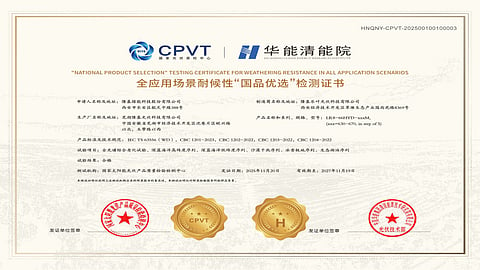

LONGi’s Hi-MO 9 series BC module went through multiple sequential reliability stress tests, covering up to 40 practical field scenarios
Since the commercial launch, the company has been accumulating empirical field performance data of these modules
In addition, data from third party certification agency indicates these modules yielded a performance gain of up to 3.92% with respect to TOPCon peers
Leading vertically integrated manufacturer LONGi has received certification for its back contact (BC) PV module, LR8-66HYD-xxxM from the Hi-MO9 series from the National Quality Inspection and Testing Center for Solar Photovoltaic Products (CPVT) and Huaneng Clean Energy Research Institute (CERI). The certification, titled ‘National product selection testing certificate for weathering resistance in all application scenarios’, follows the IEC TS 63556 ED1 (Working Draft - WD) standard. This coupled-stress acceleration test sequence for photovoltaic modules and materials simulates up to 40 ‘full-scenario’ test sequences. These scenarios include complex, dynamic external environments such as lakes, deserts, ice, and marine environments, among others, validating the module’s long-term reliability under diverse stressors.
LONGi stated that its module performed well during testing, including operational temperature, low-light generation, and reliability. The company, however, didn’t share the pass criteria or test results in the press release. Altogether, this certification goes beyond the traditional characterization and extended reliability test protocol, making the BC module suitable for ‘full scenario’ applications, says LONGi.
In addition, the company states it is accumulating empirical field performance data on its modules across global markets covering a variety of harsh environments, including temperate continental, tropical, arid, and high-humidity coastal regions, since the launch of the product. Apart from its own empirical database, LONGi considers data from independent third-party institutions. These data demonstrate the BC module’s stable and consistent performance across metrics of actual power generation, system economics, and environmental adaptability, which sometimes went beyond expectations, the company claims. The latter’s data (third-party institutions) indicate that these BC modules yielded a power generation (kWh/W) gain in the range of 1.21% to 3.92% compared to TOPCon alternatives.
The dual-glass module is equipped with 132 half-cut hybrid passivated back contact (HPBC) cells and is rated for a power output of up to 670 W and an efficiency of up to 24.8%. It measures 2,382 × 1,134 × 30 mm and weighs 33.5 kg. The company offers a product and performance warranty of up to 12 and 30 years, respectively, for this module.

