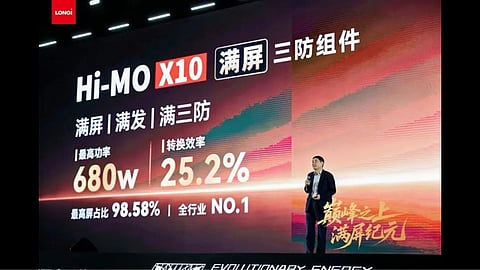


LONGi’s Hi-MO X10 Ultimate achieves up to 680 W and 25.2% efficiency, with 670 W currently available for delivery
Several module-level innovations aim to increase the effective area utilization to 98.58%
The module comes in three bifaciality variants, with the highest rated at 85%
Integrated PV manufacturer LONGi has launched a new module as part of its Hi-MO X10 series, offering a maximum higher power output of 680 W and an efficiency of 25.2%. Called the Hi-MO X10 Ultimate, the product is based on the company’s hybrid passivated back-contact (HPBC) 2.0 cell platform and incorporates three technologies – cell overlapping, hidden busbars and Selective Temperature Alloy Connection (STAC) – from its ‘Technology Forest’ portfolio unveiled in July 2026 (see LONGi Unveils ‘Technology Forest’ With 8 Core Technologies).
The module measures 2,382 × 1,134 mm. LONGi says it has entered mass production, with 670 W being the main power rating currently available for delivery.
In September 2026, LONGi achieved a record crystalline silicon solar cell efficiency of 28.29% using its hybrid interdigitated back-contact (HIBC) technology, verified by German’s Institute for Solar Energy Research Hamelin(ISFH) (see LONGi Raises Single-Junction Silicon Cell World Record to 28.29%)
According to LONGi, with crystalline silicon cell efficiency approaching its theoretical limit of 29.4%, there is limited scope to improve module efficiency through cell-level innovations alone.
Back-contact (BC) cells already have the advantage of a gridline-free front surface. The next step is to make use of the areas occupied by busbars, gaps between cells and strings, and margins along the frame.
One way to eliminate the gaps between cells is to overlap them. However, this can create mechanical stress between the cells and interconnection ribbons, increasing the risk of cell breakage. BC technology offers an advantage here as the interconnections are entirely on the rear side. LONGi says it has optimized the overlapping structure to limit the height difference between adjacent cells to 130 µm. The use of nearly 30 ribbons helps distribute mechanical stress across the cells, it adds.
Another concern is thermal stress during soldering, as cells and ribbons have different coefficients of thermal expansion. With STAC, the ribbons and cells are first fixed in position using a special film at room temperature. Soldering takes place at a lower temperature once all the cells are arranged. According to LONGi, this reduces soldering-induced stress by 53%. The cell overlapping technology adds around 178 cm² of light-receiving area to the module.
Moving the three front-side module busbars behind the cells adds another 294 cm². However, the combined thickness of the cells, ribbons, and busbars exceeds 500 µm. Directly stacking these components creates a height difference, increasing the risk of microcracks. LONGi first solders the ribbons to the busbars before joining the assembly to the cells at a lower temperature. It has also reduced the busbar thickness to 170 µm.
With better manufacturing precision, LONGi has reduced the spacing between cell strings from 1.48 mm to 1 mm while maintaining electrical insulation. The company plans to narrow the margins along the module frame in future versions by using improved insulation materials. This could add another 287 cm² of light-receiving area. Together, these four technologies could take the effective area utilization ratio to 98.58%.
Placing busbars behind the cells comes with a trade-off: increased rear-side shading. LONGi minimizes this by using round ribbons in place of flat ones. The company also introduces breaks at selected points in the fine gridlines to electrically separate the positive and negative electrode regions during interconnection. This helps reduce shading from insulating adhesive. An optional alloy frame further reduces rear-side shading, improving bifaciality by more than 2 percentage points, according to the company. The product is offered in three variants offering bifacialities of 75±5%, 80±5%, and 85±5%, respectively.
The new module builds on the existing Hi-MO X10 platform’s three protective features against fire, shading, and dust accumulation. To improve hot-spot resistance, LONGi has increased the number of bypass diode-like structures within its HPBC cells. According to the manufacturer, the maximum hot-spot temperature remained within 100°C in repeated controlled tests. Another change is in the junction box, where laser fusion welding is used to join the terminals to the busbars, minimizing the risk of DC arcing arising from poor solder joints.
The module has a power temperature coefficient of -0.26%/°C, with degradation of 1% in the first year and an annual linear degradation of 0.35% thereafter. It comes with a 15-year product warranty and a 30-year power output warranty.
Compared to 650 W TOPCon modules of the same size, LONGi estimates that the commercially available 670 W version would allow an additional 59 kW of PV capacity to be installed on a 10,000 m² industrial rooftop without increasing mounting material and labor costs.