
Key takeaways:
Advancements in TOPCon cell architecture are increasing demands on metallization pastes, particularly for finer grid lines and new rear-side structures
Processes such as EPD treatment, polyfinger designs, and 0BB concepts require improved paste chemistry to maintain electrical performance and reliability
Efforts to reduce metallization costs include narrower printed lines, stencil printing approaches, and alternative materials such as nickel- or copper-containing pastes
PV cell technology advancements not only optimize the processes or designs but also require significant changes in the consumption and configuration of materials used in cell lines. Metallization is one such step where any change in the cell architecture demands optimization of pastes and processes to achieve the final goal of enhanced surface passivation and efficiency of the PV cell.
At the TaiyangNews High-Efficiency Solar Technologies Conference 2025, Fangqing Guo from DKEM discussed how metallization pastes are evolving to support the next stages of TOPCon solar cell development. His presentation focused on how paste design influences efficiency, reliability, and cost, particularly as TOPCon processes become more complex and move toward finer metallization structures.
Silver paste remains one of the most important consumables in solar cell manufacturing, forming the electrical contacts that collect current from the cell surface. The presentation focused on improving TOPCon efficiency while simultaneously reducing silver consumption, since metallization materials remain a significant cost component in cell production.
Guo described how metallization requirements have changed as TOPCon technology has evolved. In early TOPCon designs, sometimes referred to as ‘TOPCon 1.0’, silver-aluminum pastes were used on the front side, but high recombination at the metal contact region limited open-circuit voltage (VOC). The introduction of laser-enhanced firing reduced this recombination by optimizing contact formation and lowering the aluminum content in the paste. These changes not only improved electrical performance but also enabled narrower printed lines and lower paste consumption, reducing silver usage as a result.
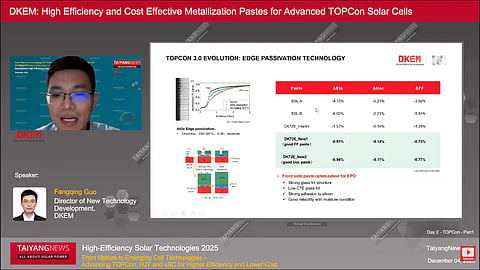
As TOPCon moved into newer process stages, metallization became closely linked to other innovations in the cell architecture. For example, processes such as edge passivation deposition (EPD), polyfinger structures on the rear side, and zero-busbar (0BB) module designs introduce new requirements for paste chemistry and reliability. The EPD process in particular exposes the metallization to conditions of around 250-300°C for 2-3 hours in the presence of moisture. Under these conditions, some pastes can degrade, particularly through a drop in fill factor (FF). Guo explained that paste formulation, especially the design of the glass frit and its thermal expansion properties, plays a key role in maintaining adhesion and electrical stability during these treatments.
Another major trend he highlighted is the rapid reduction in metallization line width. Screen openings that were around 9-10 µm a few years ago have already narrowed to about 7-8 µm in 2025, with some manufacturers experimenting with 6 µm openings. This typically produces fired finger widths of about 12-15 µm, and further reductions below 11 µm are expected. Achieving such fine features requires pastes with excellent printability and leveling behavior. Poor leveling can cause interruptions in the grid lines, which not only affect appearance but also increase electrical resistance and contact problems.
To support these narrower structures, manufacturers are also experimenting with stencil printing, especially on the rear side of the cell. Stencil printing can reduce paste laydown and produce better line morphology, improving both electrical resistance and contact quality. Guo suggested that although stencil printing was first adopted on the rear side, it may also be applied to the front side in the future, as reliability concerns are addressed based on experience with it for the rear side.
On the rear side of TOPCon cells, the introduction of polyfinger designs presents another challenge for metallization. Because these designs often rely on full-area aluminum oxide passivation layers, the paste must have a stronger etching capability to penetrate the dielectric layer and form a good electrical contact. However, excessive etching increases recombination losses. Achieving the right balance between contact quality and recombination, therefore, requires careful control of the paste chemistry and the size of the silver crystallites formed during firing.
Cost reduction was another topic in the presentation. One approach involves reducing the silver content by incorporating nickel particles into the paste. Nickel-silver pastes can reduce cost while maintaining acceptable electrical performance, and some manufacturers are already using formulations with roughly 5% nickel. However, because nickel has higher resistivity than silver and is more difficult to disperse uniformly, excessive nickel content can increase grid resistance and create printing challenges, especially for very narrow front-side lines. A more aggressive approach involves copper-based metallization. In this approach, a silver paste seed layer is printed first, followed by a copper-rich paste layer. Copper offers substantial cost advantages but introduces new technical challenges, particularly the risk of copper diffusion into silicon. To prevent this, the silver seed layer must act as an effective barrier, and the copper powder is typically coated with silver to slow diffusion. Paste formulation and powder design are therefore critical for maintaining reliable contacts.
Copper metallization must also remain stable under advanced processing conditions such as the EPD treatment mentioned earlier. High temperature and moisture can accelerate silver migration and potentially allow copper diffusion. Guo noted that improving the coating of silver-coated copper particles and carefully tuning the paste formulation can mitigate these effects while maintaining stable ohmic contact.
Guo concluded that there is considerable room for further optimization in both efficiency improvement and silver reduction, making metallization development an important part of the ongoing evolution of TOPCon technology.
To access the full presentation titled, High-Efficiency & Cost-Effective Metallization Pastes, click here.

