
Key takeaways:
While cell technologies often dominate attention, module-level design changes have progressed in parallel and now play a critical role in overall PV performance
Innovations at the cell and module levels have pushed module production equipment to complement these innovations
TaiyangNews' first market survey focuses on production equipment enabling the cell and module level advances, process-level trends, and product insights from equipment suppliers
In the narrative of solar energy’s meteoric rise, the ‘brain’ of the solar panel, the PV cell, has traditionally claimed most of the spotlight, and rightly so. Cell architectures form the fundamental building blocks of any PV device, and their evolution from BSF to PERC, followed by TOPCon, HJT, and back-contact technologies defines the major technological eras of the industry. Largely overlooked in this story, however, is the ‘body’ of the device, the module, where a quieter but equally important evolution has been unfolding. When viewed purely from a design perspective, the number and impact of module-level innovations do not fall far behind those seen at the cell level, even if they are less often framed as distinct “generations.”
Over time, interconnection schemes have evolved from single-busbar designs to multi-busbar (MBB) configurations and, more recently, to zero-busbar (0BB) concepts. The once-standard glass-backsheet architecture has increasingly been replaced by glass-glass designs, driven by durability requirements and compatibility with bifacial operation. Full-size cells have given way to half-cut formats and, increasingly, to 3-, 4-, and multi-cut configurations, while inter-cell spacing has steadily shrunk from reduced-gap layouts to virtually no-gap designs. What makes these developments particularly interesting is their inter-compatibility: many of these technologies can be combined within a single module, defining what is now considered state-of-the-art module design. At the same time, PV is finding new application spaces and integration environments that demand fundamentally different module designs. Importantly, most of these advances are largely independent of the underlying cell architecture, enabling manufacturers to extract additional performance gains beyond what cell improvements alone can deliver.
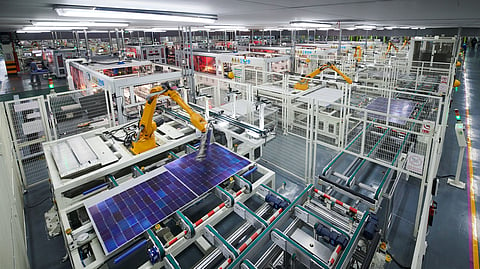
These innovations at the module level have, in turn, placed far greater demands on production equipment. What was once primarily an assembly process has become a discipline of precision, requiring accurate alignment, tightly controlled thermal processes, and high levels of automation. The module production equipment segment has responded rapidly to these changing requirements, evolving in step with increasingly complex module designs. Today, equipment capability is no longer a supporting factor but a critical enabler of reliable, large-scale manufacturing.
Against this backdrop, TaiyangNews launched its first Market Survey on Module Production Equipment, extending its long-standing coverage from cell technologies to the module manufacturing domain. Rather than analyzing the module design improvements themselves, the survey focuses on the latest developments in key production equipment that make these advances possible. In addition to identifying trends across individual process steps, the survey presents detailed product-level insights from leading equipment suppliers, highlighting how module manufacturing technology continues to evolve alongside – and increasingly in support of – the broader PV ecosystem.
The text is an edited excerpt from TaiyangNews’ latest Market Survey on Solar Module Production Equipment 2026, which can be downloaded for free here.

