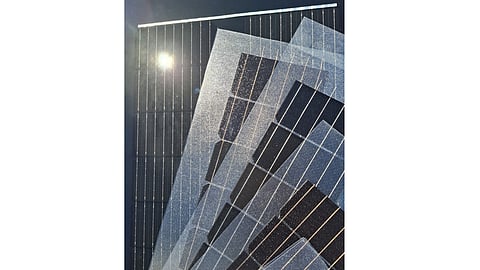


Mondragon Assembly and CEA jointly developed a prelaminator for producing PV components that can be integrated into application-specific products
The equipment produces pre-laminated PV components up to 1.6 m long at a speed of 20 mm/s to 30 mm/s
The 2-stage process supports final integration using flat lamination, 3D lamination, molding, or overmolding
Generally, solar modules are manufactured by laminating solar cell strings in a flat laminator. Today’s production lines are designed to manufacture large volumes of standard-sized modules. However, their ability to design modules in different sizes, shapes, and materials remains limited.
PV module production equipment manufacturer Mondragon Assembly, together with research partner CEA, has developed a prelaminator for manufacturing pre-laminated PV components. It separates module manufacturing into 2 stages. In the first stage, solar cells are assembled and held in place using pre-lamination. In the second stage, the pre-laminated components can be integrated into final products using conventional flat lamination, 3D lamination, molding, or overmolding. This allows the pre-laminated components to enter the production lines of other industrial manufacturers.
The jointly developed equipment can manufacture pre-laminated components up to 1.6 m long. It is compatible with different types of silicon PV cells and may eventually support other cell technologies. The cells are encapsulated between thermoplastic or thermosetting polymers, while other materials can be added to provide functions related to storage, logistics or recycling.
The equipment operates at a speed of 20-30 mm/s and processes a standard-length cell string in less than a minute. A digital interface controls the temperature, speed, and pressure. According to CEA, the process produces pre-laminated components without visible defects such as bubbles or cracks.
The quality of the final modules was verified using photoluminescence, according to CEA. It adds that when thermoplastic polymers are used, the pre-laminated components can be reworked without adding additional materials or incurring additional costs. CEA says their physical properties are maintained over time. This allows them to be transformed again into final products that comply with the relevant standards.
The technology was developed as part of the European SEAMLESS-PV project, which began in 2023 and was coordinated by Tecnalia. The project also includes the production of 60 m² of panels. These will be integrated into the façade of the FACT experimental building at INES in Le Bourget-du-Lac. According to CEA, the 4-year project will bring the technology closer to commercialization.
