

Key takeaways:
The laminator uses a 3-chamber design to separate pre-heating, pressing, and cooling stages within a continuous process
Flat metal press plates and controlled temperature uniformity support consistent lamination across the module
The system processes modules in about 6.5 minutes per cycle, contributing to high throughput levels
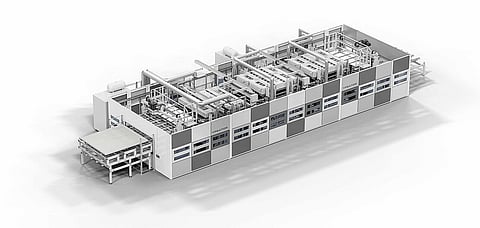
Robert Bürkle, the only European laminator manufacturer, responded to the TaiyangNews Market Survey on Solar Module Production Equipment 2026 by sharing the specifications of its 2021 model, Ypsator 2527-X VFF. The tool tops the list of products in the laminators segment of this survey, with a throughput of 150 modules per hour. The Ypsator VFF model consists of 3 chambers: pre-heating + membrane pre-press, heated metal flat press, and cold metal flat press. The membrane used in chamber 1 is silicone-free and was developed by Bürkle together with its supplier. The benefit of this membrane, according to the company, is its lifetime of over 20,000 cycles, the highest among the listed products in the survey.
This model can utilize a maximum total lamination area of 2,500 × 2,700 mm and can accommodate a maximum module dimension of 2,500 × 1,300 mm. The laminator has 5-10 openings, each accommodating 2 modules with a maximum laminate thickness of 10 mm and a maximum weight of 250 kg. The machine is supported by an external vacuum pump. The modules are moved on an automated belt during loading and unloading. Ypsator VFF uses thermal oil to heat the chamber and the flat press plates, reaching a maximum temperature of 180°C. The uniformity of the metal plate temperature is maintained within an allowed tolerance of ±0.5°C. Heating and cooling of metal plates takes place on both sides. It has a built-in pin-lifting system that lifts the pins before loading the laminate, preventing direct contact between the glass and the heated plate and thus avoiding glass bowing.
The process occurs in 3 steps within a temperature range of 145 to 175°C and a pressure of 200 to 1,450 mbar. After pre-heat and pre-press in the first chamber with a membrane press, the modules move into the second chamber, where heated flat metal plates allow a uniform application of pressure on the laminate. After this, the module is moved to the third chamber, again, with flat metal press plates, but with channels to allow cold water to run through. This chamber completes the cross-linking of the encapsulant and sends the module out of the machine at room temperature. Bürkle claims at least 80% gel content post-lamination, while not specifying the encapsulant.
The Ypsator VFF laminator can process all kinds of module configurations, including thinner glass-glass or thin-thick glass combinations. The cycle time for the laminate to go through all the chambers is 6.5 minutes. As mentioned above, the tool has a throughput of 150 modules/h, with a mechanical yield of 99% and 95% uptime. The laminator requires no changeover time.
The text is an edited excerpt from TaiyangNews’ Market Survey on Solar Module Production Equipment 2026, which can be downloaded for free here.
