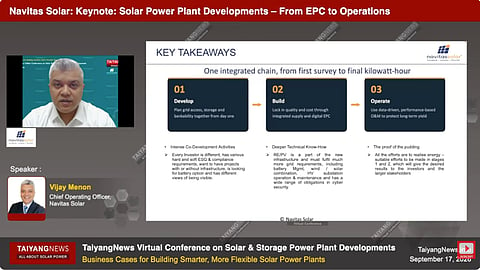


Navitas Solar’s Vijay Menon identified grid-connection delays and curtailment as major challenges for solar project development
He cautioned that excessive cost reduction during design and procurement can weaken long-term plant performance
Predictive maintenance, better use of plant data, and robotic cleaning can support a more proactive O&M approach
Solar power plants should be planned, built, and operated as one integrated chain, according to Vijay Menon, Chief Operating Officer of Navitas Solar. Speaking at the TaiyangNews Solar Power Plants & Storage Conference 2026, he said decisions made during development and engineering, procurement, and construction (EPC) directly affect plant yield and operating costs throughout the project’s lifetime.
Menon identified grid-connection queues as one of the main challenges facing solar project development. Project deployments are outpacing grid expansion, while developers and EPC companies have limited control over transmission availability.
He cites curtailment as another concern for operating projects. Solar generation typically peaks around midday, while electricity demand is often higher in the mornings and evenings. This mismatch can reduce the amount of electricity sold and affect project returns.
Menon said developers should consider co-located storage early to shift solar generation to periods of higher demand. Grid access, land acquisition and community engagement should also progress in parallel. Other challenges include volatile development costs and different commercial and compliance requirements among regional and international investors.
Recycling also needs to be considered beyond the manufacturing stage. Menon said the industry requires solutions for damaged and end-of-life modules as well as other project components. Regional recycling hubs are beginning to provide these services in response to regulatory and voluntary requirements.
EPC and Project Quality
Solar construction has become faster with higher-power modules, improved trackers, and cleaning systems. However, Menon said EPC services don’t follow a single global standard, even though individual components may comply with UL or IEC requirements. Tight margins and the availability of skilled personnel also remain concerns.
Menon said digital tools are already changing project execution. He referred to design software and drone surveys as examples. In his view, quality control should extend beyond factory audits and cover risks that may emerge after the equipment has been supplied.
He also questioned the focus on reducing upfront project costs, adding that lower capital expenditure (CapEx) can come with compromises in design and product selection, which may later reduce output. He said lowering lifetime costs may require spending more on quality at the beginning.
Operations and Maintenance
The real test of a solar project comes after commissioning, when the plant must deliver the expected energy yield, said Menon. Yet operations and maintenance (O&M) is still often handled reactively. Teams step in after a fault appears, while construction-related issues can remain unresolved for long periods.
Weather conditions and equipment quality can also result in unexpected degradation. At the same time, useful plant information remains divided among inverter, tracker, and other equipment providers. The project needs to use this data across teams rather than keeping it with individual specialists.
AI tools, drones, and predictive maintenance platforms can assist O&M teams, while robotic systems can support cleaning. Menon also advocated for repowering older projects whose output has declined. This may be necessary where a power purchase agreement (PPA) requires the plant to supply a minimum amount of electricity.
The commercial conditions for O&M remain difficult. Service providers must meet high performance guarantees, although the available maintenance budget may not cover the work needed to deliver those results.
Storage in Solar Projects
Menon said storage is becoming part of more solar projects in India. Solar plants can be built quickly, but their output varies through the day and cannot provide firm power on their own. Storage can store some midday generation and supply it when demand is higher.
Lithium-ion is currently the main technology used for this purpose, although work continues on other storage options. Menon expects deployment to increase as systems become available at larger scale and more competitive prices. In his view, combining solar with storage offers opportunities both within and outside India.
Watch the presentation on the TaiyangNews YouTube channel here.
