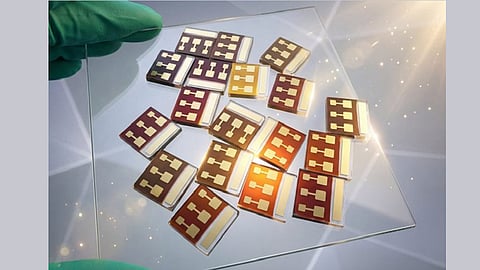


UNSW researchers achieved 10.7% efficiency in antimony chalcogenide solar cells, the highest independently verified result reported for the material to date
The study identifies non-uniform sulfur-selenium distribution as a key efficiency bottleneck and demonstrates a chemical route to mitigate this limitation
The results support antimony chalcogenide’s potential as a top-cell candidate for tandem silicon solar cells, as well as for niche photovoltaic applications
As the solar industry explores alternatives to traditional silicon technology, researchers are investigating new photovoltaic materials that could work alongside current commercial solar cells. These materials may offer lower production costs, thinner designs, or better performance for certain uses. However, turning promising lab results into reliable devices is still difficult. Recent studies have focused on finding materials and methods that can actually improve efficiency.
Researchers at the University of New South Wales (UNSW) have reported record performance for antimony chalcogenide solar cells, achieving a certified efficiency of 10.7% using a mixed sulfur-selenium Sb₂(S,Se)₃ absorber. According to the researchers, this is the highest independently verified efficiency reported for the material to date. The work was led by Xiaojing Hao, Scientia Professor at UNSW’s School of Photovoltaic and Renewable Energy Engineering, with Chen Qian as first author.
Antimony chalcogenide has attracted interest as a photovoltaic absorber due to its earth-abundant composition, inorganic structure, and good light absorption. The material can also be deposited at low temperatures, which helps reduce energy demand during manufacturing. Despite these advantages, researchers say that efficiencies have changed little beyond 10% in recent years. To address this limitation, the UNSW team used a mixed sulfur–selenium Sb₂(S,Se)₃ absorber, which allows the bandgap to be tuned while balancing voltage and current output. However, they found that uneven sulfur–selenium distribution during film formation remained a key performance bottleneck. Compositional gradients within the absorber created internal energy barriers that hindered charge transport and limited device efficiency.
In the present study, the team addressed this issue by introducing a small amount of sodium sulfide during the hydrothermal deposition process. The additive stabilized the chemical reactions during film growth, resulting in a more uniform elemental distribution across the absorber layer. This improved charge transport and reduced recombination losses, enabling the observed efficiency improvement.
The improved material quality translated into higher device performance, with laboratory efficiencies reaching 11.02% and an independently certified value of 10.7%, confirmed by the Commonwealth Scientific and Industrial Research Organisation (CSIRO), one of the internationally recognized photovoltaic measurement centers. Beyond single-junction performance, the researchers highlighted antimony chalcogenide’s relevance for tandem solar cells, where it could serve as a top absorber layer paired with conventional silicon. The material’s thin and semi-transparent nature, along with its high bifaciality, also makes it suitable for applications such as solar windows. A UNSW spin-out, Sydney Solar, is working to scale window-integrated solar products based on this technology.
The team also believes that efficiencies of around 12% are achievable in the near term by addressing remaining material challenges through defect passivation. They say the results support broader exploration of antimony chalcogenide for tandem, indoor, and application-specific photovoltaic technologies.
The findings are detailed in a study published in Nature Energy titled “Regulation of hydrothermal reaction kinetics with sodium sulfide for certified 10.7% efficiency Sb₂(S,Se)₃ solar cells”. According to the researchers, the result also led to antimony chalcogenide being included for the first time in the international Solar Cell Efficiency Tables.
