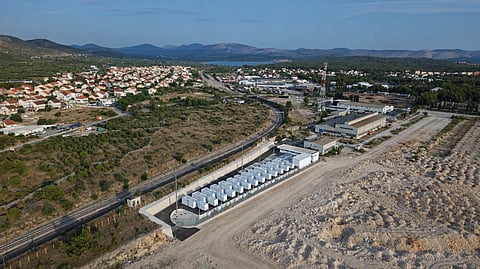

NGEN and NextGrid Energy have commissioned a 60 MW / 120 MWh standalone BESS at the IMPOL-TLM industrial complex in Croatia
The system's full capacity is dedicated to aFRR services under a contract with Croatian grid operator HOPS
The €60 million project received support from the EU Modernisation Fund and equity investments from EBRD, Raiffeisen pension funds, and IE-ENERGY
NGEN and Croatia-based investment platform NextGrid Energy have commissioned a 60 MW / 120 MWh standalone battery energy storage system (BESS) in Šibenik, Croatia. It is connected to the country’s 110 kV transmission grid and is designed to provide grid balancing services.
The system is located at the IMPOL-TLM industrial complex and comprises 34 Tesla Megapack battery units using lithium iron phosphate (LFP) cells. The system can draw from and feed to the grid within 2 hours when operating at its full capacity of 60 MW.
The system’s entire capacity is dedicated to automatic frequency restoration reserve (aFRR) under a contract signed with the Croatian transmission system operator HOPS. This service helps maintain grid frequency by balancing deviations between electricity generation and consumption, either absorbing excess or injecting stored energy into the grid.
For this project, NGEN developed a software platform to continuously monitor the electricity market and grid conditions, and optimize the system’s operation in 15-minute intervals. The project operates on a merchant basis, without guaranteed revenues. Its income depends on demand for flexibility services, and the owners and investors bear the associated market risks.
Roman Bernard, CEO and co-founder of NGEN Group, said, “I believe Šibenik marks the beginning of our continued cooperation and of new projects that matter for the energy future of Croatia and the region.”
The project was funded by the EU Modernisation Fund and equity investments from the European Bank for Reconstruction and Development (EBRD), Raiffeisen pension funds, and IE-ENERGY, with a total investment of €60 million. It was developed in phases, starting with an initial 10 MW / 20 MWh installation and expanding to the current 60 MW / 120 MWh capacity.
