

In an outdoor study, 2 single-junction perovskite modules were monitored for 1 year, providing rare field data at the module level
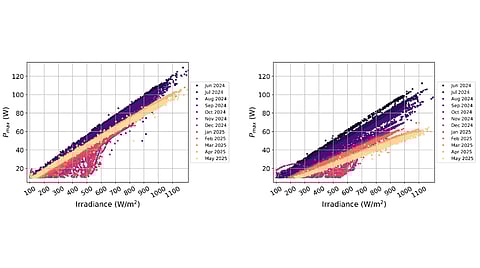
One module showed moderate degradation, with efficiency declining from about 15% to around 12%, while another from the same batch fell below 7%
Temperature and seasonal conditions influenced performance, with measurable temperature coefficients and morning-afternoon differences observed
Perovskite photovoltaics are advancing quickly in the lab, with new efficiency records reported for both single-junction and tandem designs. What remains less documented, however, is how full-size modules perform outdoors over extended periods. Much of the stability evidence to date still relies on small-area devices evaluated under controlled laboratory settings. For an emerging technology known for metastability and light-soaking effects, real-world field performance at the module level remains a critical benchmark.
A recent study shows 1 year of outdoor performance data for 2 single-junction perovskite solar modules. Each measuring 0.7164 m² and labeled YZ517 and YZ518, the modules were installed on fixed racks at a 45° tilt, facing south, at the European Solar Test Installation (ESTI) in northern Italy.
Researchers characterized 3 modules were characterized as part of the study. As mentioned above, YZ517 and YZ518 were monitored outdoors for 1 year. A 3rd module, YZ519, was used indoors to investigate measurement protocol stability. All 3 were identical glass-glass modules from the same production batch.
Both modules initially recorded 14.1% efficiency under indoor testing. Once deployed outdoors, however, the 2 modules followed different stability paths. YZ517’s efficiency dropped from about 15% to around 12% over 12 months. YZ518, despite coming from the same production batch, degraded far more severely, with efficiency falling below 7% during the monitoring period.
Beyond the annual degradation, the study also reports daily and seasonal performance shifts. During summer, when module temperatures reached roughly 60°C, peak efficiency occurred before peak irradiance and declined toward solar noon. In winter, when module temperatures remained below about 35°C, peak efficiency aligned more closely with maximum irradiance. Differences between morning and afternoon behavior were also observed, particularly following cloudy periods. The study links these variations to known metastability and light-soaking effects in perovskite solar cells, where device performance can shift under sustained illumination or after changes in irradiance history. Such behavior complicates both measurement and long-term performance assessment.
The researchers extracted outdoor temperature coefficients of -0.054%/°C for Pmax, -0.09%/°C for VOC, and +0.089%/°C for ISC. While these values indicate moderate temperature sensitivity, some clustering of data over time suggests possible aging or metastability influences.
The study reinforces that perovskite modules are progressing toward field viability, but stability uniformity remains a key hurdle before large-scale commercialization.
The full findings are published in Progress in Photovoltaics: Research and Applications under the title “Outdoor Measurements of Perovskite Modules.”
