
Key takeaways:
Perovskite solar cells offer design flexibility, including transparency, color tuning, and mechanical adaptability for BIPV
Balancing efficiency with optical properties such as transparency and color remains a key technical challenge
Material design, electrode structures, and low-temperature processing are critical to enabling practical BIPV applications
The progress in crystalline silicon photovoltaics over the past decade has been tremendous. The transition from Al-BSF to PERC to current mainstream TOPCon, and emerging technologies such as BC and tandem are being widely explored as the next generation of PV technologies. Several other integrated applications, such as agri-PV and building-integrated PV (BIPV), are increasingly being adopted, driven by regulatory mandates, self-consumption, and electricity prices, to name a few.
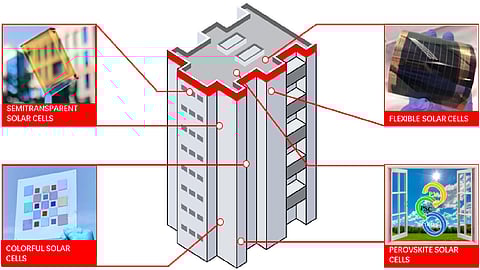
In this scenario, perovskite solar technology is being consistently evaluated for several integrated PV applications, especially BIPV, due to its semi-transparent nature, availability in various colors, and flexibility. However, there is a critical concern related to perovskites – stability.
The faculty of Materials Science and Energy Engineering at Shenzhen University of Advanced Technology has assessed the compatibility of perovskite solar cells with BIPV through several technological approaches. The team discussed different strategies, such as composition tuning, electrode design, and interfacial modification, based on cell functionalities, including semi-transparency, color, and flexibility. These functionalities are useful depending on the building surfaces. For example, for rooftops, opaque panels with silicon-perovskite tandem technology can be used to achieve high power conversion; for windows, semitransparent perovskites; and for exterior façades, flexible, color-tunable, and lightweight perovskites are better suited.
Semi-transparent perovskite cells are preferred for windows to partially transmit light while achieving photovoltaic functionality. The optical performance depends on the efficiency of the cells used in the panel. It is measured in average visible transmittance (AVT) and color rendering index (CRI). The power conversion efficiency (PCE) is inversely proportional to AVT. CRI, which is sensitive to spectral uniformity, is affected when spectral-selective absorption is introduced for higher PCE.
Achieving a balance between optical and power performances is the key challenge in semi-transparent perovskite cells. The thickness of the perovskite layers plays a key role in increasing or decreasing the AVT. Devices with 80-150 nm perovskite films have been demonstrated to achieve a PCE of about 16.5% and 20% AVT.
The microstructure of the films also impacts performance: compressive stress in the films improves lattice stiffness, which suppresses light-induced migration. This can achieve a PCE of 13.97% with an AVT of 41.58%.
Metallization is another key player in balancing the transparency and electrical performance. Conventional opaque metal contacts block light, which directly reduces the AVT. Other strategies explored include transparent conductive oxides (TCOs), dielectric metal-dielectric electrodes (DMDs), and emerging concepts like metal nanowires, conductive polymers, and hybrid electrodes.
TCOs, such as gallium and titanium-doped indium oxide (IO:GT), are used to achieve devices with PCE of 17.53% and 21.9% AVT. DMDs use ultrathin metal stacks embedded between dielectric layers, for example, MoO3 / Au / MoO3 with thicknesses of 35 nm / 10 nm / 35 nm. Cells made with DMD electrodes achieved a PCE of 13.6% and an AVT of about 7%.
Flexible perovskite solar cells are being explored primarily because they combine 2 useful features: decent efficiency and mechanical flexibility. It makes them suitable for applications where rigid panels are not well-suited. Early work in this area began with CH₃NH₃PbI₃-based devices, which showed a modest efficiency of about 2.6%, but it established the basic feasibility of making perovskite cells on flexible substrates. The substrates are typically polymers like PET or PEN, or ultrathin glass. PET and PEN cannot tolerate high temperatures, which restricts processing conditions and can affect film quality. On the other hand, ultrathin glass provides better protection against moisture but is still relatively brittle. Low-temperature process developments have resulted in multilayer substrates such as SiO2/PET/SiO2/ITO, which improve electrode smoothness and form a more uniform perovskite layer. Efficiencies of around 22.4% have been achieved, along with better mechanical stability. Other alternative substrates are also being explored, such as polyimide and polycarbonate, which appear promising but also come with their own challenges.
For colorful perovskite solar cells, building façades are the key applications in BIPV. One useful property of perovskites is that their color can be tuned quite easily. This comes from their adjustable bandgap, which determines how much of the visible spectrum is absorbed or transmitted. But the trade-off here is that creating more distinct or vivid colors comes at the expense of efficiency, as it reduces the availability of light for power generation. The adjustment of halide content results in the color control of perovskite. For example, in a mixed halide perovskite, MAPb(I1-x Brx )3, increasing the bromine content shifts the absorption edge toward shorter wavelengths, changing the film color to yellowish shades. There are several other methods of controlling the color of a perovskite film, and efficiencies of about 20.6% efficiency have been achieved. More experimental approaches are being explored, including plasmonic structures or patterned nanostructures, to create angle-stable coloration.
TaiyangNews will delve into next-generation PV technologies on April 22, 2026, during a Virtual Conference on Next-Generation PV Technology, where the focus will be on Perovskite Tandem Solar Technology Status & Outlook – Assessing Commercialization Roadmaps. Registrations are free and open here.

