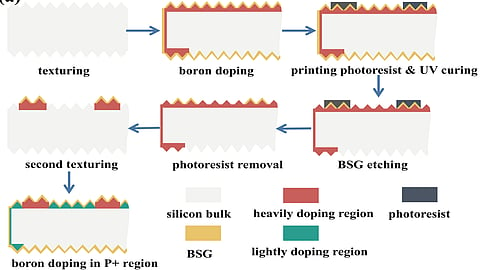

Photoresist masking and etching raised the non-contacted emitter sheet resistance to 1,600 Ω/sq, while retaining approximately 450 Ω/sq beneath the contacts
The selective emitter achieved an average cell efficiency of 25.98%, compared with 25.82% for the conventional uniform emitter
Quokka3 simulations suggest further efficiency gains may be possible by optimizing the width of the heavily doped contact regions and the front grid pitch
China-based industrial collaborators and university researchers investigated a laser-free approach to selective-emitter formation on the front side of a TOPCon cell. University of Electronic Science and Technology, Southwest Petroleum University, Tongwei Solar, and Jiangsu Inspiray Equipment evaluated a photoresist-based approach to form a boron-doped selective emitter. After the emitter diffusion in the TOPCon process, this approach uses photoresist masking, followed by etching of the non-contacted emitter regions.
With this process, the sheet resistance reached a maximum of 1,600 Ω/sq in the non-contacted regions. The higher resistance in these regions reduces the influence of boron-related recombination. High boron doping beneath the metal contacts helps maintain good electrical contact. In the reported structure, the sheet resistance of the contacted regions was recorded as approximately 450 Ω/sq.
Earlier approaches had already raised the front emitter sheet resistance beyond 400 Ω/sq, but the current study extended it to 1,600 Ω/sq.
The researchers compared the average cell efficiency achieved with this approach to a conventional uniform emitter, and found a gain of about 0.16 percentage points from 25.82% to 25.98%. The open-circuit voltage Voc also recorded a jump from 742.6 mV to 745.5 mV, and the fill factor from 83.54% to 83.76%. An optimized cell with this approach recorded an efficiency of 26.03%, with a Voc of 746.5 mV.
The study also examined a locally doped boron emitter finger, which showed an efficiency gain of only 0.04 percentage points and a lower fill factor, which was partly attributed to increased recombination at the p-n junction edges.
The team also conducted simulations using Quokka3, which indicated that this selective emitter structure could be optimized further by adjusting the width of the high-doped contact regions and the front grid pitch.
This work, titled High-efficiency TOPCon solar cells featuring super-high sheet resistance emitters via low-cost photoresist etching,presents a laser-free route to selective emitter formation. From a commercial perspective, whether this approach can serve as an alternative to the currently widely used laser-enhanced contact optimization (LECO) process will depend on its manufacturing cost, process integration, and the efficiency gains it can deliver at production scale.
