

ProLogium has started mass-producing its Gen 3.5 lithium ceramic battery in Taiwan
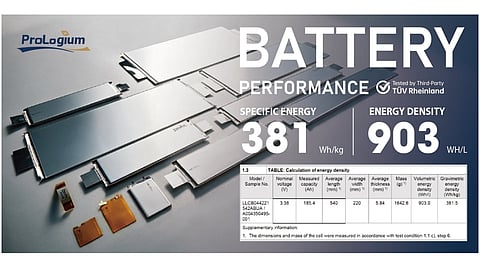
The 185.4 Ah cell achieved an energy density of 381 Wh/kg by weight and 903 Wh/L by volume
Its planned Gen 4 battery will use a fully inorganic electrolyte
Taiwanese battery manufacturer ProLogium says it has started mass production of its Gen 3.5 lithium ceramic battery (LCB) at its Giga-level manufacturing facility in Taiwan. The large-format cell has a capacity of 185.4 Ah and is designed for high-power and fast-charging applications.
The battery is based on ProLogium’s Logithium cell architecture. It combines a ceramic separator with an edge-frame structure that adds protection around the electrodes. According to the company, the structure provides sealing and electrical insulation while helping prevent sharp electrode edges from damaging the separator.
The Gen 3.5 battery uses a composite solid electrolyte in which the amount of organic electrolyte has been progressively reduced.
TÜV testing showed that the cell achieved an energy density of 381 Wh/kg by weight and 903 Wh/L by volume. UL Solutions separately tested the cell according to China’s GB/T 43568-2026 standard, in which the cell recorded a weight loss of less than 0.05% after being kept under vacuum at 120°C for 6 hours. This was below the standard’s maximum limit of 0.5% for classification as an all-solid-state battery. According to ProLogium, the result qualifies the cell as all-solid-state under the Chinese standard.
ProLogium is also developing a Gen 4 battery with a fully inorganic superfluidized electrolyte. The company says it will retain the same Logithium cell architecture and manufacturing process used for the Gen 3.5 battery. It expects only around 10% of its existing production line and related equipment to need modification to manufacture the new cells.
According to ProLogium, the Gen 4 battery is designed to maintain high energy density, high-power output, and fast-charging performance. It is also expected to improve safety and low-temperature performance while reducing material and manufacturing costs. The company is targeting electric vehicles (EVs), AI data centers (AIDCs), and maritime and aerospace applications.
Founded in 2006, ProLogium established its LCB platform in 2012 and began commercial production using sheet-by-sheet manufacturing in 2013. The company introduced roll-to-roll production in 2017, followed by its Giga-level manufacturing platform in 2024.
ProLogium says it has shipped more than 2.4 million cells across consumer, specialty, and automotive applications. These include more than 900,000 cells supplied for in-vehicle audio systems. The company has also delivered around 10,000 automotive battery samples.
The company is constructing a battery factory in Dunkirk, France. Its first phase is designed to progressively reach an annual production capacity of 4 GWh by 2030, while the complete site has a planned maximum capacity of 44 GWh.
