
Key takeaways:
Most of the cost in PV recycling comes from logistics, more than the recycling process itself
High-value materials like silver drive revenues, while bulk materials like glass and aluminum contribute little
Scaling recycling depends as much on policy and infrastructure as on technology maturity
The topic of PV recycling is not new anymore, and the technologies involved are quite familiar. However, economic viability remains a major concern for several recycling companies, and capacity scaling is one solution to address it.
Technology pathways and policy regulations play an important role in improving recycling efficiency, recycled product quality, and, most importantly, the economics of recycling. A joint study by universities across India, Saudi Arabia, and Türkiye, a data analytics company, and a recycling company from India discusses various recycling approaches and covers cost structures, revenue streams, and global and regional policy frameworks.
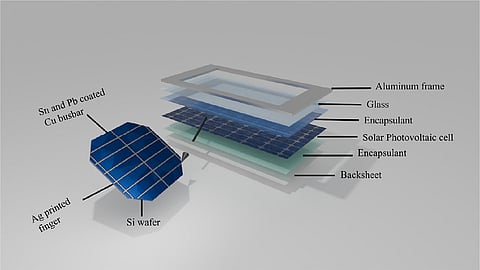
The research highlights that collection, transportation, and processing logistics account for more than 90% of the total recycling cost, rather than the recycling step itself. PV modules are often deployed across large geographic areas, especially in utility-scale installations, which makes collection and transport expensive. Most of the revenue per module comes from materials such as silver and, to a very small extent, glass and aluminum. While glass and aluminum are easy to recover in large volumes, they contribute very little to overall revenue. In contrast, high-value materials such as silver and high-purity silicon drive the economics, making the efficient recovery of these materials critical.
Given these economic limitations, policy becomes a key driver for scaling recycling. The study highlights an uneven global landscape, with Europe standing out as the most structured market, where the WEEE Directive sets clear targets of around 85% recovery and 80% recycling. In contrast, the United States relies on a mix of state-level initiatives and voluntary industry programs, resulting in a more fragmented approach. China, on the other hand, is moving quickly, with targets such as processing around 1.5 million tons of PV waste by 2030. Meanwhile, countries like India and other developing markets still lack strict PV recycling regulations, slowing down the infrastructure development.
Several recycling techniques, such as electrostatic separation, molten salt etching, and some hybrid combinations, demonstrate high efficiency at the laboratory scale; however, they present new challenges when scaled up. Operational costs, energy consumption, and process complexity when handling large volumes are some of these challenges. This is where concepts like Technology Readiness Level (TRL) and Policy Readiness Level (PRL) become relevant.
TRL presents a score between 1 and 9, in which 1-3 represents early-stage laboratory research and proof-of-concept validation. A TRL of 4-6 corresponds to a pilot-scale demonstration, and a 7-9 rating means commercial deployment. PRL is an indicator of the maturity of policy support, where 1-3 indicates minimal or absent regulatory frameworks; 4-6 represents emerging-stage and pilot regulations or limited funding schemes; and 7-9 indicates a mature policy ecosystem. Even if a recycling technology is technically mature, it may not be economically viable or supported by policy. Similarly, some regions may have policies in place but lack the infrastructure to execute them. This misalignment between technology, economics, and policy slows down real-world deployment.

Therefore, PV recycling becomes a broader system-level challenge to overcome. For PV to become a truly circular economy that works, several parts of the value chain need to align with each other. Modules need to be designed in a way that makes them easier to disassemble and recycle. Recycling processes need to become more cost-effective, especially in terms of logistics. Collection networks and infrastructure need to be established at scale. At the same time, policy frameworks must either mandate recycling or make it economically attractive.
The full study can be accessed on Recycling Silicon PV Modules: Advances, Economic Feasibility, and Policy for a Circular Solar Economy.
