
Key takeaways:
Aqueous-based recycling enables recovery of key perovskite module materials, including lead-containing layers
Recycled materials can be reused to fabricate new devices with comparable efficiency and stability
Multiple recycling cycles show limited performance loss, supporting circular approaches for perovskite PV
Perovskite cell technology and its tandem with silicon PV are seen as potential options by the end of this decade. According to ITRPV, tandem technology is expected to capture about 10% of the market by 2035. Research institutes are testing perovskite cells and modules in outdoor conditions, and module manufacturers already have pilot lines and have announced mass-scale production capacities for these cells and modules.
At the TaiyangNews Next-Generation PV Technology Conference 2026, solar manufacturers, research institutes, and material and equipment suppliers indicated that perovskite could be the next major technological transition after back-contact.
Therefore, it is also important to explore the recyclability of this technology, especially given its shorter lifetime compared with mainstream silicon PV.
In early 2025, research teams from China, Sweden, and the USA presented low-cost recycling strategies for perovskite PV waste. The research focused on developing an aqueous-based recycling approach that can rejuvenate degraded perovskite. The team also explored recycling of other layers, such as charge-transport layers, substrates, glass, and electrodes. It was found that the recycled devices showed similar efficiency and stability to virgin perovskite devices.
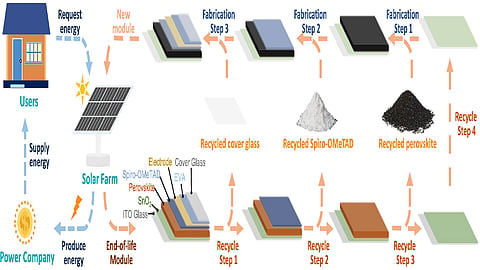
The recycling procedure starts with thermal treatment of waste modules at 150°C for 3 minutes to soften the encapsulant (EVA in this case) for delamination. The delaminated modules are processed layer by layer to recover materials such as cover glass, spiro-OMeTAD (hole-transport layer or HTL), perovskite crystal powders, and SnO₂-coated ITO substrates. These recovered materials can then be reused to fabricate new solar modules, effectively closing the loop for perovskite PV.
The teams studied various methods for recycling each material, with the perovskite layer being critical, since it contains lead. To address solubility, purity, and stability in an aqueous environment, the researchers introduced 3 low-cost additives: sodium acetate (NaOAc), sodium iodide (NaI), and hypophosphorous acid (H₃PO₂), respectively. NaOAc accelerates the solubility of lead iodide in the perovskite compound, which is otherwise not soluble in water. PbI₂ crystals are precipitated from a supersaturated solution as a result, which are then converted to MAPbI₃ crystals with the addition of NaI. These crystals are stabilized for high-temperature operation and reusability by the addition of H₃PO₂. The solution containing these additives was also tested at 95°C for 2,000 hours without color change, indicating stability and ensuring the extraction of high-quality perovskite crystals.
Ethyl acetate and ethanol are used to recycle the HTL, spiro-OMeTAD. Using this method, material with 99.82% purity was recovered. The gold electrode was recycled by centrifuging the ethyl acetate solution. There were no differences observed in perovskite cells made using recycled gold electrodes, according to the researchers. The last step involves recycling the SnO₂-coated ITO substrate by cleaning it with UV-ozone treatment to remove SnO₂ defects. These substrates can be reused for new cells.
The research team also investigated multiple rounds of recycling of the same perovskite cells, up to 5 cycles. The cell made after 5 rounds of recycling achieved a maximum efficiency of 23.5% and averaged 21.8%. The team also conducted multiple reliability tests and an environmental and economic analysis, the results of which can be accessed in the publication titled Aqueous-based recycling of perovskite photovoltaics.

